
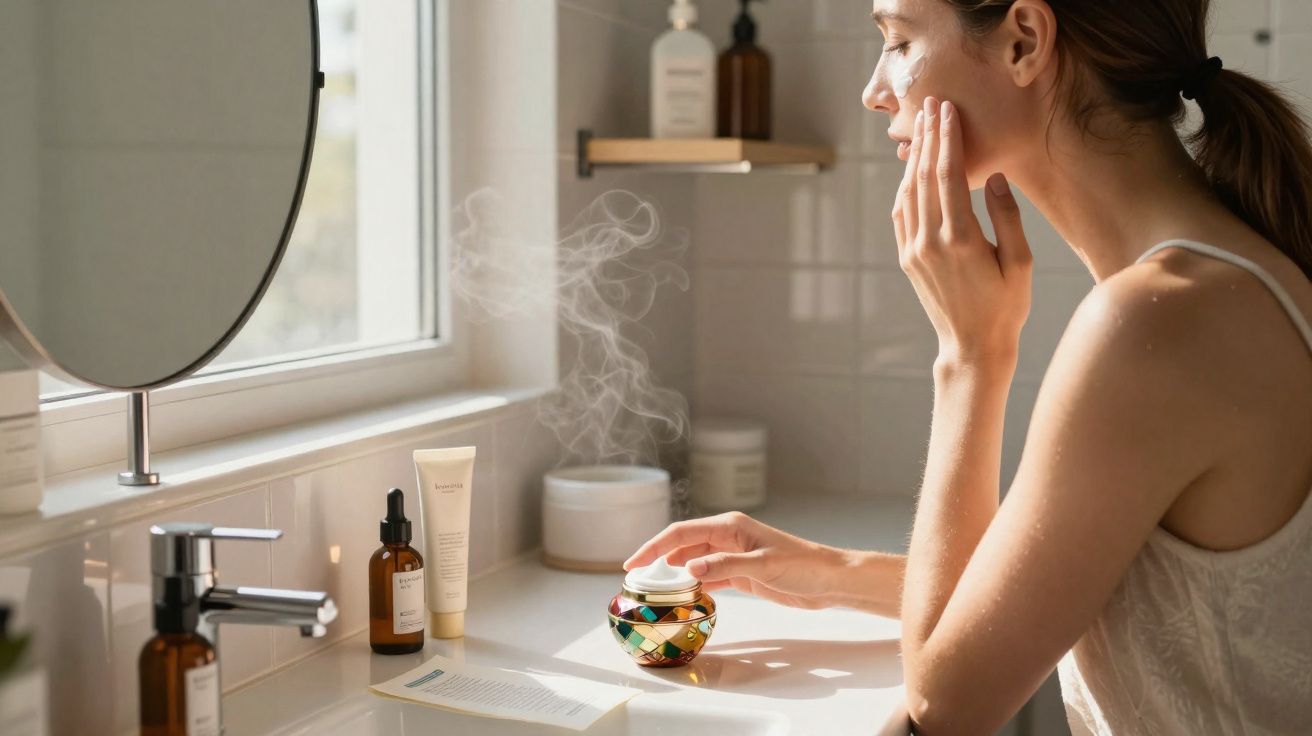
You recognise that oddly earnest, slightly daft optimism that turns up the moment you unbox a new expensive face cream.
There’s the little spatula, the weighty glass pot, the scent that hints at “five-star spa” and “this will be the one”. You catch yourself applying it under the bathroom light like you’re filming a glossy advert, half expecting to wake up to smaller pores, softened fine lines and that real-life version of a soft-focus filter.
Then time passes. First a week, then three. Your skin is… alright. Not worse, not wildly better. The redness still glows through. The fine lines are still lightly there. Spots still appear with absolute confidence. And you begin to wonder: am I using it wrong, is my skin just difficult, or is that £80 jar mainly an expensive daydream in frosted glass?
That’s the moment the story gets more interesting.
The private little fib on your bathroom shelf
When a pricey face cream disappoints, it hits differently. A jumper can be returned; a lipstick shade can be written off. But skincare is money spent on hope-on the idea you’ll look more rested, smoother, more put-together, more like the version of you that exists in flattering light (and your imagination).
Most of us know the harsh-lift-mirror moment: you spot your reflection and think, “Hold on-I’ve done the serums, the masks, the so-called miracle moisturiser… why do I still look knackered?” Back at home, you apply another careful layer and tell yourself the results just need more time. One month. Two. Perhaps it’s hormones. Perhaps it’s diet. Perhaps you’ve somehow failed at skincare.
Or-slightly painful though it is-the cream simply wasn’t designed to deliver what the marketing suggested you were buying.
Why an expensive face cream can feel gorgeous yet achieve very little
A formula engineered to charm, not to change
Luxury creams are brilliant at winning you over before they’ve done anything meaningful. The buttery glide, the subtle fragrance, the pleasing clink of the lid-your brain files these cues under “effective” long before your skin has had any chance to respond. Your senses get persuaded first; your face comes second.
Behind the scenes, many high-end moisturisers prioritise comfort and cosmetic elegance over measurable change. They often lean heavily on emollients (to make skin feel soft) and silicones (to make skin feel smoother immediately). Does it create an instant “silky” finish? Absolutely. Does that automatically mean it’s repairing sun damage, supporting collagen, or calming long-term redness at a deeper level? Not particularly. That immediate wow is frequently clever texturing, not transformation.
Skincare chemists will also tell you-quietly, because it’s not glamorous-that truly effective active ingredients can be inelegant. Some smell odd. Some feel less luxurious. Some cause mild irritation while your skin adjusts. Real-world anti-ageing rarely arrives in a rose-scented haze.
The lovely ingredients that rarely do the heavy lifting
Turn the box around and you’ll often find a gorgeous-sounding roll-call: algae, flower extracts, thermal water, rare oils from somewhere you’ve never visited. They read beautifully, photograph well, and some genuinely have supportive benefits-but often at levels too low to significantly shift fine lines, pigmentation or texture.
The uncomfortable truth is that the list of ingredients with strong, repeated evidence for noticeable improvements is fairly short: retinoids, vitamin C, exfoliating acids (AHAs and BHAs), niacinamide, some peptides, and-non-negotiably-sunscreen filters. Much of the rest is “nice to have”: helpful in a supporting role, but rarely the lead actor. If your expensive face cream doesn’t meaningfully rely on proven actives, you may be paying for a comforting blanket rather than a proper renovation.
That doesn’t make the cream pointless; it just means its main purpose is soothing and surface comfort-and comfort alone was never going to undo years of UV exposure or stress-driven skin changes.
The awkward mismatch: your skin versus the marketing
Your face cannot read a price tag
This bit can feel brutal: your skin doesn’t know whether a jar cost £8 or £180. It doesn’t recognise luxury branding, viral popularity or “cult” status. It responds to molecules-the structures it can interact with, tolerate, absorb, or react against. Your bank account notices the difference; your skin often doesn’t.
So if you’re dealing with adult acne and you’re massaging in a rich, fragranced moisturiser designed for very dry, mature skin, your face will respond to what’s actually inside. Heavy occlusive oils on already congested pores? Breakouts. Lots of perfume on sensitive cheeks? Flare-ups. The minimalist label and fancy pot won’t override basic biology.
Many people end up with the wrong product not because they’re foolish, but because marketing gently implies something impossible: that one-size-fits-all is also somehow “personalised”. Those two promises rarely coexist.
Your routine may be undoing the benefits
Sometimes the cream isn’t the main issue-your routine around it is. A foaming cleanser that leaves your skin squeaky-clean might be stripping your skin barrier nightly. A gritty physical scrub marketed as a “deep clean” can create repeated micro-damage. Then the expensive face cream arrives like it’s meant to tidy up the mess.
And, honestly, few people are perfectly consistent. Double cleansing properly, layering actives in the right order, letting them absorb, applying sunscreen daily-it’s easy in theory and messy in real life. Children, delayed trains, hungover mornings, nights you fall asleep on the sofa with make-up still on. The cream becomes a last-minute gesture, like a firefighter walking into a house you keep accidentally setting alight.
If your skin barrier is irritated day after day, very little will “work” as promised. It’s like watering a plant you’ve also shut in a dark cupboard. Something else has to change first.
The quiet heroes that actually improve skin
One word that keeps winning: consistency
The least exciting truth in skincare is that the product you use faithfully will beat the luxury one you use twice and then abandon in a drawer. Skin renewal is slow-around 28 days in youth, often longer as we age-so anything that genuinely changes skin needs repetition, time and patience.
This is why dermatologists can sound almost boring: gentle cleansing, a moisturiser your skin tolerates, nightly retinoids, and daily sunscreen. Get those right and most of the rest is optional detail. They also know you’d rather hear about “rare marine extracts” than “wear SPF every morning”, because one sounds magical and the other sounds like chores.
But if you talk to people with calm, steady skin, their routines are often surprisingly basic-and they follow them with the consistency of brushing their teeth.
The ingredients worth spending on
If you’re tired of dropping another £100 on a moisturiser that mainly feels nice, build a small, focused set of products around proven actives, and let your moisturiser be-plainly-a moisturiser.
- Sunscreen: every day, broad spectrum, SPF 30 or higher. No drama. No loopholes. UV exposure drives much of what we label “ageing”: fine lines, sunspots, dullness and that crêpey texture around the eyes. The most impressive anti-ageing routine can’t outpace what daily unprotected daylight quietly does.
- Retinoid at night: retinol or a prescription retinoid. This category has the strongest evidence for smoothing texture, softening fine lines, improving pigmentation and supporting collagen. It’s not instant and can be irritating at first, but used gently and consistently it’s genuinely transformative. A mid-priced, fragrance-free retinol often achieves more than a very posh cream full of vague “rejuvenating complexes”.
- Vitamin C in the morning (if your skin tolerates it): helpful for brightness and antioxidant support.
- Niacinamide: particularly useful if redness and visible pores are a concern.
- Moisturiser: choose one whose job is to comfort and support the skin barrier, not perform miracles-think humectants (such as glycerin and hyaluronic acid) and barrier-supporting lipids (ceramides and fatty alcohols), rather than gold flakes and gemstone dust.
Why a “boring” moisturiser can be your skin’s best ally
The unglamorous reality of barrier repair
If your skin is tight, flaky, reactive or constantly a bit inflamed, it often isn’t begging for more actives-it’s asking for less chaos. Less fragrance. Less alcohol. Fewer essential oils. Fewer complicated, layered steps that keep your face in a permanent state of “almost irritated”.
This is where a no-nonsense moisturiser becomes the hero you didn’t think to praise. It locks in hydration after serums, buffers your skin against central heating in winter and air conditioning in summer, and reduces low-grade irritation so your actives can actually do their job. A good moisturiser is like a soft jumper on a difficult day-it won’t fix everything, but it makes everything easier.
If your expensive face cream is strongly perfumed, packed with essential oils, or makes your skin tingle without containing a known active like glycolic acid or a retinoid, it may simply be too busy. Your face is not a scented candle.
The relief of spending less on the jar
There’s a quietly rebellious move that works surprisingly well: choose a mid-range (or budget) moisturiser and redirect the savings towards an excellent sunscreen and a retinoid. Or, if funds are tight, buy the gentlest, best-value basics you can and drop the guilt about not owning the “it” cream of the season.
Your value is not the brand name lined up on your bathroom shelf. Stepping off that treadmill can be oddly powerful. You stop chasing prestige and start giving your skin what it tends to reward: reliability.
Give it a few months and something subtle often shifts. Breakouts settle. Redness eases. Your reflection stops startling you under unforgiving light because it becomes… familiar again. Not a new face-your face, simply better supported.
Two overlooked factors: stability and sensitivity
Even when a formula contains genuinely useful ingredients, it may not be set up to deliver them well. Some actives (including certain forms of vitamin C) are notoriously unstable when exposed to light and air. A wide-mouthed jar opened daily can be less ideal than an airless pump, simply because the ingredients degrade faster. In other words, the packaging can quietly decide how effective your routine is.
It’s also worth remembering that “luxury” often comes with fragrance and botanical blends designed to feel indulgent-which can be a problem if your skin is sensitive, rosacea-prone or eczema-leaning. If your cheeks flush easily or your skin stings with seemingly gentle products, choosing fragrance-free and pared-back formulas can make a bigger difference than any upgrade in price.
How to reset your routine without spiralling
The gentle reset
If you’re staring at a crowded shelf and wondering which product is the troublemaker, simplify. Commit to two to three weeks of skincare minimalism:
- a gentle cleanser
- a straightforward moisturiser
- sunscreen during the day
That’s it. No peels, no scrubs, no seven-step “glass skin” routine you found online at 1 a.m.
During this pause, your skin gives you useful feedback. If it becomes calmer-less red, less itchy, less tight-that’s your skin barrier relaxing. Once things settle, reintroduce one active at a time: a retinoid a couple of nights a week, or niacinamide, or a mild AHA/BHA. Not all together in a chemical soup.
Each time you add something, give it at least two weeks before deciding whether it’s helpful or hostile. It’s slower than buying another miracle pot, but it’s one of the only reliable ways to learn what works for your very real, very individual skin.
What to do with the expensive face cream you already own
What about the jar you’re side-eyeing right now-the one you still want to love? You don’t need a dramatic binning ceremony unless it clearly stings, triggers breakouts or smells off. You can:
- use it on your neck and chest
- apply it on nights when your skin is calm and you want the ritual
- treat it as a sensory luxury, not a corrective treatment
Think of it more like an indulgent candle than medicine. Enjoy it without asking it to carry your entire hope for change. Let the serious work be done by the retinoid, the dependable bottle of SPF, and the plain moisturiser you hardly notice because it never causes drama.
The real upgrade isn’t replacing one expensive face cream with another-it’s adjusting what you expect a cream to do. A moisturiser provides support. The real science sits in the actives and, crucially, in the habits.
The uncomfortable, freeing truth
There’s a small sting of grief in admitting that your beloved luxury moisturiser was mostly a beautifully packaged comfort. You weren’t silly for buying it. You were sold a story-youth, control, the promise that waking up radiant would make everything feel easier. Skincare marketing doesn’t just sell molecules; it sells a mood.
But it’s genuinely liberating to choose a different story: a bathroom shelf that isn’t a museum of half-used jars and quiet disappointment, but a small set of products that steadily cooperate with your skin. A routine where you can still enjoy a gorgeous texture and a lovely scent sometimes, while understanding where the real results come from.
Maybe your expensive face cream isn’t working because it was never meant to carry that much hope on its own. Give it lighter duties. Hand the heavy lifting to sunscreen filters, retinoids, vitamin C, niacinamide and well-chosen AHAs/BHAs-plus the consistency that turns “nice ideas” into visible change. And the next time you face that unforgiving bathroom light, you may find you don’t want a new face at all-just a calmer relationship with the one you already have.






Comments
No comments yet. Be the first to comment!
Leave a Comment