
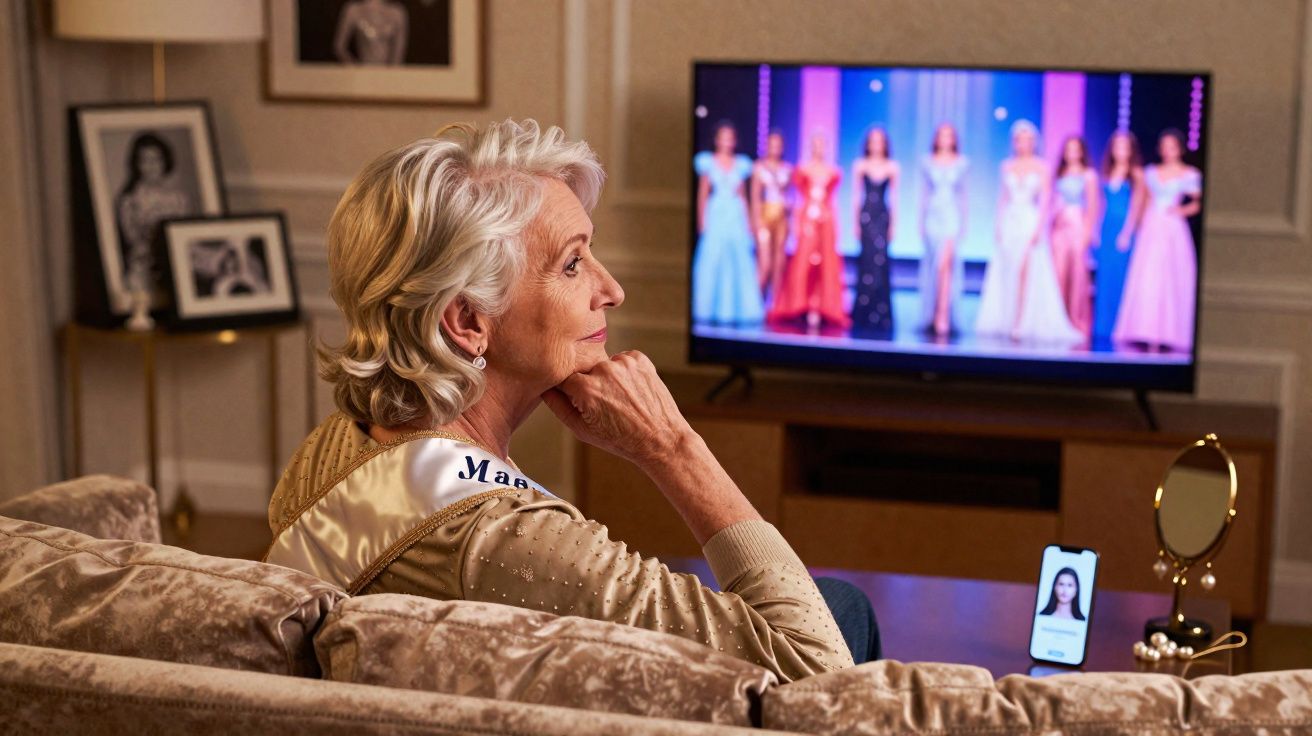
As France looks ahead to the 75th Miss France final in December 2025, one former titleholder from the 1960s follows every detail with a pen and paper. Her assessment of what the competition has become is neither rose-tinted nor wholly enthusiastic.
Muguette Fabris, Miss France 1963, watching the Miss France 2025 show
Muguette Fabris won Miss France in 1963 at the Grand-Théâtre in Bordeaux. Now in her eighties, the slim, lively brunette of Italian heritage still studies the contest with an almost investigative focus, aware that it once altered the course of her life.
When the live broadcast comes on each year, she settles in front of the television with a notebook at the ready. She draws up her own shortlist of potential winners, scrutinises the staging, and records which interview answers cut through. By her own account, she remains sincerely impressed by the professionalism of the organising committee.
At the same time, she is among the few people who can weigh up, from lived experience, the stripped-back elections of the 1960s against the highly produced television event due to take over the Zénith arena in Amiens in 2025.
Behind the sparkle, some former winners are beginning to wonder whether so much preparation ends up draining candidates of spontaneity.
“Too managed”: when coaching smooths away personality
For Fabris, the most striking shift is not the gowns or the lighting rigs, but how tightly the young women’s presentation is steered.
She approves of some of the modernisation. The introduction of a general-knowledge test, for example, feels to her like a sensible acknowledgement that intellect should count-at least in principle.
Even so, she considers the current format-a multiple-choice quiz-much too superficial. In her view, candidates ought to answer in their own words and be nudged towards genuine cultural substance: history, art, public affairs and political life, rather than mere snippets of trivia.
What worries her most is the impression that, by the time the final arrives, a number of contestants seem pre-programmed.
On live television, she argues, adrenaline and pressure collide with intense coaching, and some candidates appear to have mislaid the distinctive spark that first set them apart.
As she describes it, the women line up before veteran host Jean-Pierre Foucault and deliver remarks honed through repeated rehearsals. Ready-made phrases take the place of instinct, and personal judgement is pushed to the background.
To Fabris, surrendering that sense of “free will” is an expensive trade-off for a flawlessly run show.
1963: no media training, no briefing-only you and the press
Her own experience, she says, could scarcely be more different. In 1963 there were no media coaches, no curated messaging, and no image consultants. Contestants were effectively dropped into the public eye without a script.
Journalists would quiz them in corridors and dressing rooms. Once crowned, Miss France had to respond immediately-without a buffer, without rehearsal, and without anyone smoothing the edges. Whether an answer came out awkwardly or brilliantly, it was unmistakably her own.
That freedom had clear drawbacks: there were fewer professional openings, and there was little protection if a comment landed badly. Back then, winning Miss France did not automatically mean stepping away from ordinary employment.
Fabris, who was teaching mathematics at the time, simply stayed in the classroom. The title brought status, but it did not instantly convert into a career in entertainment.
From the classroom to Paris flats: what today’s winners inherit
For recent winners, the post-crown reality tends to look far more structured. They are accommodated in Paris, receive benefits linked to the role, and are expected to keep pace with a packed calendar of appearances.
The crown also functions as a gateway to the media world. For many candidates, the competition is now a launching pad into television, radio, influencing or acting, with producers and casting directors watching as though it were a nationwide audition.
Fabris understands why that prospect is attractive-yet she stresses how unforgiving the odds remain:
- Only one contestant takes the title.
- A small number manage to secure a lasting media profile.
- Most return home without a clear professional pathway.
She advises teenagers dreaming of the sash to prioritise a robust qualification as well, and to decide early what they would pursue if the cameras stopped tomorrow.
In a climate where a single viral moment can tarnish a name overnight, she believes a degree or a trade is a steadier safety net than follower counts.
Although she openly dislikes social media and the speed at which online controversies flare, she accepts that contestants can no longer opt out. Their public image now persists on platforms beyond their control.
One additional change, often overlooked, is the pressure to behave as a “brand” from the outset: careful wording, constant availability, and the expectation to be camera-ready at all times. Even minor missteps can be clipped, reposted and judged out of context for years.
Rules, feminism and a specific “image of woman”
Miss France has also had to navigate debates about sexism and inclusivity. Requirements that once seemed immovable have been challenged or softened, including limits linked to age, marital status and motherhood.
Fabris, who describes herself as practical and supportive of women’s independence, admits she has mixed feelings. She actually valued the old rule that only unmarried young women could enter.
In her eyes, those restrictions were not as harsh as critics claim, and they upheld a clear-if traditional-ideal of femininity that still makes sense to many in her generation.
She points out that in the most recent edition, none of the contestants were married anyway, suggesting that the contest’s underlying “image of woman” remains broadly familiar even when public messaging highlights change.
She maintains, however, that each woman should live as she chooses, and that the deepest kind of freedom more often comes from education, work and gradual self-emancipation than from a televised title.
For her, autonomy tends to begin at legal adulthood-when young women start making their own decisions-rather than the moment they step into a ball gown under stage lights.
A related issue is duty of care. With nationwide scrutiny now routine, contestants increasingly need credible support around wellbeing, privacy and harassment-before, during and after the final-because the impact of exposure rarely ends when the broadcast does.
Artificial intelligence, image control and the future of beauty contests
When she looks forward, Fabris identifies another looming disruptor: artificial intelligence. In her view, the pace of technological change is only accelerating, and pageants will inevitably be affected.
AI-generated images and deepfakes already make the boundary between authentic and synthetic beauty harder to define. That raises uncomfortable questions for a live competition based partly on appearance: how can audiences trust what they are seeing, and how can contestants protect their likeness once it can be copied, reshaped and redistributed without limit?
She also suspects production teams may increasingly use AI to script, edit and refine segments, reinforcing the feeling that much of the programme is assembled long before the night itself.
| Era | Key features | Risks for contestants |
|---|---|---|
| 1960s | Very limited coaching, fewer opportunities, modest media reach | Minimal protection, brief visibility |
| 2000s | Large television audiences, growing media careers, stronger branding | Intense scrutiny, tighter image management |
| 2020s–2030s | Social media pressure, AI tools, influencer economy | Online harassment, unstable reputation, digital replicas |
Behind the tiara: what young candidates often underestimate
Fabris’s account reads like an informal career briefing for anyone considering applying. She highlights several blind spots that many young women only discover too late.
First comes the time commitment. Months of preparation, rehearsals and travel can interrupt or postpone study. A gap year devoted to chasing a crown may be exhilarating, but it can leave an awkward gap on a CV if nothing materialises afterwards.
Second is the emotional load. National exposure at 19 or 20 means being judged not only on appearance, but also on accent, opinions and private life. Today, criticism arrives instantly-and can be amplified by thousands of anonymous accounts.
Third is what happens “after”. Once attention moves to the next cohort, former contestants often have to rebuild a sense of self away from the Miss France label:
- Some return to university or vocational training.
- Others launch small businesses, using brief recognition to attract customers.
- A minority stay in showbusiness, often after years of auditions.
Her own path-pairing a high-profile title with a serious academic direction (she was the only Miss accepted at France’s prestigious École Polytechnique during her reign)-illustrates one approach: treat the crown as a chapter, not a blueprint for an entire life.
What “singularity” really means in a modern Miss France pageant
When Fabris says candidates “lose part of their singularity” on election night, she is naming a tension that runs through almost every contemporary talent or beauty contest.
On one side, producers need a coherent television product: clean soundbites, consistent gestures and easily readable storylines. That requirement naturally encourages intensive rehearsal and coaching. On the other, audiences increasingly demand authenticity and distinctive character.
In this context, “singularity” is not simply a particular look or an unusual hobby. It is the way a contestant thinks, how she reacts when surprised, and how she handles a difficult question about politics or social issues without hiding behind a rehearsed line.
One practical way to protect that edge, Fabris suggests, is to prepare more than posture and smiles. Reading widely, forming independent opinions, and practising unscripted speaking can help a candidate resist-politely but firmly-when a polished line no longer sounds like her.
For viewers and voters, recognising the choreography behind the scenes can change how the show reads on screen. A flawless answer may be the product of hours of training, while a slightly imperfect but heartfelt response can be the rare moment when a contestant’s real personality breaks through the glitter.





Comments
No comments yet. Be the first to comment!
Leave a Comment