
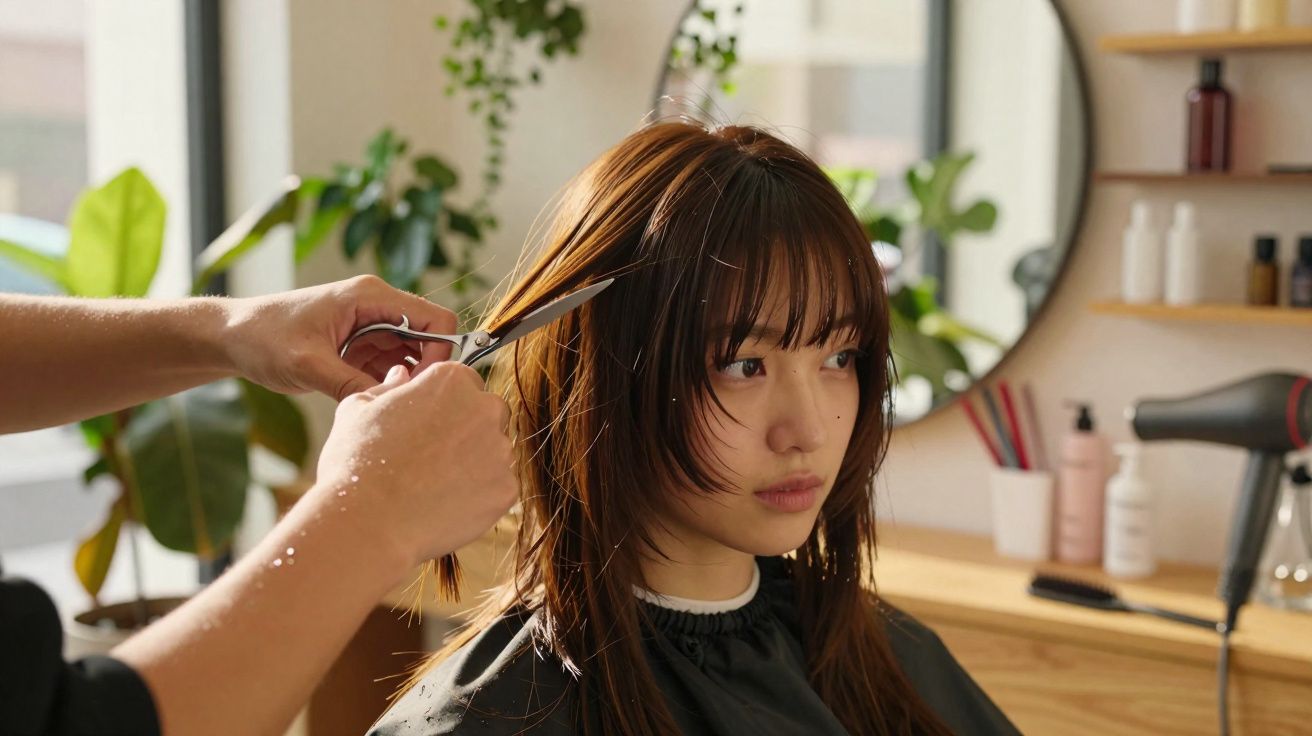
Soft edges, interrupted lines and a fringe that never quite stays in place are quietly dominating salon chairs as we head into 2026.
Hair trends this year are easing off the rigid finish: shapes are less severe, texture is being embraced, and a new style of fringe is changing what “finished” hair looks like.
What the shattered fringe actually is
The shattered fringe (also known as a deconstructed fringe) is essentially the opposite of the dense, heavy slab of hair many people imagine when they think of a fringe.
Rather than a blunt, solid panel sitting across the forehead, this look is intentionally broken apart. The ends are sliced, chipped and texturised so the fringe feels airy, light and slightly piecey.
A shattered fringe has soft edges, uneven lengths and tiny gaps that allow your skin and brows to peek through.
To create it, hairdressers typically use point-cutting, feathering scissors or a razor. They work through small sections so the finish looks natural and “grown-in”, not perfectly uniform.
The result is relaxed and current: it draws attention to the eyes without overwhelming your features, and it moves with you instead of sitting rigidly in place.
Why 2026 is the year of the deconstructed fringe
The wider direction of 2026 hair is moving away from ultra-polished, high-effort styles. Mid-length hair is returning after years of sharp bobs, pixie cuts are being softened into “air pixies”, and colour is shifting towards subtle dimension-think glossing and delicate light lines, rather than relying on bold balayage alone.
The shattered fringe fits right into that mood. It updates your look without demanding a dramatic chop, so a long length or a mid-length cut can feel instantly different simply by reworking the front.
For lots of people, it’s also a gentler way to explore identity and personal style. Instead of committing to a big change that takes months to grow out, you can tweak the shape every few weeks and evolve it gradually.
How it differs from the fringes you already know
The shattered fringe sits somewhere between a classic fringe, curtain fringe and soft layers-yet it isn’t fully any of them.
- Versus a blunt fringe: lighter overall, more negative space, and no harsh horizontal edge.
- Versus a curtain fringe: it doesn’t part neatly down the middle; pieces fall in multiple directions.
- Versus a wispy fringe: it still has enough presence to change how your face reads, but it’s nowhere near a thick, solid block.
That fragmented structure is exactly why it’s called “shattered”. It looks as if it’s been delicately broken into tiny sections-almost accidental-despite being a very deliberate cut.
If your fringe looks like it could have been drawn with a ruler, it isn’t shattered. The whole point is controlled imperfection.
Shattered fringe: who it suits best
Because it’s so adjustable, the shattered fringe can flatter many face shapes. The key is deciding where the longest pieces sit and how much density you keep through the centre.
| Face shape | Why it works | Stylist tips |
|---|---|---|
| Round | Reduces the look of fullness and pulls attention towards the eyes and cheekbones. | Keep the middle slightly shorter, with longer pieces at the sides to lengthen the face. |
| Heart-shaped | Softens a broader forehead while spotlighting the upper cheek area. | Add light, broken pieces near the temples to balance a narrower chin. |
| Long | Shortens the face visually without creating a heavy, blunt line. | Aim for mid-forehead to brow-skimming length, with scattered strands. |
| Square | Softens strong angles with irregular, feathered ends. | Leave the outer corners longer and more diffused to blur the edges. |
The more carefully your face shape and features are assessed, the more personalised-and flattering-the shattered fringe becomes.
What about different hair types?
Not every hair texture behaves the same way, but this trend is more flexible than it first appears.
Straight and slightly wavy hair
On straight hair, the shattered pattern reads very clearly: the chipped ends and the spacing between pieces are easy to see. You can opt for a soft veil that grazes the brows, or go a touch shorter so it skims the eyes.
With loose waves, it looks even more effortless. Natural bends encourage the tiny sections to separate on their own, creating movement with minimal styling.
Curly and very curly hair
This is the category where you’ll want to be more cautious. Curls spring upward once cut, and the final length can be hard to judge in advance.
If you have tight curls, a shattered effect can still work, but it’s often more flattering as face-framing layers than as a strict fringe line.
For that reason, many stylists cut curls dry so they can see the true bounce and shrinkage. If you have coily hair and you’re committed to having a fringe, expect to book a consultation and build the shape over two appointments rather than trying to nail it in one.
How to ask for a shattered fringe at the salon
“Shattered fringe” is becoming a common term, but your hairdresser may not use it every day. Being specific helps you avoid a result that feels either too bulky or too barely-there.
- Bring two or three reference photos that match the level of texture you want.
- Explain that you want a light, piecey fringe with uneven ends-not a blunt line.
- Be clear about how much forehead you’re happy to cover.
- Describe your usual styling habits so the cut suits your routine.
The best shattered fringes are designed around your laziness level: the less time you plan to style, the lighter and more low-maintenance the finish should be.
Styling a shattered fringe day to day
A big reason this fringe is taking off is that it’s forgiving. Slight waves, cowlicks and even a touch of frizz can improve the effect rather than ruin it.
Most stylists recommend drying your fringe first-even if you’re letting the rest of your hair air-dry. A quick blast of the hairdryer while brushing the hair from side to side stops it settling into a stiff, helmet-like shape.
After that, your fingers usually do the job. Use a tiny amount of lightweight cream, mousse or styling powder to separate small sections. Steer clear of heavy oils and thick waxes, which can stick the pieces together and undo the “shattered” spacing.
Aim for “unstyled on purpose”: soft, separated, slightly uneven, and easy to push out of your eyes.
In typical UK weather-especially damp, drizzly days-humidity can actually help this trend by encouraging natural separation. If your fringe collapses or clumps when it’s wet, a quick refresh with dry shampoo at the roots (then re-separating with fingertips) usually brings the texture back.
Maintaining the look without constant trims
Because it isn’t a single straight line, a shattered fringe tends to grow out more nicely than a blunt fringe. If you like a looser, more relaxed shape, you can often leave six to eight weeks between tidy-ups.
To keep it looking fresh at home: - Choose a gentle volumising shampoo to prevent heavy roots. - Pat the fringe area with a towel rather than rubbing it. - In the morning, mist with water or use dry shampoo, then reshape with your fingers.
Trimming it yourself can be tempting, but errors are obvious at the front of the face. If you do touch it up, only snip individual strands vertically into the ends-never straight across.
Growing it out is also fairly painless: as the longest pieces drop, the fringe naturally blends into face-framing layers. If you’re unsure, ask your hairdresser to cut the outer edges slightly longer from the start so you have an easy “escape route” into a soft curtain-like shape later.
What “shattered” means in hairdressing terms
In professional terms, “shattering” doesn’t mean hacking at the hair randomly. It’s a method of breaking up a solid shape so it looks lighter, softer and more fluid.
Common techniques include: - Point cutting: holding scissors vertically and cutting into the ends. - Slide cutting: gliding the blades along the hair to reduce bulk. - Razor work: carving frayed, soft edges with a razor.
These approaches remove weight without sacrificing length, which is exactly why they’re so effective around the eyes and cheekbones.
Who should think twice before getting it
Even though the shattered fringe is adaptable, it won’t suit absolutely everyone. If you have a very oily forehead, any fringe can look greasy quickly regardless of how it’s cut. And if you feel self-conscious about your hairline, you might prefer longer face-framing pieces that can be pinned back easily.
Anyone devoted to a perfectly sleek, glassy finish may also find this trend underwhelming. A shattered fringe looks best when it has movement; aggressively straightened, ultra-flat results can make the delicate ends appear sparse rather than soft.
Combining the shattered fringe with 2026’s other hair trends
This fringe is especially flattering with mid-length cuts that fall around the collarbone or just below the shoulders. The broken texture at the front mirrors soft layering through the lengths, creating a gentle, flowing outline.
It also updates a classic bob instantly. A chin-length or shoulder-grazing bob paired with a shattered fringe looks less severe-particularly styled with loose bends or a subtle blow-dry instead of a poker-straight finish.
On pixie cuts, a shattered micro-fringe acts like a built-in detail, highlighting the eyes and cheekbones without demanding complicated styling.
A realistic way to experiment with your image
If you’re wary of a major transformation, the shattered fringe is a manageable way to try something new. Your overall length stays intact, but your face reads differently in photos, and your everyday mirror routine feels noticeably refreshed.
It can also be a soft first step towards broader changes: once you’re used to your features being framed differently, adjusting your colour, adding layers or shifting your parting often feels easier and less intimidating.
Think of the shattered fringe as a small, strategic risk: enough change to feel new, not so much that you stop recognising yourself.



Comments
No comments yet. Be the first to comment!
Leave a Comment