
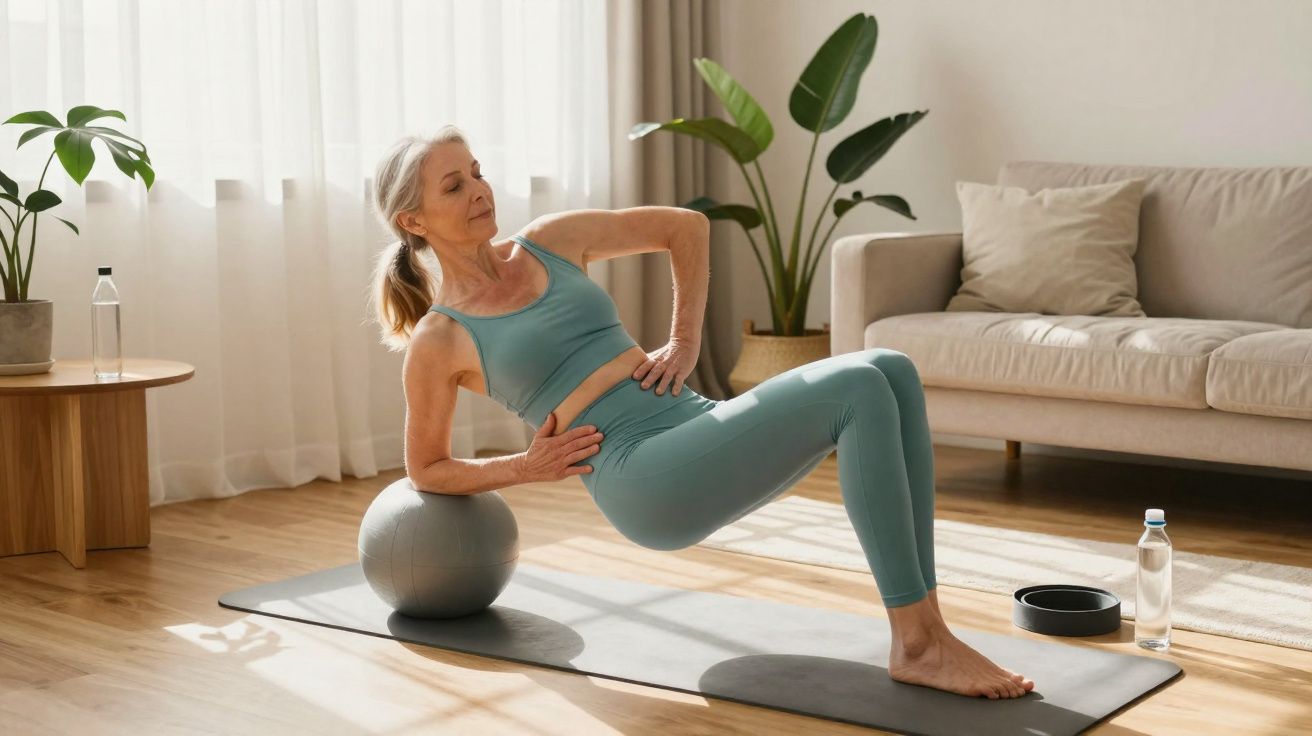
On sitting-room carpets and on yoga mats up and down the country, women in their sixties are quietly changing the story of what ageing can look like.
Rather than signing up for bootcamps or forcing themselves through punishing gym routines, many women over 60 are finding that a small set of gentle Pilates movements can make a noticeable difference: a firmer-feeling middle, less back niggle, and a steadier, more upright posture that boosts day-to-day confidence.
Why Pilates is winning over women past 60
After 60, a familiar trio of irritations often shows up: the tummy softens, the back feels less supple, and balance can become less reliable. Traditional ab work such as crunches may aggravate the neck, while long planks can feel harsh on wrists and the lower back.
Pilates tends to suit this stage of life because it takes a different approach. Instead of chasing speed or maximum sweat, it emphasises slow, exact control-especially through the deep “corset” of muscles around the midsection. One of the key players is the transverse abdominis, a deep layer that wraps around the torso like a built-in support belt.
By switching on the deeper core rather than only the visible “six-pack”, Pilates can narrow the waist while helping to keep the spine protected.
This isn’t just about looking trimmer. When the muscles around the trunk are stronger, everyday movements often feel more secure-stepping down from a kerb, balancing to put on trousers, or catching yourself if you stumble on uneven pavement.
For women already navigating arthritis, osteoporosis, or old injuries, the appeal is also practical: Pilates is low-impact, largely floor-supported, and easy to scale up or down depending on how you feel on the day.
The three floor exercises changing over-60 bodies
1. Pelvic tilt: the small action that supports the lower back
The pelvic tilt can look almost too modest to matter. You lie on your back with your knees bent and your feet flat. As you breathe out, gently draw in your stomach muscles and press your lower back into the mat. Then release back to a neutral spine.
The range of movement is minimal, but when done slowly-around 8 to 12 repetitions-it can:
- activate deep abdominal support muscles
- ease tightness in the lower back
- improve posture awareness for standing and walking
Many Pilates teachers describe the pelvic tilt as the core’s “on switch”: once you can feel it, the rest of the session often becomes safer and more effective.
Physiotherapists use a similar pattern in rehabilitation because it trains the body to stabilise the spine from the front of the trunk, rather than relying purely on the back muscles.
2. Single leg lift: working the lower abdominals without the strain
From the same starting position on your back, brace gently as though you are zipping up a snug pair of jeans. Then, with control, lift one leg up towards the ceiling. The goal is to keep the lower back steady against the floor. Lower the leg slowly and repeat on the other side.
This exercise is particularly helpful for the lower abdominal region-an area many women find stubborn, especially after pregnancy and during hormonal shifts around menopause.
If hips feel tight or the lower back is sensitive, keep the “resting” leg softly bent rather than straight. That small adjustment can reduce tugging through the pelvis and make the movement more comfortable.
3. The hundred (adapted): a classic made kinder on joints
The Hundred is a well-known Pilates warm-up intended to wake up the whole body. In an adapted version for older adults, you lie on your back with your knees bent, keeping your feet on the floor-or lifting the legs to a comfortable tabletop position if that feels stable.
To protect the neck, you can keep the head and shoulders on the mat. Extend the arms alongside the body and pump them in small, quick movements.
Breathing follows a clear rhythm: inhale for five arm pumps, then exhale for five. Beginners can start with 30–50 pumps, increasing later only if it feels comfortable.
The adapted Hundred blends abdominal engagement, breath control and circulation-without compromising the security of the mat.
How often to practise, and how to breathe
When working with older adults, many experts favour consistency over intensity: three to four shorter sessions per week rather than one long “all-or-nothing” workout. In practice, 10 to 15 minutes of focused Pilates often delivers more than an hour done half-heartedly.
Breathing is central to Pilates rather than an add-on. A commonly used pattern is:
- inhale gently through the nose to prepare
- exhale through pursed lips while drawing in the abdominals, as if tightening a belt around the waist
That controlled exhale can help support the pelvic floor-an important consideration for women after childbirth and through menopause. Straining, pushing, or breath-holding during effort can increase downward pressure, which is unhelpful for anyone dealing with prolapse symptoms or mild incontinence.
What women over 60 are really noticing
When women in their sixties describe the results, they rarely lead with appearance. Yes, the waist can look slimmer and the stomach can feel firmer-but the changes they value most are often practical.
Many say they feel steadier on stairs, less anxious about falling, and more conscious of their posture throughout the day.
Some notice they can stand at the hob longer without back discomfort, or spend time in the garden without paying for it the following morning. Others mention small clothing changes: waistbands feel less tight, and tops sit more smoothly across the middle.
These tend to be gradual gains rather than dramatic overnight shifts. Even so, for women who felt their bodies were becoming unpredictable, the cumulative effect can be quietly transformative.
Pairing Pilates with everyday habits
Core work alone does not “flatten the stomach” if daily routines are pulling in the opposite direction. Trainers supporting older clients often recommend combining Pilates with:
| Focus | Example habits |
|---|---|
| Movement | Gentle walks on most days, plus 10–20 minutes of Pilates |
| Nutrition | Sufficient protein (fish, eggs, beans) and fibre (vegetables, oats) with each meal |
| Recovery | A consistent sleep routine and a few light stretches before bed |
With age, muscle mass naturally declines (sarcopenia). Without adequate protein and some form of resistance, strength can drop more quickly than many expect. Pilates provides resistance through bodyweight and controlled tension-particularly around the trunk, where stability matters most.
Staying safe: when to adapt or pause
For most healthy over-60s, these three exercises are gentle enough to practise at home. However, certain situations warrant extra care:
- Significant osteoporosis: avoid deep twists or strong spinal flexion/crunching.
- Uncontrolled high blood pressure: keep the head supported and maintain steady breathing.
- Shoulder or neck problems: keep the head down during the Hundred and reduce arm speed.
Sharp pain, pins and needles, or breathlessness that feels disproportionate are all signals to stop and reassess. If you have a complex medical history, a brief conversation with a GP or physiotherapist can provide reassurance and help you choose the safest modifications.
Women over 60 and Pilates: choosing the right level and progressing sensibly
If you are new to Pilates, it can help to start with a beginners’ or “Pilates for over-60s” class-either at a local leisure centre, a community hall, or a reputable online programme. Look for clear cueing, an emphasis on alignment, and permission to rest when needed.
Progression does not have to mean harder, faster, or longer. You can improve by refining control: slower leg lifts, smoother breathing, and better pelvic stability. Over time, that precision often delivers the “flatter” feeling in the stomach without relying on strain.
Simple ways to bring Pilates into daily life
The benefits do not have to stay on the mat. Once you understand the sensation of a good pelvic tilt, you can recreate that gentle abdominal engagement while waiting for the kettle to boil or queueing in the supermarket.
Many women use small daily prompts: while brushing teeth, they practise standing tall with relaxed ribs and light core support; when standing from a chair, they focus on using the core rather than pushing down with the hands.
This sort of “micro-Pilates” reinforces the technique between sessions, keeping that steadier posture and firmer middle active in real life-not just during exercise.
Related activities that boost the results
Pilates often works brilliantly alongside other joint-friendly options. Yoga can loosen tight hips and hamstrings, making floor work more comfortable. Light strength training with resistance bands or small dumbbells can support bone density. Tai chi and balance classes build further confidence on the stability gained through core work.
A realistic weekly rhythm for many women over 60 might be: short Pilates routines three times a week, one or two longer walks, and an occasional class at a community centre for variety and social connection. In combination, the impact often goes beyond a slimmer waist-it can change how ageing feels from one day to the next.


Comments
No comments yet. Be the first to comment!
Leave a Comment