
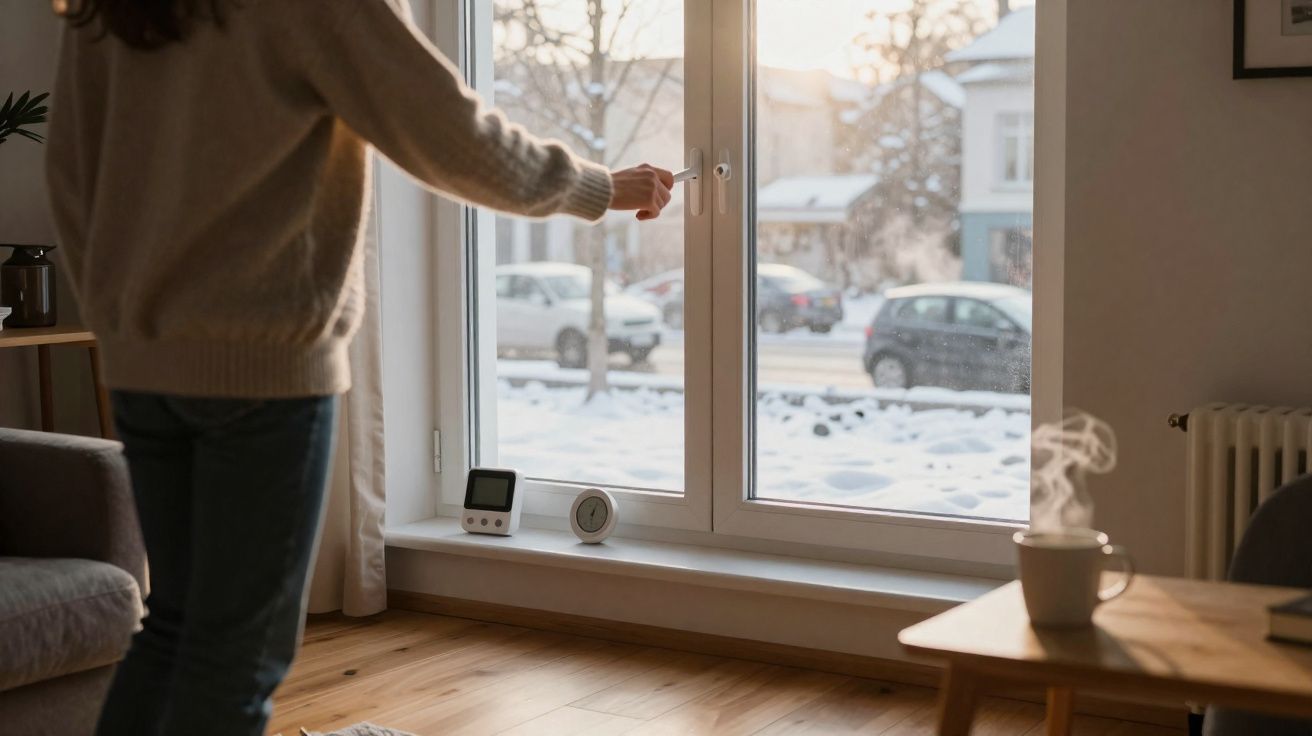
Those bitterly cold early-morning hours can seem like the ideal moment to “freshen up” your home.
Outside, the air feels sharp and clean-almost as though it must be healthier than whatever has built up indoors overnight.
Plenty of households still fling the windows open after breakfast, certain they are doing their lungs a favour and even saving on heating. Yet what air-quality specialists and building engineers measure each winter morning increasingly contradicts that belief.
Morning rush hour, invisible smog
Between about 8 and 10 a.m., towns, cities and suburbs surge into motion. Engines start, buses pull away, school runs clog local streets and delivery vans criss-cross residential roads. Alongside the noise and movement comes a rapid rise in exhaust, fine particles and a complicated mix of gases.
If you open the windows during that same period, your living space effectively joins the outdoor air stream. The “fresh” air that flows in often contains nitrogen oxides, fine particulate matter (PM2.5 and PM10) and small amounts of unburnt fuel. These pollutants infiltrate indoor rooms easily-particularly in flats near busy roads or in closely built-up areas.
Ventilating during the morning peak doesn’t weaken pollution-it can bring the most contaminated outdoor air of the day straight into your bedroom.
Public health bodies associate frequent exposure to fine particles with irritated airways, worsened asthma, cardiovascular strain and higher hospital admissions on days when pollution levels are elevated. Children, older people, and anyone with heart or lung conditions are usually affected more, but no set of lungs is entirely immune.
In winter, the problem can be even harder to shift. Cold air can become trapped near the ground beneath warmer air higher up, a process known as temperature inversion. Instead of dispersing, pollutants build up and linger-often at the height of typical windows. At street level, that means poor dispersion at precisely the time many people open up their homes to “change the air”.
Why indoor air can be better than outdoor air in the morning
Indoor air is often criticised because of dust, cooking odours and chemical emissions from furniture, paints or cleaning products. Even so, in many urban areas during winter, outdoor air between 8 and 10 a.m. can be worse than what is already indoors.
If you ventilated later the night before, used an extractor fan while cooking and kept humidity under control, your indoor air may actually sit at a lower pollution level than the street outside. Opening windows during rush hour can wipe out that advantage immediately.
Think of your flat as a filter: pollutants build up gradually, but opening the windows at the wrong time can swap what you have for a dirtier mixture.
Monitoring devices positioned near busy junctions commonly show clear surges in nitrogen dioxide and ultrafine particles from roughly 7.30 to 9.30 a.m. After that, levels tend to fall as traffic eases, daylight increases and air masses mix more effectively. If you align your airing routine with those spikes, you are effectively breathing the curve at its highest point.
Cold air, warm bills
There is also a quieter, practical reason to avoid airing the home early on winter mornings: basic physics and how heating systems respond. In most properties, the outdoor temperature shortly after sunrise is close to the day’s lowest point. Opening several windows at once allows heat stored in walls, floors and furnishings to pour out, while dense, cold air rushes in to replace it.
Your heating then has to work harder to bring the home back to a comfortable temperature. That extra demand often lands during the energy system’s own “peak load”, when homes, schools and workplaces are all drawing power or gas at once. In some areas, networks respond by using less efficient backup generation, which can increase emissions-feeding more pollution into the very air you are drawing in through the morning window.
How much heat you really lose
The loss is not limited to the air. Surfaces cool too, and once walls, floors and furniture drop below the room temperature, you can feel a lingering chill for hours. In buildings with poor insulation, repeated short openings at the coldest point of the day can add up to significant waste over the course of a winter.
| Scenario | Outdoor temp | Effect on heating |
|---|---|---|
| Windows open 10 min at 8:30 a.m. | 0–3°C | Sharp temperature drop; boiler or heat pump runs at high output |
| Windows open 10 min at 12:30 p.m. | 5–9°C | Gentler drop; shorter re-heating period; lower peak load |
Building engineers also note another knock-on effect: larger, frequent temperature swings increase wear on radiators, boilers and heat pumps. More frequent cycling can shorten equipment life and raise maintenance needs over time.
When should you air your home in winter?
You still need ventilation. Without it, humidity rises, windows mist up and mould can quietly develop behind wardrobes and in corners. The solution is not to avoid fresh air, but to use better timing and a more effective approach.
Smarter window airing for home ventilation in winter
For many households, the most sensible balance is short, controlled bursts of ventilation during the warmer, calmer part of the day-typically from late morning into early afternoon. Traffic is often lighter then, even weak winter sunshine may have lifted outdoor temperatures a little, and the air tends to mix more efficiently.
- Favour shock ventilation: open windows fully (ideally on opposite sides) for 5–10 minutes to create a strong cross-draught.
- Aim for late morning or early afternoon, when temperatures and dispersion are usually more favourable.
- Prioritise rooms that generate moisture: the bathroom after showers, the kitchen after cooking, and bedrooms after sleeping.
- Turn the thermostat down slightly before opening, then return it to normal once the windows are shut.
Some newer homes and refurbished properties use mechanical ventilation with heat recovery. These systems remove stale indoor air and bring in outdoor air through a heat exchanger that recovers a large proportion of the warmth. Where this is installed and functioning properly, keeping windows closed and letting the system do its job often provides a better mix of fresh air, comfort and lower energy use.
If your home has mechanical ventilation with heat recovery, frequent winter window airing can interfere with its carefully balanced airflow.
The hidden role of humidity and condensation
A major reason people open windows first thing is obvious: steamed-up glass and that slightly damp, stale bedroom smell. Overnight, two adults can release more than 1 litre of water into the air simply by breathing. With nowhere for that moisture to go, it condenses on cold panes and colder wall surfaces.
A quick, intense airing still helps-but it does not need to happen during rush hour. Often you can wait 30 minutes (or longer), allow the heaviest traffic to pass, and then ventilate thoroughly. Pairing that with a slightly warmer indoor temperature in the evening can also reduce morning condensation in the first place.
Dehumidifiers, correctly sized extractor fans and trickle vents above windows can all help keep moisture in check. Lower humidity means reduced mould risk, fewer dust mites, and a feeling of warmth even at slightly lower room temperatures-which can, in turn, ease the load on your heating.
What commuters and home workers can actually do
Daily life rarely follows neat schedules. Parents managing school runs, home workers on back-to-back video calls and shift workers all face different constraints. Even so, small changes can noticeably improve what you breathe during winter.
Practical adjustments for typical households
- If you leave early, ventilate the bedroom briefly when you first get up, then air again at lunchtime or when you return-rather than during 8–9 a.m.
- If you work from home, avoid leaving windows on the latch for hours in the morning. Instead, do one or two strong airing sessions around midday.
- In more polluted areas, check local air-quality forecasts (or look for a visible haze) and delay airing on days with smog or official alerts.
- Link winter airing with simple measures: shut internal doors during ventilation so you do not cool the entire home, and pull furniture a few centimetres away from external walls to reduce hidden mould.
It is also worth thinking about transport. Every car removed from the morning rush reduces emissions near homes and schools. Walking, cycling and lift-sharing not only cut pollution outside your own windows, but also improve background air for everyone’s ventilation routines-including yours.
Finally, if you are planning building work, treat insulation, airtightness and controlled ventilation as a package rather than unrelated upgrades. A well-insulated home with no designed air paths can trap moisture and pollutants. Add a balanced ventilation approach-even a straightforward one-and those short winter airing windows become a useful backup rather than your only defence against stale indoor air.



Comments
No comments yet. Be the first to comment!
Leave a Comment