
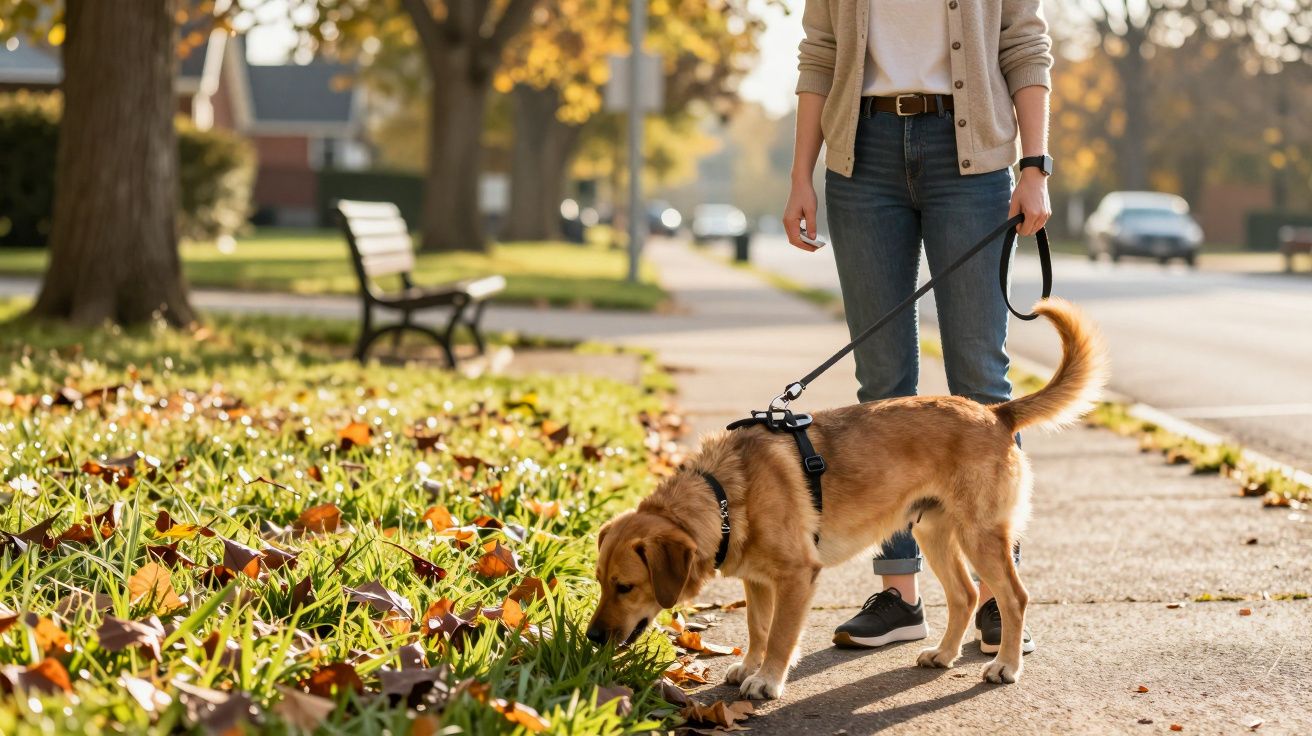
City pavements are packed with dogs padding alongside time-poor owners, tugged from lamppost to lamppost with scarcely a moment to pause.
Plenty of people assume they are doing right by their dog as long as it gets outside to toilet and stretch its legs. Behaviour specialists warn that this quiet assumption can be harming pets: how we walk dogs often matters far more than how far we go or how quickly we cover the distance.
Dog walking: why a walk is far more than exercise
For a dog, a walk is not merely a route from A to B. It is a sensory experience, a social outing and a mental workout all at once. Dogs are strongly social animals and, as the saying goes, “noses on legs”. While humans tend to navigate streets using sight, routine and familiarity, dogs move through an intricate world of scents and signals.
Researchers in canine cognition emphasise that the nose does most of the work. A dog’s sense of smell is thought to be tens of thousands of times more sensitive than ours. Each tuft of grass and every tree trunk holds detailed information about who has been there, how long ago they passed, and even clues about how they were feeling.
For many dogs, sniffing a lamppost is as engaging as reading a breaking news alert is for a human.
When we turn a walk into a brisk, head-down march, we deny dogs access to that information. They may be moving, but they are not truly “out” in the way their brains and bodies are designed for. They are simply following.
Fast walks, frustrated dogs
Across trainers and scientists, a blunt message is gaining traction: fast, tightly managed walks can create frustration and stress. A dog held on a short lead, hurried along, and repeatedly pulled away from smells or other dogs has little genuine control over what is meant to be its time.
Over weeks and months, that frustration often shows up at home in other forms: chewing furniture, pacing, barking for attention, or licking itself excessively. Some dogs begin spinning or chasing their tails. Others seem perpetually “wired”, as though they never properly settle.
Keeping a walk to quick marching purely for toileting might tick a box for the owner, but it leaves the dog’s brain under-stimulated and emotionally unfulfilled.
Professionals also highlight a simple point: the brain needs exercise as much as the body. If a walk delivers only physical exertion, without opportunities to sniff, investigate or make choices, a dog’s mental needs are left unmet.
Short and rich beats long and dull
Many owners cite an hour-long walk as proof they are responsible. Yet time and distance alone say very little about the quality of the outing. A dog can plod for an hour along the same pavement, tightly controlled, and return home more stressed than when it left.
By comparison, a 15–20 minute amble where the dog can sniff, stop, backtrack and examine new corners can be genuinely satisfying. Behaviourists often report calmer, more relaxed dogs when owners shorten the distance but enrich what happens during the walk.
- Long, rushed walk: high physical effort, low mental stimulation, little choice.
- Short, varied walk: moderate physical effort, high mental stimulation, plenty of choice.
- Mixed routine: one brisk fitness walk plus one slow “sniffari” each day.
What a good walk actually contains
Researchers commonly describe three experiences dogs benefit from when they go out: anticipation, exploration and autonomy.
Anticipation: the build-up begins at home
As soon as the lead appears or keys jingle, many dogs enter a state of happy excitement. Their heart rate rises; they may bounce, whine or hover by the door. That anticipation is itself rewarding, linked to the expectation of going outside to explore and collect information.
If that expectation is repeatedly met with rushed, restricted walks, the emotional “high” can become flat or edgy. Dogs may go out over-stimulated and come back still unsatisfied, which can feed anxiety rather than relieve it.
Exploration: sniffing is a basic need
On a relaxed walk, a dog takes in a remarkable amount of information through smell alone: which dogs live nearby, whether a female was recently in season, whether a rival male is around, and what has changed since yesterday. This steady stream of scent information calms many dogs and helps them feel oriented.
That investigative sniffing is not pointless “dawdling”. For a dog, it is closer to reading local headlines, mapping social connections and scanning for threats-simultaneously.
Sniffing is not a luxury skill for dogs; it is a core biological need that helps them feel safe and grounded.
Autonomy: allowing the dog to make some choices
Walks can also offer dogs rare moments of control. Selecting which patch of grass to inspect, deciding which direction to take at a junction, or choosing when to pause helps them feel like participants rather than passengers.
Even modest choice can raise confidence and reduce stress. Dogs that always follow the same route, at the same pace, on a short lead often show boredom or growing tension. Changing the route and letting the dog “vote” with its paws can noticeably improve behaviour at home.
Warning signs your dog’s walks are too rushed
Trainers point to several signs that a dog may be struggling with its walking routine:
- Pulling on the lead constantly from start to finish.
- Whining or barking on seeing other dogs, while being prevented from interacting.
- Over-the-top behaviour on getting home: zoomies, jumping up, grabbing cushions.
- Destructive chewing, especially in the hours after a walk.
- Compulsive patterns such as tail chasing or excessive licking.
These behaviours can also have medical causes or other emotional triggers, so a veterinary check is sensible. However, when health issues are ruled out, many professionals look first at the walk itself: is the dog being given the chance to behave like a dog?
Practical ways to make walks richer
Experts are not suggesting owners abandon structure or ignore safety. Rather, they encourage a change of focus-from speed to experience. Small shifts can transform an everyday routine.
| Common habit | Suggested tweak |
|---|---|
| Pulling the dog away from every smell | Add a cue such as “go sniff” and allow several minutes of free smelling in safe spots |
| Always using the same route | Rotate between a few routes or build in small detours |
| Keeping a short, tight lead the whole time | In quiet areas, swap to a longer, non-retractable lead to create more space |
| Walking only for toileting | Include one dedicated “sniff walk” each day, even if it is brief |
| Rushing due to your timetable | Set a timer to protect at least 5–10 minutes of unhurried sniffing |
Quality walks are measured in experiences, not in kilometres or step counts.
A useful addition: equipment and safety that support sniffing
If you want to allow more exploration without sacrificing control, many trainers recommend a comfortable harness and a longer, fixed-length lead (rather than a retractable one), used thoughtfully in low-traffic spaces. Choosing quieter routes and off-peak times can also make it easier to pause for sniffing without feeling you are blocking the pavement or dodging crowds.
How better walks can improve behaviour at home
When dogs come back mentally satisfied, their indoor behaviour often changes. Many owners find that a dog given time to sniff and explore settles more quickly, sleeps more deeply and asks for attention less frantically.
Persistent barking at the window, constantly trailing family members around the house, and clingy behaviour can all reduce once the dog’s life outside feels fuller. With less pent-up energy and greater confidence in its environment, the dog can relax.
When to get extra help
If you enrich walks and the dog remains highly reactive, frantic, or shows compulsive behaviours, it can be worth speaking to a qualified behaviourist in addition to your vet. Pain, anxiety disorders and environmental stressors can all influence how a dog copes outdoors, and a tailored plan can make the “decompression walk” approach far more effective.
Two example routines for busy owners
Even with a tight schedule, owners can meet a dog’s needs by planning walks with intent. Behaviourists often advise mixing different types of outings across the day or week.
The “sniff-first” morning
One workable option is a slow, 20-minute “sniffari” first thing. In a calm area, use a slightly longer lead, let the dog set the pace and (where it is safe) the direction, and try not to hurry. Later on, a shorter and faster walk can focus more on fitness and training.
The weekday micro-adventure
For owners with only short windows before and after work, variety becomes the key ingredient. One day might mean a brief stroll on an unfamiliar street; the next could be a quick visit to a small park. Hiding a few treats or a toy in the grass gives the nose a job, even if you only have ten minutes.
For readers who are new to this, the phrase many trainers use is “decompression walk”. It means a walk where the dog can move at its own pace, sniff extensively and interact with the environment with minimal pressure. These walks can lower overall stress and help the dog cope better with everyday triggers such as doorbells or traffic.
Owners who swap rushed marching for richer, slower outings often describe a subtle but striking shift: instead of returning with a dog that is physically tired yet mentally buzzing, they come home with a dog that is genuinely calm-because it has finally been able to experience its surroundings on its own terms.
Further reading links included with the original article
- Fine hair after 60: these 3 hair colours are the ones that age the face the most, according to a hairdresser.
- France gets its mojo back in solid-state batteries as a new study points the way for industrial heavyweights.
- What are the health benefits of courgettes?
- Valentine’s Day: here’s the ideal hair styling tool for a dream blowout.
- The €72.8 billion price tag for France’s new nuclear fleet is tiny next to the €200 billion grid overhaul.
- China begins returning Boeing aircraft to the US.
- Pixie cut after 50: 4 tips to “look 10 years younger” with this short hairstyle.
- Grey hair after 50: “salt and pepper” balayage is best for enhancing it, according to a hairdresser.
Comments
No comments yet. Be the first to comment!
Leave a Comment