
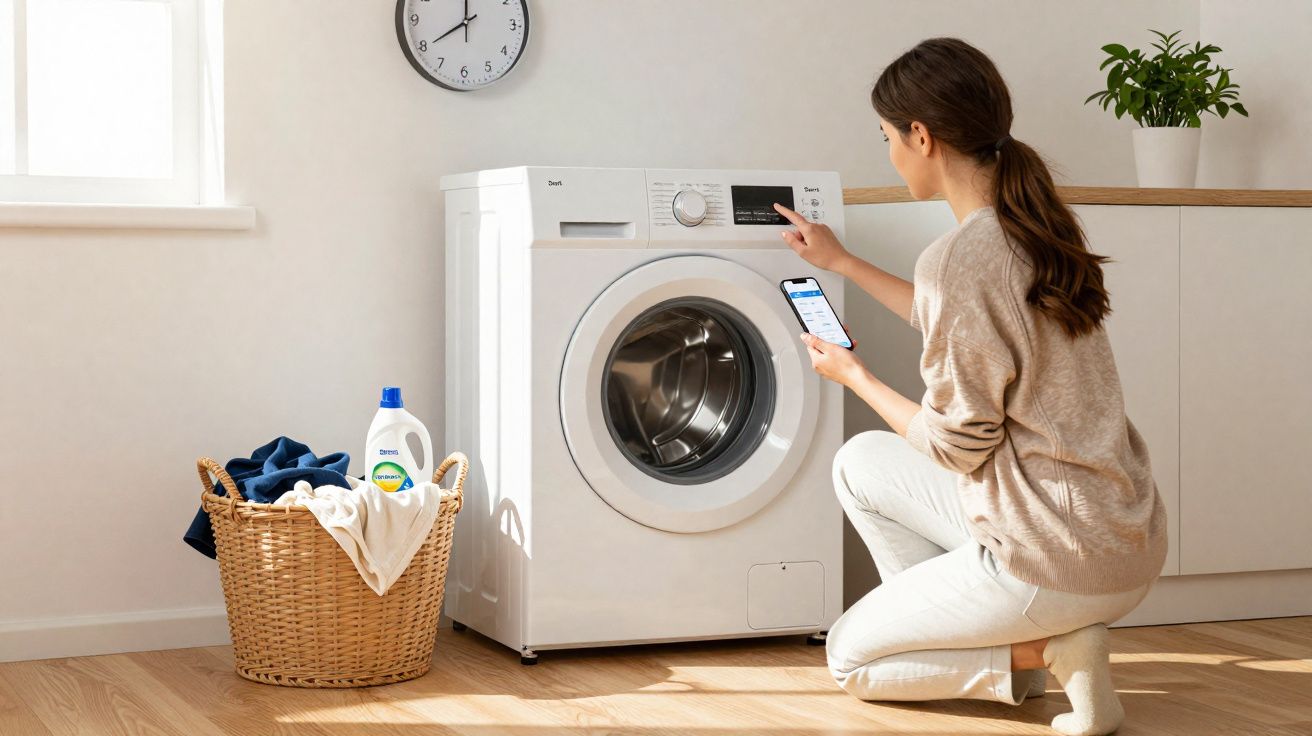
Many households underestimate how much the timing of a wash cycle can affect the electricity bill. If you plan your washing machine use more strategically, you can save money month after month while also taking pressure off the grid. And no: you do not need to sit in the dark or wash everything at 30 °C - it is mainly about timing and a few straightforward settings.
Why the time of day you run the washing machine suddenly matters
Electricity does not cost the same at every hour. With many time-of-use tariffs and modern pricing models, rates shift depending on how busy the network is. In the early evening in particular, lots of homes are drawing power at the same time: ovens and hobs, televisions, lighting, dishwashers - and, of course, the washing machine.
From late afternoon through late evening, electricity demand is at its highest - and washing during that window is often the most expensive choice.
The reason is simple: suppliers and network operators must deliver far more capacity during peak periods. Providing that extra power costs more and puts additional strain on the system. Those costs tend to filter through to households, either directly via higher unit rates (pence per kWh) or indirectly through rising standing charges and network costs over time.
When you should avoid switching the washing machine on
For most households, the most critical period sits in the early evening. Many network patterns and tariff structures point in the same direction:
- Highest demand: roughly 18:00 to 22:00
- Typical after-work peak: cooking, lighting and entertainment devices all run in parallel
- During the heating season: heat pumps or electric heaters may add extra load
If you start a wash during these hours, you are running straight into the day’s heaviest demand. That often means a higher price, and it can also increase your carbon footprint because peak demand is more likely to be covered by conventional power stations rather than low-carbon generation.
In practical terms: where you can, avoid running wash cycles during the core evening peak. Families and shared households that wash frequently usually notice the savings clearly after a few months.
The best times to wash cheaply (and still conveniently)
Outside the peak window, demand is typically lower - and many time-based tariffs reflect that with cheaper rates.
Electricity is often at its lowest price when most people are asleep: overnight and in the very early morning.
Typical low-cost windows across the day
Exact times depend on your supplier and plan, so it is worth checking your online account, app or smart meter portal. Commonly attractive periods include:
- Late evening: from around 22:00
- Overnight: roughly 23:00 to 05:00
- Early morning: approximately until 06:00
With time-of-use tariffs (for example, smart meter plans, dynamic electricity prices, or classic night-rate options such as Economy 7), the difference per kWh can be noticeable. If you shift your washing machine from the expensive evening band into a cheaper night window, the savings can add up across the year - often to double-digit sums, and in some households even more.
How to use cheap times without getting up in the night
Nobody wants to set an alarm for 02:00 just to press “Start”. Fortunately, you can usually automate it:
- Use the delayed start (start time delay): load the drum in the evening, then set it to begin overnight or early morning.
- Use a timer plug for older appliances: if your washing machine does not have a delayed start, a programmable plug can often do the job.
- Keep noise in mind: in homes with poor sound insulation, early morning may be kinder than the middle of the night if you want to avoid complaints.
One important practical point in flats and shared buildings: quiet hours may apply. A washing machine in a bathroom or a small flat can be surprisingly audible. In that case, a quieter eco programme, a lower spin speed, or running the machine in shoulder periods (for example, late morning or mid-afternoon) can still help you avoid the costliest peaks without falling out with neighbours.
Eco programme on your washing machine: longer cycle, lower cost
Most modern washing machines include a saving mode or eco programme. Many people ignore it or mistrust it because it takes longer - but it often reduces running costs significantly.
The eco programme usually cuts energy use even though it runs longer - the key is washing at a lower temperature.
Why eco programmes genuinely save energy
The biggest share of electricity in a wash cycle goes into heating the water. Lower the temperature and the energy requirement drops sharply. The machine compensates by washing for longer, but that extra time generally uses far less electricity than heating water to higher temperatures.
Common benefits of the eco programme:
- usually washes at 30 °C or 40 °C instead of 60 °C
- noticeably lower electricity use per cycle
- gentler on fabrics, so clothes keep their shape for longer
For everyday laundry with normal soiling, that is typically more than enough. Very hot washes are mainly useful for heavily soiled items or specific hygiene needs (for example, during illness or for some baby items) - and even then, not necessarily on every wash.
Reduce electricity use further with a few simple habits
Timing is only one lever. If you run your washing machine efficiently overall, you can cut consumption even more.
Choose the right load size and temperature
A quick check of the drum can pay off:
- Fill it well: a nearly empty drum can use almost as much electricity as a properly filled one - just do not ram-pack it so tightly that items cannot move.
- Lower the temperature: switching from 40 °C to 30 °C, or 60 °C to 40 °C, shows up quickly in energy use.
- Sort sensibly: wash heavily soiled items separately so you do not heat everything unnecessarily.
Regular maintenance also saves energy
A poorly maintained washing machine has to work harder. Build-up, blocked filters and limescale on the heating element all reduce efficiency.
- Clean the filter so water can circulate properly.
- Wipe the door seal to prevent mould and odours.
- Run an occasional 60 °C empty maintenance cycle with washing machine cleaner (or a small amount of concentrated white vinegar) to help prevent biofilm build-up.
A clean machine not only washes better; it is also more likely to perform close to the consumption figures quoted by the manufacturer.
Extra tip: think about spin speed and drying (often overlooked)
If you use a tumble dryer, your washing machine settings can affect total energy use. A slightly higher spin speed can remove more water, reducing drying time afterwards. If you air-dry on a rack, stronger spinning can also speed up drying - but balance that against noise and wear on delicate fabrics.
How much can you realistically save?
A washing machine usually accounts for a low single-digit percentage of a home’s overall electricity use, but it is still worth attention - especially in families or shared homes with frequent wash loads.
| Lever | Possible impact over a year |
|---|---|
| Using cheaper time windows | Depending on your tariff, several tens of pounds less in electricity costs |
| Consistently using eco programmes | Significantly lower energy use per wash cycle |
| Loading optimally | Fewer cycles needed, lower total consumption |
The best part is that these savings happen in the background. Once you adjust your routine, the reduced costs tend to continue automatically.
What changes with smart meters and dynamic electricity prices
With a smart meter and dynamic electricity prices, timing becomes even more influential. Some suppliers link your unit rate closely to wholesale market prices. In that kind of plan, it can be worth checking the app before you plan the next wash.
Typical strategies for these tariffs include:
- run the washing machine (and tumble dryer, if you use one) during hours when wholesale prices are low
- when prices spike - for example, on winter evenings - shift washing to another day if you can
- use smart home automation to start appliances automatically once the price falls below a chosen threshold
If you also have a photovoltaic system (solar PV), you may prefer to move wash cycles into sunny midday hours. In that scenario, the public tariff matters less than maximising self-consumption - run the washing machine when your roof is generating strongly.
More comfort through simple routines (and a sensible safety check)
To keep everything workable day to day, fixed habits help. For example: do the big wash on the same weekday, load the machine in the evening, and programme a delayed start for the night or early morning. That way you use cheaper periods without having to think about it.
One additional consideration: running appliances unattended can carry risks (leaks, vibration, or, very rarely, electrical faults). If you regularly use overnight cheap-rate periods, make sure the washing machine is level, hoses are in good condition, and the appliance is not overloaded. A little prevention keeps the savings stress-free.
If you take a deliberate look at your washing routine, you will often find that small changes lower more than just your electricity bill. Clothes last longer, laundry baskets pile up less often - and the quiet benefit of helping to reduce peak demand comes at no extra cost.






Comments
No comments yet. Be the first to comment!
Leave a Comment