
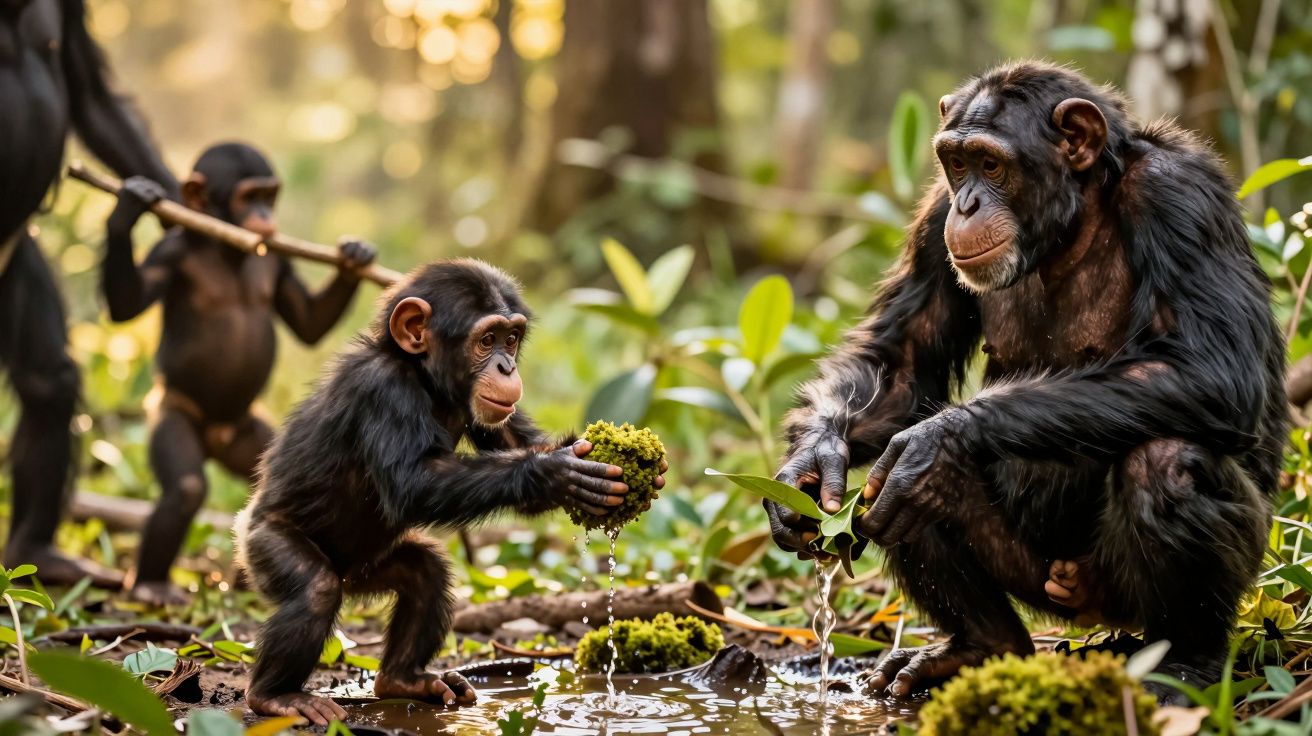
In Uganda’s rainforest, young chimpanzees are quietly reshaping what we think we know about how culture starts, spreads - and sometimes disappears.
After months of close observation, researchers saw far more than youngsters awkwardly copying adult routines. They recorded genuine firsts: fresh tools, altered gestures and inventive ways of tackling familiar challenges. These small-scale experiments by small bodies pose a large question about where culture truly begins - in apes and, by extension, in humans.
Young chimpanzees as cultural tinkerers, not miniature imitators
The old assumption that young animals are blank slates, simply soaking up adult behaviour, is looking less and less convincing. At Ngogo in Kibale National Park, Uganda, a team from the University of Montreal and collaborating institutions tracked immature chimpanzees for 15 months, noting every instance in which a youngster picked up or used an object.
Across the study period they recorded 67 object-use episodes involving 36 young chimpanzees. Strikingly, close to half of these actions - about 49% - did not align with the way adults at Ngogo typically used the same materials. That divergence is important: it suggests youngsters do not just learn rules; they also test and bend them.
These “odd” behaviours are not simply errors. They generate the variation from which new traditions can emerge.
Leaves, sticks, moss and stones became components in an ongoing, open-ended experiment. Rather than repeating a single familiar routine, juveniles mixed and matched elements, tried actions in new settings and explored unlikely uses - ranging from improvised toys to functional, make-do tools.
Their freedom is closely tied to their place in the social order. Juveniles are under less pressure to conform, adults are more tolerant of their fiddling, and failed attempts rarely carry serious consequences. That relatively safe space for trial and error effectively functions as a living laboratory for cultural change.
Three young chimpanzee behaviours that hint at advanced cognition
A moss “sponge” that beats the adult method
One of the clearest innovations came from a six-year-old female. Adult chimpanzees at Ngogo commonly make “leaf sponges”: they bunch leaves together, chew them slightly and then use the wad to soak up water for drinking. The youngster took a different route - and skipped the “manufacturing” stage.
She collected a ready-made clump of moss, dipped it and drank from it using moss’s naturally absorbent structure. No one had demonstrated this exact method to her. Instead, she drew on a known idea (using a sponge) and substituted a different, more efficient material.
The moss approach worked more quickly and held more water than the usual leaf sponge, yet it never became a local fashion.
That lack of spread highlights how delicate innovation can be in the wild. Even when a new method is clearly effective, it may be blocked by social factors. Status, who notices, and when an action is observed can determine whether a smart adjustment becomes a shared habit - or dies with the individual.
“Doll play” as practice for future motherhood
A second example involved a female scarcely a year old who began carrying a tree trunk as though it were an infant. She held it close, shifted her grip and transported it in ways that resembled maternal handling of real babies.
This “doll play” has been reported in other chimpanzee communities, but it had not been documented at Ngogo. Its appearance there suggests some behaviours may repeatedly re-emerge without direct copying from a local model. Although it looks like simple play, it may also serve a developmental purpose.
By practising on a log, the youngster appears to rehearse the posture, timing and coordination needed for later infant care. In that sense, pretend caregiving may form an emotional and cognitive bridge between playful exploration now and parental responsibility in the future.
Repurposing a social signal to request a piggyback
The third case involved an existing signal used in a new way. Adult chimpanzees use “leaf-clipping” - tearing pieces from a leaf to make a distinctive, audible ripping sound - to draw attention, often in social or sexual contexts.
A young male used leaf-clipping differently. Instead of using it as a display, he performed it in front of his mother as a request: he wanted to be carried. She responded by picking him up.
Reusing a shared signal for a new purpose suggests the youngster understood both how the signal works and how its meaning can be shifted.
This kind of change looks more like cognitive flexibility than rote copying. The juvenile seemed to grasp a simple social mechanism (sound plus audience can produce a reaction) and then applied it with a different goal in mind - essentially solving a problem using a “social tool”.
Why some young chimpanzees invent more than others
Measuring curiosity: identifying the “high explorers”
Not all youngsters behaved like frequent innovators. To explain the variation, the researchers created an “exploration index” combining several measures:
- how often the individual used objects
- how many different kinds of objects they tried
- the proportion of their actions that were atypical
- how early in life these behaviours appeared
- the length of time the chimpanzee was observed
A distinct subgroup stood out: nine youngsters - five females and four males - scored far higher than the rest. They handled more objects, used them in more ways and departed from adult norms more often. The researchers described these individuals as “high explorers”.
Two influences helped shape these profiles: sex and maternal experience. Young females were generally more exploratory than young males, matching other research in which females acquire skills such as termite-fishing earlier.
Youngsters whose mothers had previously raised infants also scored higher. These experienced mothers appeared more tolerant when juveniles grabbed, broke or played with objects nearby, effectively creating the conditions for more experimentation.
Innovation grows from both temperament and setting: a curious youngster supported by a patient, permissive social environment.
Social scaffolding - and the cultural ceiling
By contrast, “low explorers” largely stayed within the adult script. They did copy what they saw, but seldom altered it. Their object use could look capable, yet remained relatively narrow, with few attempts to adjust, remix or repurpose techniques.
This pattern echoes ideas in human developmental psychology: children who have more freedom to try, fail and tinker often go on to develop broader problem-solving abilities. The chimpanzee evidence suggests similar dynamics are not uniquely human.
However, even bold young chimpanzees run into a social ceiling. Innovations often stall if they come from low-status individuals or happen away from influential observers. Without the right audience, new behaviours remain private trials rather than becoming shared traditions.
Two theories for how ape culture advances
Latent solutions versus guided opportunities
The Ngogo observations sit within a broader debate in primatology about how culture is transmitted and transformed. Two leading concepts are the “zone of latent solutions” and the “zone of proximal acquisition”.
| Concept | Core idea | What the Ngogo study suggests |
|---|---|---|
| Zone of latent solutions (ZLS) | Individuals can rediscover certain behaviours independently through trial and error, without precise imitation. | The moss sponge and doll play fit this: no adult model performed those exact actions in front of the youngsters. |
| Zone of proximal acquisition (ZPA) | Social surroundings shape when and how behaviours emerge by providing opportunities, materials and models. | Access to tolerant mothers and exposure to adult tools clearly framed what juveniles could attempt and adapt. |
In practice, both forces probably operate at once. A juvenile may produce a new behaviour alone - but only within a toolkit, environment and social world created by the group. Adults show what is available; youngsters push at the boundaries.
Why most bright ideas never become traditions
The Ngogo examples reinforce a basic reality: inventing something does not ensure it will persist. For an innovation to become a stable cultural trait, it must be seen, understood and repeated by others.
Factors that appear to influence the leap from individual quirk to shared custom include:
- who performs the behaviour (young or low-status chimpanzees may draw less attention)
- how frequently others can observe it
- whether the benefit is clear to onlookers
- how easily it slots into existing routines
This bottleneck may help explain why chimpanzee cultures vary across populations but rarely show the steady, layered accumulation typical of humans. New behaviours appear, flicker briefly - and often fade before they can be embedded in group memory.
What the Ngogo chimpanzees suggest about human cultural evolution
Humans are distinctive for cumulative culture: each generation adds improvements to what came before, from stone tools to smartphones. Chimpanzees, in comparison, display cultural diversity without long chains of refinement.
The Ngogo study suggests the psychological roots of our cultural capacities may begin with something simple: curious youngsters being allowed to experiment.
The similarities between young chimpanzees and human children are hard to miss: long developmental periods, a strong drive to play, social tolerance for clumsy attempts, and continual exposure to others’ skills. Together these look like general ingredients for innovation, not a uniquely human oddity.
The key difference appears later - in how groups capture and preserve new ideas. Human communities use teaching, language, stories and technologies such as writing or video to stabilise innovations and transmit them widely. Chimpanzees depend largely on observation, so many promising inventions disappear when the innovator dies, migrates or simply stops performing the behaviour.
Going further: what “innovation” means in animals
In animal behaviour research, “innovation” typically refers to actions that arise spontaneously, differ from the local norm and achieve a practical aim. It need not be dramatic. A small change - how a tool is held, when a signal is deployed - can count if it alters efficiency or outcome.
Among chimpanzees, many innovations surface during play. A youngster that bangs sticks “for fun” may stumble upon a technique useful for cracking nuts. A playful tug at vegetation might reveal a new edible source. Play offers low-risk conditions: the cost of doing something odd is small, while the potential payoff can be substantial.
It is also worth reflecting on how many everyday human habits may have begun the same way: an alternative knot, a quicker route, a toy invented out of boredom - playful deviations that later became normalised as tradition.
Extra perspective: the role of relationships and attention in chimpanzee culture
The Ngogo findings also point to a subtle driver of cultural transmission: attention. In chimpanzee communities, who watches whom matters greatly. A clever technique performed in the wrong place, at the wrong time or by an individual others tend to ignore may never be copied, regardless of its usefulness. In that sense, chimpanzee culture is shaped not only by intelligence and opportunity, but by the social dynamics of prestige, proximity and daily association.
Conservation caution: losing youngsters can mean losing culture
Finally, the results raise a conservation warning. If communities lose juveniles through disease, hunting or habitat disruption, they may be losing more than future breeders. They may also be losing a major engine of cultural renewal. Protecting primate populations - particularly youngsters and experienced mothers - does not merely preserve numbers; it helps maintain the social conditions under which new ideas can arise at all.






Comments
No comments yet. Be the first to comment!
Leave a Comment