
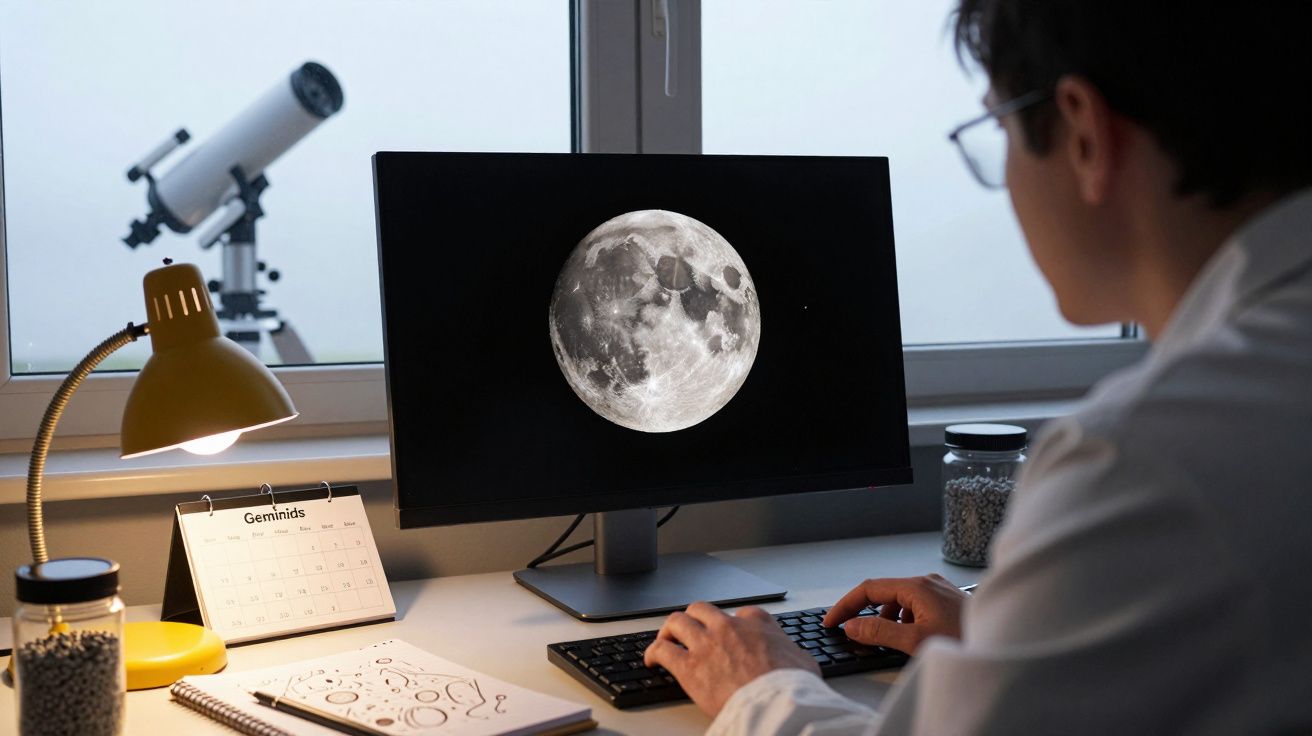
That momentary glint came from the Moon’s far darker hemisphere, turning an otherwise ordinary monitoring run into a real scientific conundrum. Scientists are now combing through the footage frame by frame to pin down what the split-second burst of light can tell us about the steady drizzle of space debris passing through our neighbourhood.
A lunar impact flash at Armagh Observatory: a blink-and-you-miss-it moment
At 03:09 UTC on 12 December 2025, a tiny point of light flared on a live video stream at Armagh Observatory in Northern Ireland. PhD researcher Andrew Marshall‑Lee was using a robotic telescope to watch the Moon’s night side when the image brightened for only a fraction of a second.
The flash appeared close to the lunar crater Langrenus, about 2° to the north‑east of the crater’s rim. Nothing crossed the field of view that could explain it: no spacecraft, and no obvious camera artefact in the raw data. The signature instead fits what observers call a lunar impact flash-the instant a fast-moving fragment strikes exposed regolith and converts momentum into heat and visible light.
For less than the time it takes to blink, a fragment only a few centimetres across released energy comparable to a large conventional bomb.
Initial calculations indicate the incoming body was roughly 3–5 cm in diameter. Even so, it likely hit at about 35 km/s, a speed consistent with debris associated with the Geminid meteor shower. At that velocity, the kinetic energy is huge relative to the object’s mass. On impact, rock and dust at the strike point would have heated and vaporised almost immediately, producing a short-lived luminous plume that registered as a crisp, brief flash.
This observation has already earned a small place in the record books. It is the first confirmed impact flash ever captured from the island of Ireland, and only the second documented from anywhere in the British Isles. For the professionals and dedicated amateurs who monitor these events at unsociable hours, a single verified detection represents a lot of patient, painstaking work.
What a tiny collision tells us about an airless world
Because the Moon has no meaningful atmosphere, it has little protection. On Earth, most meteoroids burn up as they pass through the air; on the Moon, the vast majority reach the ground unimpeded. Even dust grains can behave like high-speed projectiles because nothing slows them down.
When one of these fragments strikes the lunar surface, the physics plays out in a stark sequence: the incoming body compresses the ground, temperatures spike, material melts and vaporises, and an expanding cloud of incandescent ejecta forms around the impact site.
These flashes function like real-time seismographs for the near‑Earth environment, logging small debris that Earth’s atmosphere would otherwise conceal.
Although lunar flashes happen far more frequently than we capture them, recording one requires several conditions to align:
- The impact has to occur on the hemisphere facing Earth.
- The target area must be in darkness, well away from the glare of the sunlit crescent.
- The observing site needs clear skies, and the Moon must be sufficiently high above the horizon.
- High-sensitivity, high-frame-rate cameras must run continuously and save large volumes of video.
- Someone must either inspect the recordings or rely on algorithms to flag suspect pixels.
If any part of that setup fails, a genuine strike can pass unnoticed. This is why the 12 December detection can be described as both commonplace and exceptional: impacts themselves are routine, but catching one in the right place at the right time can still feel like winning a scientific lottery.
The Geminids: a meteor shower with an unusual parent body
The timing of the flash strongly suggests a link to the Geminid meteor shower, which peaks each year in mid‑December. Unlike many showers that originate from dusty comets, the Geminids are associated with a peculiar object: 3200 Phaethon.
In appearance, Phaethon resembles an asteroid more than a classic icy comet. Even so, its orbit and observed behaviour point to a hybrid identity. When it swings close to the Sun, intense heating can crack its surface and shed streams of rocky material. Over millennia, those fragments have spread out along the same path, forming the Geminid stream.
From Earth, Geminids are often seen as relatively slow, bright meteors that can leave lingering trails, and many skywatchers rate them as one of the year’s most dependable displays. Yet only a portion of the stream intersects Earth’s atmosphere; other fragments pass slightly above or below our planet’s path and can instead cross the Moon’s orbit.
Pieces that miss Earth do not disappear-they can end up with the Moon directly in the firing line, quietly registering near misses that our atmosphere deals with on our behalf.
During the Geminids, the rate of lunar bombardment increases, giving sites such as Armagh Observatory a ready-made natural experiment: watch the Moon, count impact flashes, and compare those counts with meteor-camera detections in Earth’s skies. Those comparisons allow researchers to estimate how dense the debris stream is and how its intensity varies from year to year.
Why scientists pay attention to such a small impact
One brief flash may sound insignificant, but it informs practical questions with implications well beyond pure research. Space agencies are preparing for long-duration activity on and around the Moon-from NASA’s Artemis programme to commercial robotic landers-and every rover, lander and habitat will spend years exposed to micrometeoroid impacts.
For engineers, averages are not enough. Risk assessments depend on real rates: how many objects strike a square metre of lunar surface each year, what speeds they arrive at, and how those impacts are distributed across size ranges. Impact flashes are especially valuable for constraining the population of particles too small to leave craters that orbital cameras can readily resolve.
| Impact property | Why it matters |
|---|---|
| Size of incoming object | Helps gauge whether a fragment could puncture habitat walls or compromise spacesuit layers. |
| Impact speed | Determines the energy released and how deeply damage propagates below the surface. |
| Frequency of flashes | Improves estimates of long-term degradation of solar panels and exposed instruments. |
| Location on the Moon | Indicates whether certain regions-or certain orbital geometries-face heavier bombardment. |
By linking flash brightness to physical models, researchers can work backwards to estimate impact energy, and from that infer the projectile’s mass and approximate size. As catalogues grow to hundreds of detections, they begin to describe the real micrometeoroid environment-not only near Earth, but throughout cis‑lunar space.
A further, closely related benefit is calibration across observing networks. When multiple stations use consistent timing, photometric reference stars and agreed reporting formats, impact flash datasets become far more comparable-making year-on-year trends (such as changes in the Geminid stream) much easier to confirm statistically.
How automated telescopes turn chance events into usable datasets
The Armagh detection also underlines how quickly observatories are moving towards automation. The robotic telescope that recorded the flash can patrol the Moon’s night side for hours with minimal human oversight: software maintains tracking and focus, logs the data stream, and later highlights candidate events for review.
That workflow dramatically raises the effective detection rate. A person watching a grey lunar disc for whole nights is likely to miss faint, sub-second blips. Algorithms do not blink: they compare consecutive frames pixel by pixel and trigger alerts when the change matches the expected profile of an impact flash.
Human scrutiny remains essential, however. Detector noise, satellite glints and atmospheric scintillation can all mimic flashes. Researchers including Marshall‑Lee assess each candidate’s timing, shape and position, cross-check against satellite databases, and filter out artefacts. Confirmed events are then uploaded to shared international catalogues used by teams across Europe, the US and Asia.
What this means for future Moon missions
As plans develop for sustained operations at the lunar south pole and for long-term staging in trajectories such as Near‑Rectilinear Halo Orbit, these measurements take on direct operational relevance. Engineers can test multilayer insulation, inflatable habitat fabrics and dust-resistant coatings using laboratory impact facilities, but real lunar conditions are still needed to validate those tests.
If monitoring reveals higher-than-expected impact rates in particular orbital bands, mission planners may refine trajectories or adjust schedules to reduce exposure. Similarly, landers could avoid periods of heightened meteor activity-such as the Geminid peak-for critical phases including docking, surface deployment and astronaut extravehicular activity.
On the surface, crews are likely to use personal radiation and micrometeoroid monitors, while base infrastructure may incorporate acoustic or vibration sensors that detect the faint “pings” of impacts. Comparing those in-situ records with ground-based lunar impact flash observations helps connect what we see from Earth with what hardware experiences on the Moon, strengthening confidence in both datasets.
How you could spot similar flashes from home
Although the Armagh observation relied on professional facilities, experienced amateurs already make meaningful contributions to lunar impact science. With a modest telescope and a sensitive video camera, it can be possible to detect flashes-particularly during strong meteor showers when the impact rate rises.
Typically, observers aim at the Moon’s dark limb close to the bright crescent and record at standard video rates or higher. Software then searches the footage for single-frame or multi-frame bursts. When observers in different regions independently record the same flash, the likelihood that it represents a genuine impact increases markedly.
This kind of citizen science also helps address gaps in coverage by longitude. As Europe rotates out of view, North American observers can continue monitoring, followed later by Asia and Oceania. With shared procedures and standardised reporting, amateur detections can be incorporated into professional models of the impact environment.
Going deeper: what a lunar regolith impact really involves
The material struck in these events is lunar regolith-a loose blanket of dust and broken rock produced by billions of years of impacts. Unlike Earth soil, it is scarcely altered by weathering. Its grains tend to be sharp-edged, and electrostatic effects can make the dust cling stubbornly to surfaces.
When a meteoroid hits regolith, it excavates a small crater and ejects material in a characteristic pattern: a central pit, a surrounding zone of melt, and outward-sprayed debris rays. For very small impacts, these structures fall below the resolution of orbiting cameras, so researchers rely on modelling, simulations and laboratory experiments to understand the details.
In the lab, small projectiles are fired into dusty targets under vacuum, while ultra-high-speed cameras capture both the flash and the expanding plume. By comparing controlled experiments with real detections like the Armagh event, scientists refine estimates of how bright a given impact should appear from Earth. Better brightness calibration, in turn, improves the size and energy estimates assigned to real lunar collisions.
As more events are logged, researchers can tackle difficult questions: How much fresh dust do present-day impacts add to the regolith each year? How quickly might they soften or erase footprints and rover tracks? Could a local surge in micrometeoroids reduce visibility for landers that depend on optical navigation?
For the moment, that faint flash in December is a pointed reminder that the Moon is not a static relic, but an active target in a crowded region of space. Each tiny scar traces the paths of debris streams that also sweep past Earth-usually unseen, thanks to the shielding atmosphere we live beneath.






Comments
No comments yet. Be the first to comment!
Leave a Comment