
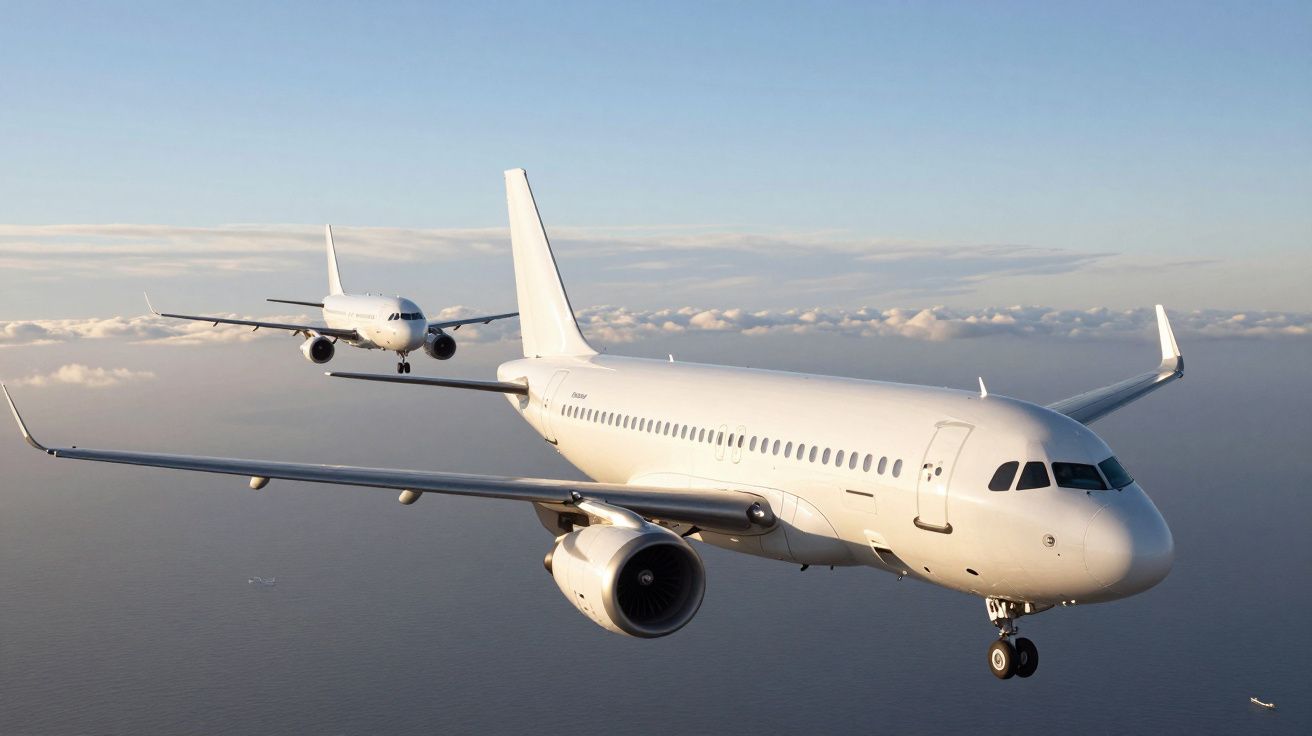
High over the North Atlantic this autumn, two wide-body airliners edged towards the same unseen point in the sky, relying on calculations, discipline and exceptionally calm cockpit decision‑making.
What appeared to be a standard long‑haul sector was, in fact, a discreet step change in how flights can be managed: Airbus, working with several airlines, demonstrated that two aircraft can be timed to reach one waypoint at precisely the same moment at cruise altitude-while staying fully within today’s air traffic control rules.
A quiet milestone above the North Atlantic
Between September and October 2025, Airbus carried out eight test flights across the North Atlantic. The aim on every sortie was unambiguous: guide two commercial aircraft to a shared waypoint at the same second, without departing from existing air traffic control procedures.
On paper, synchronising two flights can sound straightforward. In operational reality-jet streams, flow restrictions and strict separation standards-it is anything but. Long‑haul crews routinely adjust speed and, at times, routing to manage winds, traffic and workload, and a minor change can push timing out by minutes.
Two commercial airliners reached a single point at cruise in a coordinated way, while keeping to normal separation rules and established procedures.
The reason this matters is equally clear. That level of timing accuracy is a prerequisite for an efficiency concept airlines have wanted for years: wake energy retrieval, referred to within Airbus as the fello’fly project.
The principle is inspired by migrating geese. One aircraft flies slightly behind and offset from another, placing itself in the rising airflow created by the lead aircraft’s wingtip vortices. With that extra lift, the following aircraft can reduce thrust and burn less fuel-Airbus is targeting savings of up to about 5% on long‑haul routes.
A further reason the North Atlantic is an ideal proving ground is its highly structured oceanic environment. With fewer tactical interventions than many continental sectors-and with predictable routing frameworks and separation requirements-the region allows controlled experimentation while still reflecting the complexity of real airline operations.
How wake energy retrieval works in practice
Wake energy retrieval does not involve flying “too close for comfort”. The following aircraft remains at safe distances, but aims for a defined “sweet spot” inside the lead aircraft’s wake where the airflow provides beneficial lift. Less lift required from the wing means less thrust required from the engines.
The ambition is roughly a 5% fuel reduction on long‑haul services-without changing airframes or engines, simply by operating in a smarter paired configuration.
In commercial terms, 5% is substantial. On a single transatlantic rotation, it can equate to several tonnes of fuel saved. Across an entire fleet over a year, that becomes tens of thousands of tonnes of kerosene not burned, along with the corresponding reduction in CO₂ emissions.
Based on the latest IPCC estimates, aviation accounts for roughly 1% of global CO₂ emissions. Pressure to decarbonise continues to intensify, particularly on long‑haul routes where short‑range electric aircraft do not offer near‑term solutions. Concepts such as wake energy retrieval are designed to extract additional efficiency from today’s jets while the sector waits for more transformative advances.
An Atlantic‑scale rehearsal: airlines and controllers working as one
Airlines, air traffic control and the Pairing Assistance Tool (PAT)
To move from theory to practice, Airbus assembled a group that resembled a multinational operational exercise more than a simple flight trial. Air France, Delta Air Lines, French bee and Virgin Atlantic provided aircraft and crews. Air traffic control organisations also took part: AirNav Ireland (Ireland), DSNA (France), NATS (the UK), and the pan‑European network manager EUROCONTROL.
A useful analogy is two cyclists approaching the same hairpin on a mountain descent. Each cyclist speaks to their own support vehicle; similarly, each pilot communicates with their own controller. Clearances and constraints remain separate-yet both aircraft still need to arrive at the same bend in the sky at the same instant, without any rules being stretched.
For flight crews, the key innovation was Airbus’s Pairing Assistance Tool (PAT). This software module continually evaluates both flights’ optimal trajectories and proposes speed and routing changes to synchronise arrival time at the rendezvous waypoint.
Rather than trying to “chase” the other aircraft’s present position, PAT aims for where that aircraft will be minutes ahead. In effect, it functions like a high‑precision navigator that guides one flight towards the future position of another, factoring in winds, planned flight levels and operational constraints.
- PAT identifies a feasible pairing between two flights.
- It recommends speed and routing changes for both crews.
- Controllers accept or decline those proposals against traffic and safety requirements.
- The calculations refresh continuously as conditions evolve along the route.
On the ground, controllers coordinated using a dedicated interface. Importantly, every clearance stayed within standard safety margins and vertical separation rules. The trial did not rely on regulatory exemptions; it deliberately operated inside the existing framework-an essential condition if the concept is ever to work in normal traffic rather than only in tidy simulations.
An additional operational consideration is data integrity. As pairing depends on precise trajectory information, airlines and air navigation providers will need robust data governance, resilient communications and careful cybersecurity controls to ensure that timing and intent data cannot be corrupted or misunderstood.
A four‑step protocol designed to keep risk tightly managed
The flight trials confirmed a disciplined, repeatable process:
| Step | What happens |
|---|---|
| 1. Computation | PAT produces revised trajectories for both aircraft, including a shared rendezvous point and an exact time. |
| 2. Validation | Airlines, flight crews and air traffic control review the proposal for feasibility and safety. |
| 3. Flight plan update | Under normal procedures, one aircraft amends its flight plan to converge towards the other. |
| 4. Cockpit commitment | Both crews enable a cockpit function that commits the aircraft to meet the shared waypoint at the agreed time. |
The rendezvous must be accurate to seconds and nautical miles, but never at the expense of safety buffers. Vertical separation remains standard, and lateral and longitudinal spacing continue to follow today’s rules. Airbus’s current focus is on shaping and timing trajectories reliably; the closer paired phase comes later.
From birds to algorithms: wake energy retrieval, fello’fly and the maths behind it
Turning geese behaviour into predictable procedures
Geese reduce energy expenditure by rotating the lead position and exploiting each other’s upwash in a V formation. Airbus’s goal is to recreate the efficiency gain in jet operations using physics, automation and strict procedures rather than instinct.
When a large aircraft flies, vortices form at the wingtips (and around winglets on many types). These vortices create areas of rising airflow to either side of the leader’s path. A following aircraft, positioned correctly and slightly offset, can benefit from that lift and reduce thrust.
Paired operation in commercial service will not resemble military formation flying. Separation remains large enough to preserve comfort, redundancy and operational tolerance.
The challenge is precision with margins: placing the following aircraft in the beneficial upwash while leaving controllers ample room to manage traffic. Wind shear, turbulence, traffic density and procedural constraints limit how tight any pairing can be. Airbus’s position is that, with sufficient data and appropriate automation support, the following aircraft can remain in a safe, stable zone where the benefit is repeatable.
Crucially, these recent flights did not yet enable the wake energy gain itself. They demonstrated the prerequisite capability: bringing two genuine commercial flights together in a controlled way, setting the stage for future formation phases. It is comparable to aligning railway carriages carefully before attempting the first coupling.
SESAR, GEESE and a broad partner network
fello’fly is part of a wider ecosystem. In Europe, the SESAR programme (Single European Sky ATM Research) supports multiple initiatives covering wake operations, new procedures and automation. One of these, GEESE, involves a substantial consortium that includes Boeing, ENAC, Indra, CIRA, DLR, Bulatsa, Frequentis, UAB, Oro Navigacija, WaPT, UCLouvain and others.
The implication is straightforward: wake‑based eco‑flight will only be viable if aircraft manufacturers, airlines and air navigation service providers align. Procedures need international acceptance rather than one‑country endorsement. Data links between aircraft-and between aircraft and control centres-must carry extra layers of intent and coordination information without adding ambiguity to already demanding operations.
Lower‑carbon flight is not a single‑solution problem
Aviation’s multi‑track transition
Wake energy retrieval adds a new operational “tile” to aviation’s decarbonisation approach, but it cannot do the job alone. The sector is already investing across several complementary routes:
- Sustainable aviation fuels (SAF), which can reduce lifecycle CO₂ emissions by up to about 80%, depending on feedstock and production pathway.
- New‑generation engines with higher bypass ratios and improved aerodynamics, lowering fuel burn on every flight.
- Lighter airframes, enabled by composites, cabin redesign and more efficient onboard systems.
- Hybrid‑electric and fully electric aircraft for regional missions and emerging air mobility concepts.
- Hydrogen propulsion, via combustion or fuel cells, as a possible zero‑CO₂ long‑term option.
No single technology balances aviation’s climate ledger. Improvements add up: more efficient engines, cleaner fuels, smarter operations-and, in the case of fello’fly, aerodynamic cooperation between flights that previously operated entirely independently.
What comes next for Airbus and fello’fly
From timed rendezvous to genuine wake energy retrieval
The next logical step is to conduct commercial‑style missions that include real energy‑recovery segments. That means the following aircraft will transition into the leader’s wake “sweet spot” while passengers remain seated-ideally unaware of the precise geometry being managed outside.
Engineers will track several practical measures:
- Verified fuel savings across complete flight profiles.
- Effects on flight time and dispatch flexibility.
- Ride comfort and turbulence levels in the following aircraft.
- Controller workload and radio traffic, particularly in busy airspace.
Operational realism will be as decisive as aerodynamic promise. Airlines will not embrace a 5% fuel reduction if it routinely triggers delays or constrains capacity on key routes. Equally, controllers are unlikely to support procedures that add complexity to the North Atlantic, one of the world’s most carefully managed corridors.
A further practical dimension is passenger and crew confidence. Even if separations remain fully compliant, airlines may need clear internal guidance on how paired operations are communicated, monitored and-when necessary-discontinued, ensuring comfort perceptions and safety culture remain strong.
New questions on risk, training and responsibility
As formation‑style operations approach day‑to‑day use, regulators and insurers will face fresh questions. If the following aircraft experiences a wake‑related upset, where does responsibility sit? How do pilots train for infrequent but high‑consequence moments when they must exit the wake benefit immediately? What happens if one aircraft needs to divert mid‑ocean while it is paired with another?
Simulation will be central. Full‑flight simulators can reproduce wake geometry and turbulence effects so crews can practise both normal and abnormal situations. Air traffic simulations can pressure‑test procedures under heavy demand, diversions and weather deviations, examining how fello’fly behaves in real operational disorder.
The concept also connects to other operational strategies. Dynamic pairings could potentially optimise not only fuel burn but also contrail impacts by encouraging altitudes and tracks that reduce persistent contrails, which contribute to aviation’s non‑CO₂ climate effects. Over time, AI‑assisted dispatch systems might even match flights across different airlines so wake benefits can be shared within alliances-or, potentially, between competitors.
For now, the lasting image is uncomplicated: two jets in open airspace above the Atlantic, arriving at the same point at the same time-not by coincidence, but by deliberate design. That small change in how flights meet could ultimately influence how they travel together around the world.






Comments
No comments yet. Be the first to comment!
Leave a Comment