
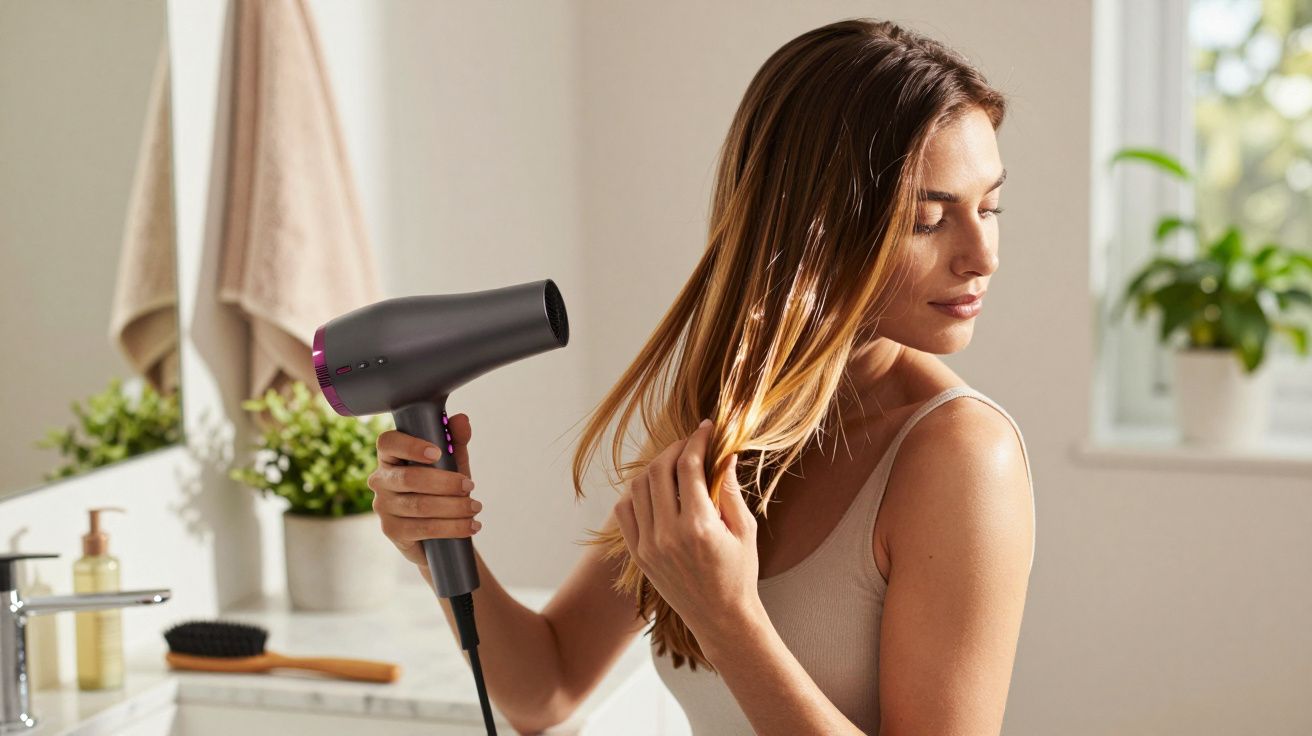
The woman in the gym changing-room loo looked completely drained. In one hand she clutched a latte; in the other she fought with a round brush, firing hot air at her hair as if the rest of her day depended on it. Then, right before she left, she did something quietly brilliant: she switched her hair dryer to the cool setting and slowly worked over each section, almost as though she were hitting “save” on a file.
When she walked out, her blowout didn’t look like “just been to the gym” hair. It looked like she’d stepped out of a salon-glossy, smooth and springy. A couple of hours later I spotted her again in the café downstairs. Same hair, same shine, and not a frizz halo anywhere.
Most people never press that cool button. And that means they may be missing the most valuable part of their dryer.
Why the hair dryer cool button changes everything
Spend a few minutes watching how people dry their hair and you’ll see the same habit again and again: maximum heat, maximum speed, straight from dripping wet to “I’m already late”. The cool setting sits there like a decorative extra-nice in theory, ignored in real life.
Stylists, though, treat it like a finishing tool, not a novelty. They understand that blow-drying isn’t only about removing water; it’s about building shape, shine and movement. Heat does the shaping. Cool air is what makes it last.
If you’ve ever had hair that looked flawless in the mirror but fell apart by lunchtime, you’ll know the pattern: volume sinks, ends puff up, and a sleek blowout turns merely… fine. In a 2023 survey by a professional hair brand, 7 out of 10 women said their styling “didn’t last the day.” Most pointed the finger at humidity, products, or “bad hair”.
Hardly anyone suspects the final half-minute with the dryer. Yet those quiet seconds-finishing on cool air-often decide whether your style survives your commute or gives up in the lift.
There’s a straightforward reason it works. When you apply heat, you temporarily change the bonds inside the hair fibre, which is why you can smooth waves straighter or encourage a curl to sit where you want it. While the hair is still warm, it remains more pliable. As it cools, it firms up in that new position.
Using the cool setting speeds up that “set” moment in a controlled way. It also helps the cuticle (the outer layer of each strand) lie flatter. Flatter cuticles reflect light more evenly-this is the high-gloss shine people often chase with serums, sprays and filters. In short: heat creates the style; cool locks it in.
How to use the cool setting like a stylist (without guessing)
Change one habit first: don’t end your blow-dry on hot. When your hair is nearly finished-around 90% dry and already shaped the way you want-that’s the point to switch.
- Flick the dryer to the cool setting (the cool button/cold shot).
- If your dryer allows it, lower the airflow slightly.
- Work in sections from roots to ends, using a brush (or your fingers) to hold the hair in the position you want while the cool air passes over it.
Think of it less like blasting leaves and more like setting a glaze: steady, deliberate, and controlled.
To smooth and polish lengths, keep the nozzle aimed down the hair shaft and follow your brush from root to tip, staying on cool air and keeping the direction consistent. For root lift, raise small sections and aim the cool airflow underneath, then let the hair sit lifted for a few seconds so it cools in that position.
Let’s be honest: almost nobody does this perfectly every day. Life is busy. But even one or two intentional cool passes over the top layer can make your hair look noticeably more “finished”-the sort of result people pay for.
The two timing mistakes that make people think it “doesn’t work”
- Switching to cool too early: If your hair is still quite wet, the cool setting will feel slow and pointless. The cool setting is a finishing step, not your main drying mode.
- Rushing the cool-down: Hair needs a brief moment to cool while it’s held in shape. If you fly over it at top speed, you don’t give the style time to set.
A London stylist once put it like this:
“Heat is the rehearsal; cool is opening night. Miss opening night and nobody sees the work.”
If you prefer a simple framework, use this:
- Hot: shape and smooth
- Warm: finish drying to roughly 90%
- Cool: set the style and seal the shine
Making shine and all-day hold part of real life (not just a trend)
On a rushed Tuesday in a steamed-up bathroom, it’s easy to treat that little snowflake icon as optional. But “cool to set” isn’t just a TikTok trick or stylist folklore-it’s a small, repeatable habit that works with the way hair actually behaves.
Finishing with cool air also means you spend less time on the highest heat, which is kinder over the long run. Less cuticle stress can mean less puffiness, fewer snapped ends, and fewer frazzled bits masquerading as “layers”. Your hair in six months’ time benefits from the 30 seconds you add today.
It’s also oddly calming. The sound changes. Your scalp stops feeling cooked. You can feel what your hands are doing rather than simply trying to get it over with. That tiny pause can act like a reset for you as well as your hair.
Extra tips that make the cool setting work even harder
If you want to get more out of the cool button without adding time, try one of these:
- Prioritise the “visible” areas: Cool-set your fringe and the front sections that frame your face. Those pieces sell the whole look.
- Use attachments properly: A concentrator nozzle improves smoothness because it directs airflow along the cuticle. A diffuser is better for curls-use heat to form, then a brief cool blast to help the curl pattern hold.
- Let hair settle before going outside: If it’s cold, windy, or drizzly, give your hair 30–60 seconds indoors after cool-setting. That reduces the chance of the style being disturbed while it’s still “freshly set”.
If you dislike hair “rules”, this isn’t really one. It’s closer to using the final step of a routine you already have. Same tool, smarter finish. The cool setting stops being a mystery button and becomes a quiet insurance policy.
You don’t need to do the full hot-then-cool routine every time. Save it for meeting days, evenings out, or whenever you want maximum all-day hold. Or just cool-set the top layer for shine. Either way, run this experiment tomorrow: don’t put the dryer down while your hair is still warm. Finish on cool once and see whether anyone asks what you changed.
| Key point | Detail | Benefit for the reader |
|---|---|---|
| Cool air sets the shape | The internal bonds in the hair stabilise as the hair cools in a given position | A style that lasts into the evening without overdoing hairspray |
| Smoother cuticle | Cool air helps the cuticle lie flatter and “close down” | More visible shine, even on dull or coloured hair |
| Less heat stress | Less time spent on the highest heat setting | Better long-term condition and fewer straw-like ends |
FAQ
Should I use the cool setting every time I dry my hair?
Not necessarily from day one. Use it on days you style with heat or when you want your hair to last. Many people end up using the cool button most times once they see the difference.Do I need special products for the cool-air trick to work?
No. A basic heat protectant is enough. Styling creams or mousse can add hold, but the cool-down step improves shine and staying power even on its own.How long should I spend on the cool setting?
Usually 30 to 90 seconds is plenty. Focus on the roots for volume and the outer layer for shine rather than trying to cool every strand perfectly.Will the cool setting make my hair look flat or stiff?
Used correctly, it tends to do the opposite. It locks in the movement you created with heat, so curls stay bouncy and blowouts stay light instead of collapsing.What if my dryer doesn’t have a separate cool button?
Finish on the lowest heat and lowest airflow you have, then let your hair sit undisturbed for a minute before heading out. You’ll get a similar “setting” effect even without a dedicated cold-shot feature.



Comments
No comments yet. Be the first to comment!
Leave a Comment