
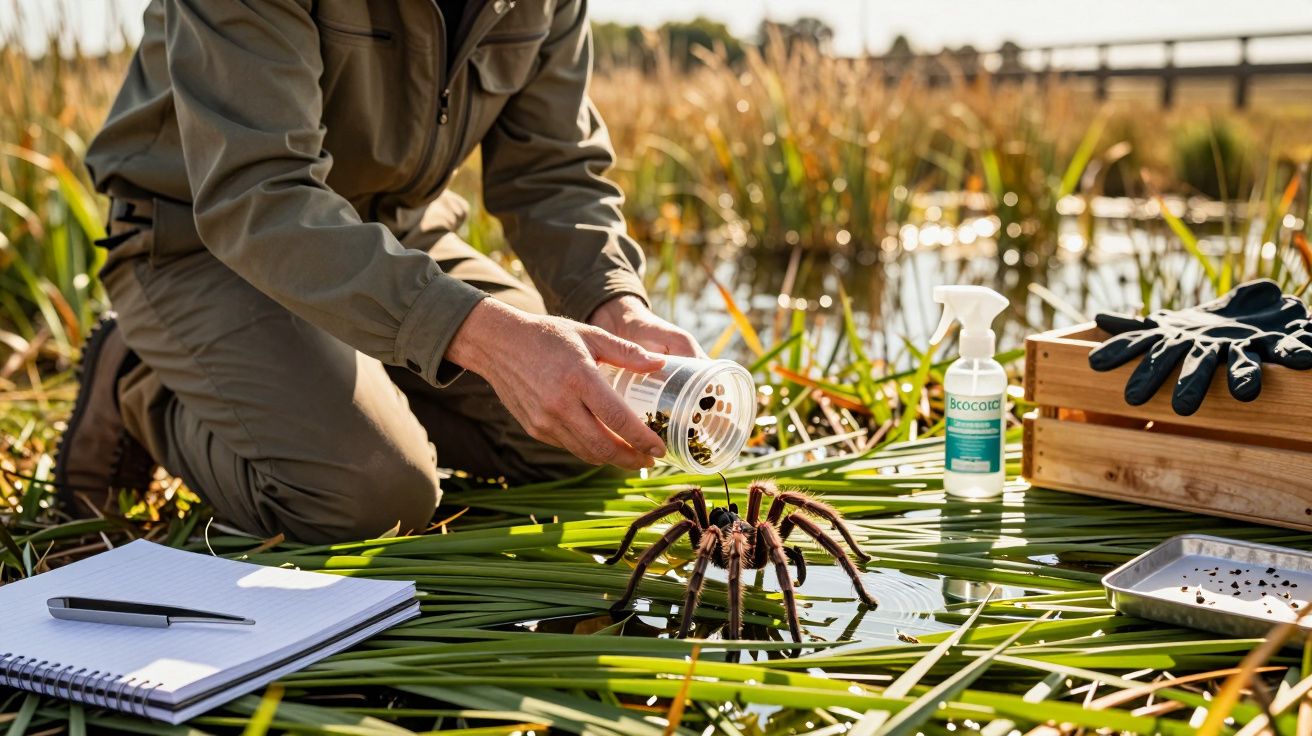
For years, an unassuming trial has been taking place in Britain’s wetlands, involving thousands of hand-sized predators that most people will never notice.
Around a decade on from an ambitious reintroduction programme, conservation teams say these spiders are not merely hanging on in parts of the UK: they are flourishing, and they are proving unexpectedly valuable within delicate marsh ecosystems.
Raft spiders (Dolomedes plantarius): from near extinction to 10,000 “giant” spiders
The “giant” spiders now being recorded in British wetland landscapes are raft spiders, known scientifically as Dolomedes plantarius.
They are large by UK standards-about the span of an adult hand-yet they pose no real danger to people.
Roughly ten years ago, Chester Zoo began breeding raft spiders and releasing them into suitable habitat, aiming to haul the species back from the edge.
Chester Zoo now estimates that more than 10,000 adult breeding females are living wild in the UK, following the most productive mating season ever documented for the species.
The work began at a point when the raft spider was close to local extinction.
Although it was once found widely across western Europe, its numbers fell so steeply that it was placed on the International Union for Conservation of Nature’s Red List for threatened species-an unusual status for a European spider.
Why the raft spider was disappearing
To see why Dolomedes plantarius required such intensive intervention, it helps to understand the kind of landscape it needs.
The species developed during warmer, wetter periods between ice ages, when retreating glaciers left vast webs of marshes and fens. Those waterlogged, insect-rich habitats once spread across large parts of western Europe.
From the 1960s onwards, many wetlands were drained for agriculture, development and flood-management schemes. In parallel, climate change has placed additional pressure on what remains, through shifting rainfall patterns and rising temperatures.
For a semi-aquatic spider dependent on shallow water, that double impact was severe.
Raft spiders are so closely tied to water that they cannot simply cross dry ground to establish new colonies when their original marshland dries out.
They typically occupy the margins of ditches, ponds and seasonally flooded meadows, using the water surface as a hunting platform. When those watery features are lost, there are few viable alternatives.
Why they can’t simply relocate elsewhere
Many species respond to warming conditions by moving north or to higher ground, but raft spiders are constrained by their way of life.
Both their hunting method and their egg-laying depend on immediate access to water. Travelling long distances over land is hazardous, and wide, dry gaps between wetlands can be fatal.
This helps explain the sharp UK decline: separated pockets of spiders were left without a safe corridor to reach better habitat. Conservationists attempted to supply that “missing link” by transferring captive-bred spiders directly into reserves that had been carefully prepared for them.
Raised one by one: tweezers, tiny flies and biosecurity
Bringing raft spiders back was not a quick win; it required meticulous, hands-on husbandry.
Spiderlings are not especially tolerant of one another-kept too close together, they will cannibalise.
As a result, keepers at Chester Zoo had to rear large numbers individually.
For weeks at a time, staff hand-fed hundreds of baby spiders each day, using tweezers to offer minuscule flies inside a bio-secure breeding facility.
The programme was delivered with the Royal Society for the Protection of Birds (RSPB), which oversees several wetland reserves that now support raft spider populations.
Alongside captive breeding, teams focused on habitat management: reedbed restoration, ditch deepening, and water-level control designed to recreate the conditions of functioning marshland.
A note on the wider information environment
Public interest in wildlife stories often sits alongside attention-grabbing headlines on unrelated topics-for example: - Heating advice from HVAC professionals (including warnings that closing vents in unused rooms can increase heating bills) - Claims about kitchen herbs reducing indoor odours without sprays or chemicals - Reports about a morning fruit linked with anti-cholesterol benefits, weight-loss support and memory improvement - Announcements of a “world’s largest oil field” being found in France and the effect on energy forecasts - Commentary on Saudi Arabia’s desert megacity project shrinking as costs and climate realities collide - Household tips such as storing aluminium foil in the freezer - Severe winter weather alerts predicting heavy overnight snow, travel disruption and stranded motorists - Updates on reforestation efforts, including landscapes absorbing millions of tonnes of CO annually
In contrast, raft spider recovery is slow-moving and evidence-led-built on monitoring, habitat work and long-term follow-up rather than dramatic day-to-day developments.
The quiet role of a top predator in marsh food webs
For many people, the phrase “thousands of giant spiders” prompts a single response: dread.
Ecologists, however, tend to see a different picture-a missing predator returning to a stressed food web.
In some British marshes, raft spiders now help sustain the diverse aquatic communities found in grazing ditches and reed-fringed pools.
Raft spiders hunt by ambush rather than by web-building.
Instead of spinning a web, they sit among plants at the water’s edge and surge across the surface when prey creates faint ripples.
Their legs carry extremely sensitive hairs-called trichobothria-that detect these vibrations. This sensory toolkit allows them to distinguish, for instance, between the movement of a struggling tadpole and the disturbance caused by a falling leaf.
Once they have locked on to a target, they rush forward, seize it with their front legs and administer a rapid bite.
What a raft spider eats in a day
Their prey range is broader than many people assume, including: - Flying insects, particularly flies and midges that rest on the water surface - Tadpoles in shallow water - Dragonfly larvae and other aquatic insect larvae - Very small fish on occasion
By feeding on these animals, raft spiders can help keep certain insect numbers in balance, which may support water quality and also benefit nearby farmland. In general, a robust layer of predators can be a sign of a reasonably well-functioning ecosystem beneath.
What this means for UK wildlife recovery
The raft spider’s resurgence points to a wider change in British conservation priorities.
Rather than concentrating solely on birds or large mammals, organisations are increasingly investing effort in overlooked predators, including invertebrates. This project illustrates how captive breeding, wetland restoration and sustained monitoring can be combined into a practical route away from extinction.
The presence of thousands of breeding females indicates more than persistence: it suggests a working, self-sustaining population-the gold standard for any reintroduction.
There are also wider gains. Managing marshes for raft spiders can simultaneously support amphibians, water beetles, wetland plants and birds that depend on the same ditches, reedbeds and pools.
For local communities, well-managed wetlands can provide natural floodwater storage and improved filtration, while increasing biodiversity in the landscape.
How conservationists track success (beyond simply “spotting spiders”)
Because raft spiders are elusive, success is not measured purely by casual sightings. Monitoring typically focuses on signs of breeding, the presence of suitable edge habitat, and consistent water levels across seasons. Repeated surveys over time help distinguish a genuine, resilient population from a short-lived spike driven by a single good year.
Just as importantly, wetland connectivity matters: linked ditches, re-wetted fields and managed reedbeds can reduce the dry-land barriers that previously isolated populations.
Living with big spiders: real risks and imagined fears
For anyone with arachnophobia, a hand-sized spider sounds alarming.
In practice, raft spiders seldom encounter people. They stick closely to quiet wet habitats, often within nature reserves and away from homes and footpaths.
Their venom is adapted for small aquatic prey rather than humans. Bites are exceptionally uncommon and are usually mild-more akin to a bee sting than anything severe.
The larger issue is psychological: an unexpected sighting can prompt panic. Some specialists argue that straightforward signage, guided walks and clear, honest information about the species can reduce fear over time.
Key terms and what they mean
Several technical terms come up repeatedly in discussions of the raft spider’s return:
| Term | What it means in practice |
|---|---|
| Captive breeding | Rearing animals in controlled facilities, typically with the intention of releasing them later into appropriate wild habitat. |
| Red List species | A species assessed by the IUCN as threatened, based on the speed of decline and how restricted its range has become. |
| Semi-aquatic | An animal that divides its life between land and water, relying on both for feeding, breeding or shelter. |
| Wetland restoration | Recreating or improving marshes, fens and bogs by managing water levels, re-establishing native vegetation and reducing pollution. |
Seeing how these ideas fit together makes the raft spider story less about a single unusual arachnid and more about a repeatable approach.
The same toolkit is increasingly being applied to threatened butterflies, dragonflies and amphibians that rely on similarly wet habitats.
What might happen next
Conservation teams will continue to follow raft spider populations to learn whether the current boom levels off or expands into additional sites.
Possible outcomes range from gradual spread through connected wetlands to local setbacks if drought conditions become more frequent or severe.
Much will depend on water management. If ditches dry out more often, the spiders will face the same limitations that nearly eliminated them before. Conversely, if more lowland farms and land managers make room for re-wetted fields and nature-friendly drainage, raft spiders could become a familiar-if rarely seen-feature of Britain’s marshland wildlife.
For now, thousands remain out there, hunting silently on still, brown water surfaces, underlining a simple point: even small, eight-legged predators can become a genuine conservation success.





Comments
No comments yet. Be the first to comment!
Leave a Comment