
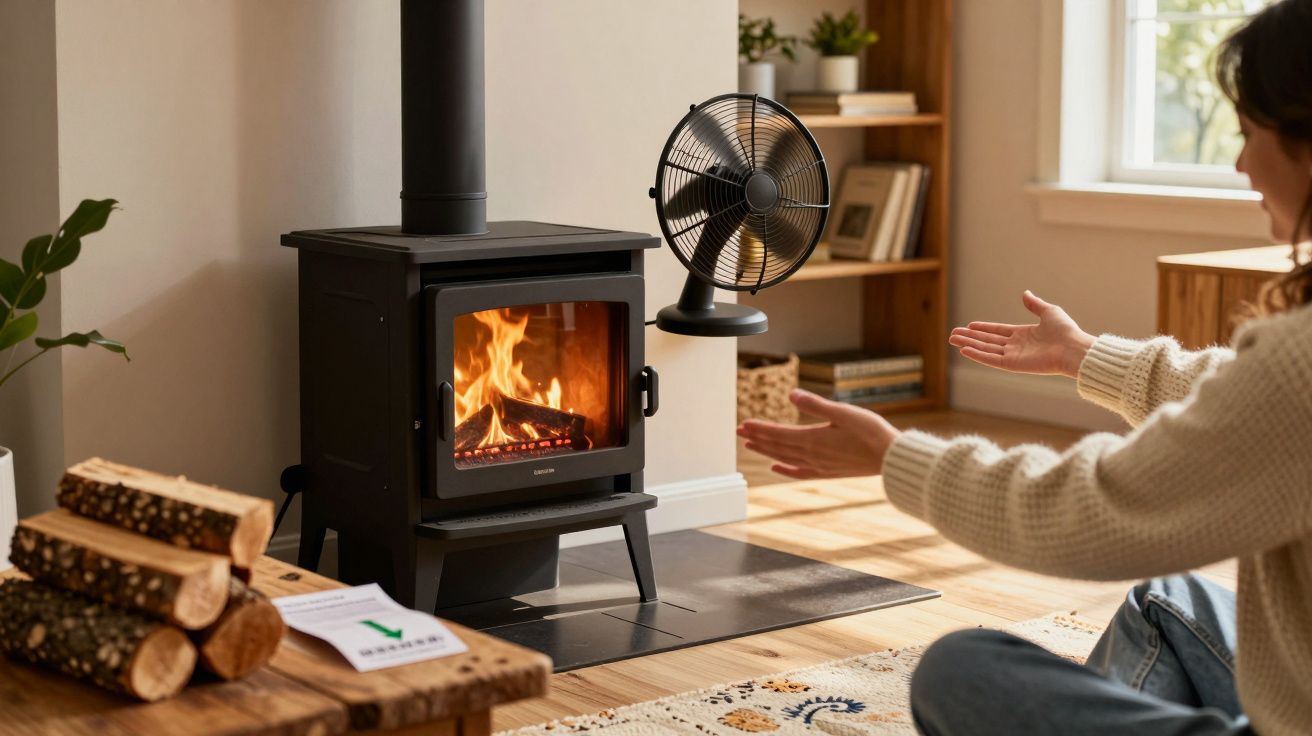
That pocket of scorching air hovering around a stove can feel wonderful, yet the armchair on the other side of the room remains stubbornly cold. A self-powered stove fan tackles that imbalance by nudging warm air out into the space, helping neglected corners warm up and often reducing firewood use-without using mains electricity at all.
What is a self-powered stove fan?
A self-powered stove fan is a compact fan designed to sit directly on the hot top plate of a freestanding stove. Instead of plugging in, it uses the stove’s own heat to run.
Inside the unit, a thermoelectric module produces a small electrical current when there is a temperature difference between its hot side and its cooler side. That current powers a low-consumption motor, which turns the blades. Rather than letting heat gather at the ceiling, the fan pushes warm air sideways into the room.
This process relies on the Seebeck effect. The base draws heat from the stovetop, while a finned heat sink above stays relatively cooler by shedding heat into the surrounding air. Within the fan’s safe operating range, the greater that hot–cool difference, the faster the fan spins. There are no leads to connect, no batteries to replace, and typically no on/off switch to fuss with.
No plug and no batteries: a temperature difference across a small module generates power to spin the fan and move warm air into the living space.
Why rooms feel warmer with a self-powered stove fan
In a calm room, air layers itself: the warmest air collects high up and close to the stove, while cooler air lingers nearer the floor. A gentle, continuous flow breaks up that stratification, mixing the layers so the hot and cold zones are less pronounced. The result is often a more even temperature across the room, so you may achieve comfort without running the stove as hard.
- More consistent warmth: helps reduce the “roasting by the stove, chilly by the doorway” problem.
- Quicker comfort: can start shifting heat across the room within the first 10–20 minutes of lighting up.
- Potentially less wood burned: steadier room temperatures can mean fewer refuelling cycles.
- Low noise: many models are close to whisper-quiet because the motor is small.
In everyday homes, people frequently report around 5–15% less wood used, because they reach a comfortable room temperature with a lower stove setting.
A £25 gadget powered by heat alone
In the UK, most self-powered stove fans sit roughly in the £20–£70 bracket (often $25–$80 in the US). It’s a one-off purchase, and it operates for free whenever the stove is hot enough.
Set-up is essentially instant: place the fan on the stovetop (commonly toward the back or to one side), ensure it has space around it, and let the fire provide the energy.
How much can you save?
What you save depends on how often you run the stove, your insulation levels, draughtiness, and how uneven the temperature feels right now. The table below is a straightforward way to estimate potential payback.
| Annual wood spend | Estimated reduction | Annual saving | Payback on a £40/$50 fan |
|---|---|---|---|
| £200 / $250 | 5% | £10 / $12.50 | 3–4 seasons |
| £350 / $450 | 10% | £35 / $45 | About 1 season |
| £600 / $750 | 15% | £90 / $112.50 | Under 1 season |
If you heat most evenings from October to March, a mid-priced fan often covers its cost within the first winter. Beyond the pounds and pence, there’s also a comfort dividend: when the far side of the room feels warmer, you can often reduce the burn rate slightly and still feel cosy.
How to position and use it safely
Where you put the fan matters more than how many blades it has. The goal is a hot base, a cooler top, and unobstructed airflow.
- Position it toward the rear or side of the stovetop, and avoid placing it on a raised cooking ring.
- Leave at least 10 cm behind the unit so the heat sink can shed heat effectively.
- Point the airflow across the room, rather than straight into a nearby wall (around 60 cm away won’t achieve much).
- Use a stovetop thermometer; many fans operate best with a base temperature of about 150–300°C (300–570°F).
- Try to avoid base temperatures of 350°C+ (660°F+); prolonged overheating can damage the module.
- Only lift the fan by its handle, and only once it has cooled-metal surfaces can cause serious burns.
Signs your stove is running too hot
- The fan races, then suddenly slows or stops when a thermal cut-out activates.
- The heat sink discolours or you notice a “hot paint” smell.
- Your stovetop thermometer stays in the overfire zone for longer than brief spikes.
Keeping a stovetop thermometer in sight helps protect the fan and reduces the risk of over-firing the stove itself.
Choosing a self-powered stove fan: what to look for
Specifications vary far more than the product photos suggest, so it’s worth checking the details rather than buying on appearance alone.
- Temperature limits: confirm the minimum start temperature and the maximum safe operating temperature.
- Airflow rating: for smaller rooms, a realistic figure is often around 120–220 m³/h (about 70–130 CFM).
- Blade configuration: two- and four-blade designs can both work well; larger blades can move air at lower speeds.
- Overheat protection: a bimetal strip in the base can lift the fan slightly if it gets too hot.
- Materials: aluminium bodies and fins typically handle sustained heat better than thin steel.
- Noise: good models often remain below roughly 25–30 dB at working temperature.
- Warranty: one to two years is a useful sign the module and motor are not built to the lowest standard.
Compatibility notes (stoves, surfaces, and room layout)
A self-powered stove fan works best on a flat, exposed metal top plate where it can sit stable and make good thermal contact. If your stove top is heavily curved, covered by a kettle stand, or has limited clear space, performance can be inconsistent.
Room shape matters too. Open-plan areas and rooms with high ceilings can dilute the benefit, because warm air has more volume to fill. If you are trying to heat multiple rooms, combining the fan with thoughtful door management (and, where appropriate, a quiet fan near the top of a doorway) can help move warmth along a corridor.
Limitations and when a fan won’t help
This is a useful tool, not magic. Very large open-plan spaces can lose heat faster than one small fan can redistribute it. Closed doors stop airflow, and poor insulation or draughty windows can erase the gains you make.
If you have an insert stove tucked behind a decorative surround, you may need a purpose-built blower designed for that appliance rather than a stovetop unit. For moving warmth between rooms, a small, low-noise doorway fan placed high (where warm air gathers) can be more effective than relying on one stove-top fan alone.
Maintenance and lifespan
Every few weeks, clean dust from the blades and the heat sink fins; dust acts as insulation and can push operating temperatures up. Wipe down with a dry cloth once the unit is cool.
Avoid oiling unless the manufacturer explicitly provides a service point-many motors use sealed bearings. Over summer, store the fan away from the stove to reduce accidental knocks and exposure to humidity. With careful use, the thermoelectric module and motor commonly last for several seasons.
Smart add-ons for better burns
- Moisture meter: aim for logs at under 20% moisture for cleaner combustion and more heat per piece.
- Rope gasket kit: improving the door seal can make the stove easier to control and reduce flare-ups.
- Carbon monoxide alarm: fit one in the same room as the stove and test it weekly during peak season.
- Chimney thermometer or probe: helps you identify cooler, smoky burns that can accelerate creosote build-up.
Burn only seasoned wood below 20% moisture, have the flue swept annually, and install a CO alarm you can hear clearly.
A quick, practical way to estimate your payoff
Take what you spent on logs last winter. Multiply by 0.05 for a cautious estimate, 0.10 for a typical outcome, and 0.15 if your room currently has strong hot–cold patches. Then compare that figure to the price of the fan you’re considering.
If the likely saving covers half the fan’s cost or more, you’re often in the territory of a one-season return. If you mainly burn at weekends, a smaller and cheaper fan may make more sense-comfort improvements may matter more than strict payback.
A short checklist before you buy
- A freestanding stove with a flat metal area large enough for the fan to sit securely.
- A clear route for air to travel across the room, and no low shelf directly above the stove.
- A stovetop thermometer ready to use, as temperature discipline protects the fan.
- Sensible expectations: improved comfort, modest savings, and absolutely no plugs.
Related reads (as seen alongside stove-fan advice)
- Millions of bees reportedly vanished from southern Italy after a geomagnetic storm disrupted navigation patterns.
- Stylists share why a particular haircut suits people who rarely visit a salon.
- Home gardeners claim a single cardboard tube can “revive dying plants overnight”; experts call it coincidence while sceptics call it fake.
- “Extremely flattering”: according to a hairdresser, a rejuvenating hairstyle said to suit people over 50.
- Some vegetables people think are different are actually the same plant.
- The United States reportedly accelerates construction of USS Kennedy, a second Ford-class aircraft carrier, as USS Ford enters combat.
- Sweet potatoes and white potatoes are not closely related, and science explains the difference.
- Outdoor materials that cost a lot yet weather badly, and which some say are best avoided.
When warmth feels evenly spread from your chair to the doorway, it’s easier to ease the stove back a notch and still stay comfortable. That is the real value of a self-powered stove fan: a small, heat-driven push that helps the warmth you’ve already paid for reach the places you actually use.




Comments
No comments yet. Be the first to comment!
Leave a Comment