
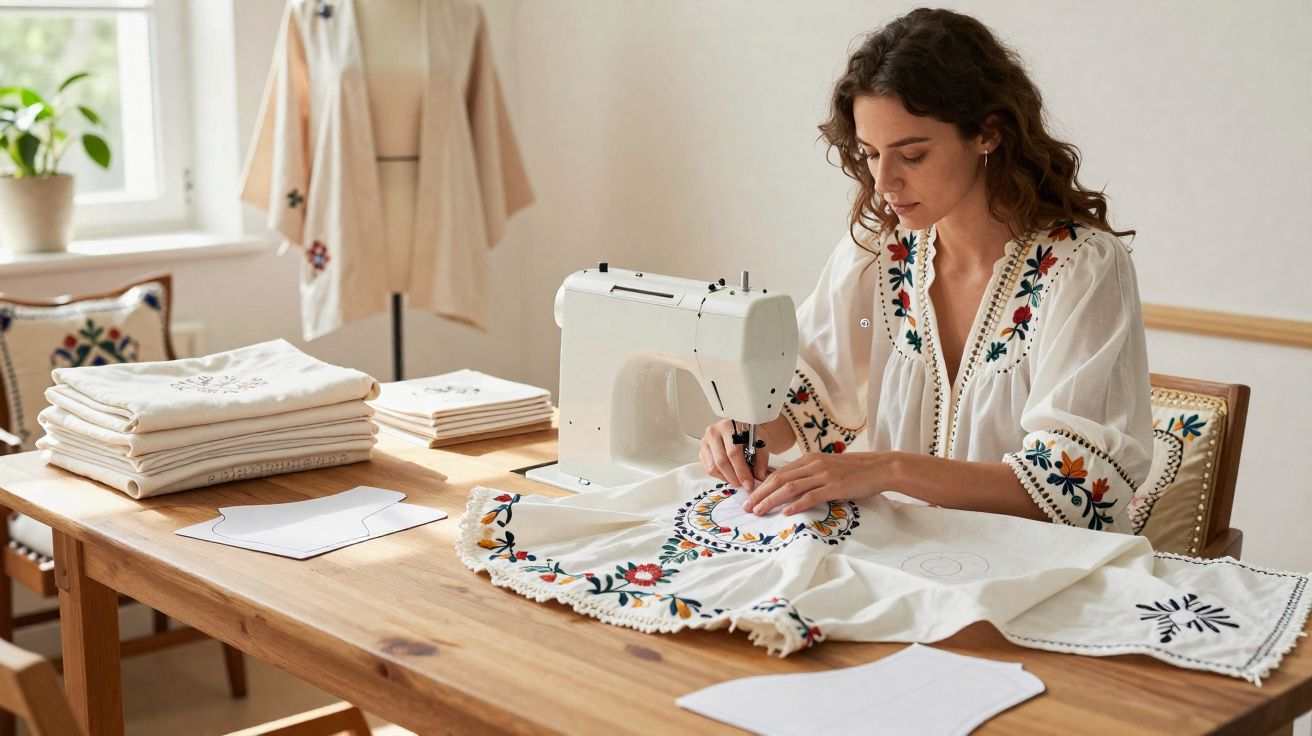
Many households have the same situation: a neatly folded stack of heirlooms in the linen cupboard-beautiful, yet seemingly pointless. Old embroidered bed sheets, in particular, often feel far too good to throw away, but also too delicate for everyday use. In reality, they are a genuine treasure trove for fashion and home décor-provided you use a smart sewing technique to turn them into new favourites.
Why old embroidered bed sheets are in demand again
Anyone looking at the growing mountains of textiles across Germany and Europe quickly realises how irrational it has become to keep binning fabric. Hundreds of thousands of tonnes of textiles end up as waste every year, even though much of it is high-quality and made to last. Heirloom pieces in linen or linen mixes fall squarely into that category-and they are perfect for creative upcycling.
Old embroidered bed sheets are often made from tightly woven linen or linen blends, can cope with high wash temperatures, and become softer with every wash.
Traditional trousseau sheets were produced to be hard-wearing. They are often:
- made from pure linen or a linen–cotton blend
- heavy in fabric weight, meaning tightly woven, sturdy and stable
- woven from long fibres, so they barely pill and drape beautifully
- finished with fine details such as monograms, drawn-thread work, scalloped edges or cutwork embroidery
That combination is something you now tend to find in department stores only at the luxury end. If you have a sheet like this at home, you effectively own the value of a good length of yardage-just in a vintage format.
Preparation: how to get old sheets ready to sew
Before you go anywhere near it with scissors, it pays to do a thorough “workshop check”. That’s how the old piece shows its full potential.
Wash, brighten, inspect
Start by putting the sheet through the washing machine to remove dust, that stored-away smell, and any marks. After washing, measure the length and width again, because natural fibres can shrink slightly after the first hot wash.
If the fabric has yellowed, two simple at-home approaches work well:
- Hot water with lemon juice: a gentle brightening method, kinder to more delicate sheets.
- Washing soda or oxygen bleach (e.g. sodium percarbonate): a much stronger effect, used at at least 60°C.
Avoid chlorine-based bleaches: they can attack the fibres and shorten the fabric’s life. After washing, the sheet often looks as though it has “woken up”-crisper, brighter and more pliable.
Press it flat and mark the “treasure” areas
Next comes ironing-aiming for a smooth, crease-free surface. It may look like a routine step, but this is where you plan the design of your future pieces. Once the fabric is flat, the special elements stand out immediately:
- monograms, initials and family letters
- borders with cutwork embroidery
- drawn-thread work bands
- curved edges and scalloped finishes
Mark these zones with tailor’s chalk. Leave the larger unembroidered areas clear: those will later become the main fabric for blouses, dresses, kimonos or home textiles. Crucially, don’t cut anything yet. Design first, scissors second-this is how you avoid irreversible mistakes.
The smart sewing technique for old embroidered bed sheets: make embroidery the focal point
The real trick isn’t about complex tailoring. It’s about placing the embroidery with intention. Done well, those old sheets start to look like designer fabric.
The simple rule: never cut through embroidery; treat it like a separate fabric piece and stage it deliberately.
Embroidery as an insert-never an accident
In practice, that means:
- Lay your pattern pieces on the fabric, then shift them until the monogram or border lands somewhere highly visible-on a chest pocket, on the back panel, or along a skirt hem.
- Cut around the embroidery with generous seam allowance so you can sew it in like a normal pattern piece.
- Stabilise fragile areas from the wrong side using lightweight interfacing, then finish the edges so nothing frays.
A real-world example: a 3-metre sheet with a large embroidered letter in the centre becomes a light jacket for in-between seasons. The maker cuts out the monogram with plenty of fabric around it and positions it precisely on a patch chest pocket. The rest of the jacket comes from the plain sections. The end result looks like a one-off from a small atelier-complete with family history.
Boho blouse, kimono or dress-clothing with a past
This approach works particularly well for airy garments. Popular projects include:
- Blouses with drawn-thread work sleeves: the delicate openwork runs exactly along the forearm.
- Kimono jackets: the cutwork frames the back panel or follows the hem.
- Summer dresses: a large monogram sits at the centre front or on a pocket.
Because the base fabric is simple while the vintage details are striking, the finished piece often looks more expensive than it ever was. The vibe sits somewhere between farmhouse, boho and minimalism-depending on the pattern and what you wear it with.
Turning sheets into standout home pieces
Not everyone wants to sew clothing straight away. Home projects are often simpler, but can create just as much impact.
Duvet covers with character
A reliable classic is a duvet cover made from two old sheets. The method is straightforward:
- Place two sheets together, edges aligned, right sides facing.
- Stitch three sides fully.
- On the fourth side, stitch around 20 centimetres closed on both the left and right, leaving the middle open.
- Add buttons and buttonholes, or press-studs, along the opening.
Position the embroidery intentionally near the edge of the duvet or in the upper area, so it’s clearly visible on the bed. The result feels like country-house hotel bedding-only more personal.
Nostalgic table linen and cushions
You can turn leftover sections into stylish accessories quickly:
- Tablecloths and napkins: place the monogram or border in the corners so plates don’t cover it.
- Cushion covers: centre the embroidery or offset it slightly depending on the cushion size.
- Tea towels: drawn-thread work along the edges gives a more refined look.
- Curtains: use the existing hem as a casing, with embroidery at hip height or along the lower edge.
A padded headboard covered in the fabric, or simple white curtains made from these sheets, also suits old floorboards, vintage furniture, and modern pared-back rooms that benefit from a softer contrast.
How to plan your sewing project without the frustration
When you’re working with heirlooms, you naturally want to avoid errors. A few basic rules help you get the most out of the fabric.
- Check fabric condition: thin spots or small tears should be placed in low-wear areas, such as upper back sections or decorative cushions.
- Place pattern pieces economically: cut the largest pieces first, then fit smaller parts like facings or pockets into the gaps.
- Make a test sample: try seams and stitch settings on an offcut-old linen behaves differently from modern cotton.
- Use fine needles and quality thread: it helps prevent holes and puckering.
Beginners often do best with straight-forward items: cushions, table runners or simple wrap skirts. If you have more experience, you can move on to blouses with inserted embroidery or relaxed shirt dresses.
What to know about fabric types, durability and care
Terms like “linen blend” or “drawn-thread work” can sound old-fashioned at first, but they’re easy to understand in day-to-day use. A linen blend, for instance, is a mixed fabric made from linen and cotton. It combines linen’s toughness with cotton’s softer feel-ideal for frequently used pieces such as table linen or cushions.
For care, many of these fabrics handle 60°C in the machine without any drama. For garments, 40°C is often enough to protect the shape and the embroidery. A gentle spin cycle and line drying help prevent harsh creases and extend the life of the seams.
If you’re using delicate monograms or open cutwork, put items in a laundry bag or turn them inside out before washing. It doesn’t look like much, but it significantly reduces abrasion against the drum.
Why the effort is genuinely worth it
Beyond the sustainability argument, there’s another appeal to this technique: every finished item carries a story. A grandmother’s monogram on a new blouse, a great-grandfather’s drawn-thread work on a tablecloth-those details add an emotional layer you simply can’t buy.
It can save real money, too. One large sheet often yields several high-quality products that would cost far more to buy new. And on top of that, nobody else will wear that exact jacket, have that exact cushion on their sofa, or lay that exact tablecloth.
Once you’ve turned an old embroidered bed sheet into a modern favourite, you’ll never look at your linen cupboard the same way again. What used to feel like “old stuff” suddenly becomes material with a luxury edge-and that’s exactly what makes this sewing idea so compelling.



Comments
No comments yet. Be the first to comment!
Leave a Comment