
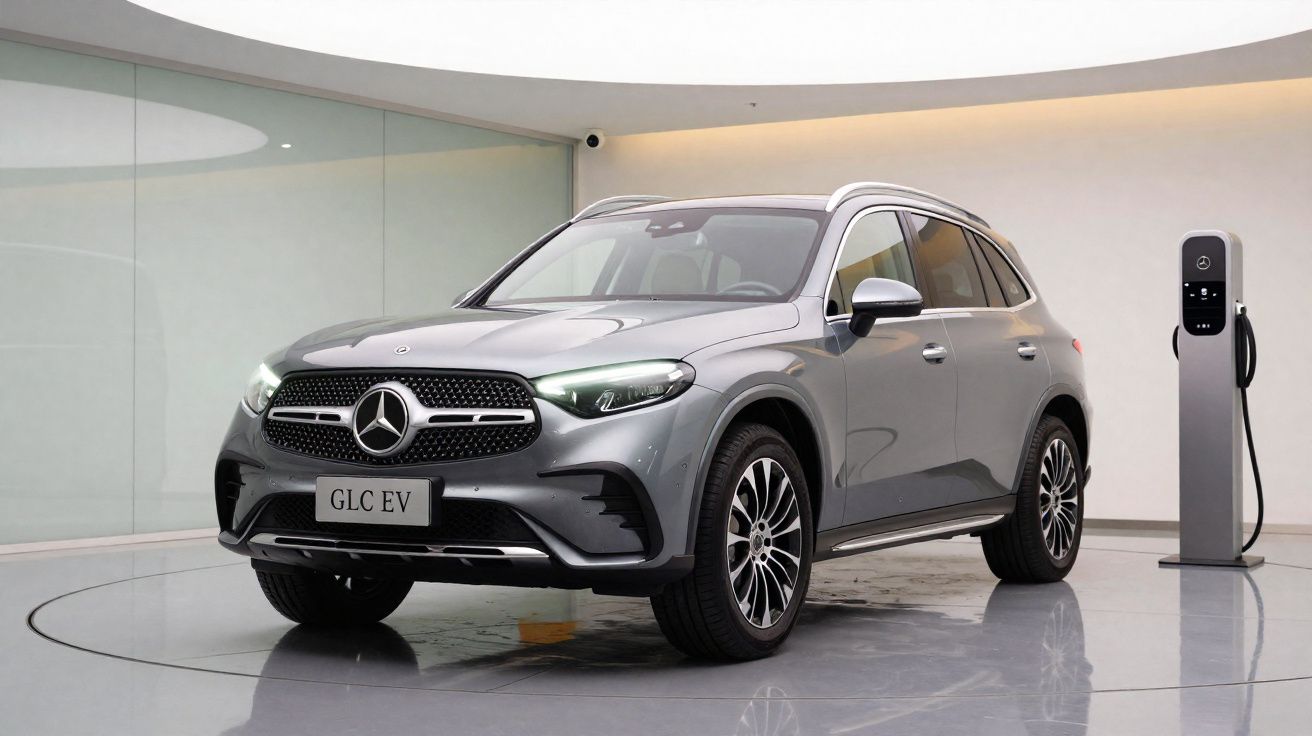
The new Mercedes-Benz GLC electric won’t have it easy: not only must it take on its German arch-rivals, there’s now a Swede in the mix too.
If the new CLA set out the foundations for what Mercedes-Benz’s next generation of electric cars will look like, the new GLC is the model tasked with turning that strategy into a lasting success - which is no small thing, given it is the brand’s best-selling car worldwide.
That’s a big ask. For Mercedes-Benz, this is one of those launches that simply cannot afford to misstep, especially as it lands in a segment where BMW, Volvo and Audi are already setting the pace.
We drove it on Portuguese roads in the Algarve region to uncover the details behind one of Mercedes-Benz’s most significant launches in years. Here’s what we found.
A light show
The Mercedes-Benz GLC debuts an entirely fresh look, led by a front end the German design team calls an “illuminated work of art”.
Because it’s an electric car, the grille is fully closed and therefore has no practical role. Even so, it carries major visual weight, as it completely reshapes the model’s “face”.
The front headlamp units - new on this GLC - also play a key part in the updated light signature, this time with an obvious functional benefit: Mercedes-Benz says they illuminate up to the length of six football pitches, i.e. around 630 metres.
Another clear change versus the previous-generation GLC is its footprint. This new model is larger in every dimension: 13 cm longer (4.85 m), 2.3 cm wider (1.91 m) and 0.5 cm taller (1.64 m), plus an extra 8.4 cm in wheelbase (2.97 m).
Digitalisation taken to the extreme
If you’re still taking in the exterior light show, brace yourself: open the GLC’s door and you’re greeted by the largest screen Mercedes-Benz has ever fitted to one of its cars. The new Hyperscreen measures 39.1 inches and spans 99.3 cm in width, stretching across the entire dashboard.
Despite this high level of digitalisation, the GLC cabin retains a handful of physical controls for core functions - a welcome decision that helps keep driving safer. The biggest drawback may be the steering wheel, which lacks more direct controls for basics such as “skipping to the next track”.
Cabin quality is also a standout: everything feels solidly assembled and the materials are carefully chosen. Buyers can opt for vegan leather or genuine leather, and choose between brushed aluminium and wood.
One more detail is worth calling out: this SUV can be specified with a panoramic roof featuring adjustable opacity and, alternatively, it can recreate a starry-sky effect using 162 individual light points.
More room than ever before
In the rear seats, it’s immediately obvious where the extra 8.4 cm of wheelbase has gone. Legroom and headroom are generous - enough for us to say, confidently, that this is the most spacious GLC yet.
That claim largely extends to luggage capacity too, although the numbers tell a slightly more nuanced story. In the version we drove, fitted with two electric motors, the GLC offers a 570-litre boot (100 litres more than PHEV versions, but 30 litres less than today’s combustion variants).
Add the 128 litres provided by the frunk, and total capacity rises to almost 700 litres - making this the GLC with the biggest overall load space you can buy.
Up to 713 km of range
You may or may not love the exterior design, and the cabin tech may feel like a lot - but once you look at the technical package on offer, it’s hard not to acknowledge just how much work Mercedes-Benz has put into this model.
To start with, it uses the new 800 V MB.EA platform, enabling DC charging at speeds of up to 330 kW. Mercedes-Benz claims you can add up to 305 km in just 10 minutes. The GLC’s electrical system can also run at 400 V and up to 100 kW on compatible chargers.
On AC, 11 kW charging is standard, while a 22 kW onboard charger is available as an option for an extra €700.
At this stage, the Mercedes-Benz GLC electric is only offered with a 94 kWh battery. That allows the 400 4MATIC version (the only one confirmed so far) to quote up to 666 km of WLTP combined range, rising to as much as 713 km with the Long Range pack, priced at €2950.
This optional pack doesn’t change the battery’s capacity. Instead, it adds more aerodynamic wheel designs, air suspension, and rear-axle steering.
Mercedes-Benz GLC: smart suspension
As for the electric drivetrain, the GLC 400 4MATIC uses two electric motors (one on each axle), delivering 360 kW (489 hp) of total power and 800 Nm of peak torque. That’s enough for 0–100 km/h in 4.3 s despite a 2.5-tonne kerb weight. Top speed is limited to 210 km/h.
As with the CLA, there’s a two-speed gearbox paired with the rear electric motor. The idea is to sharpen initial acceleration and reduce consumption at higher speeds. Anyone driving daily on the autobahn will appreciate that.
During this first drive in the Algarve - combining B-roads, motorways and town traffic - I managed consumption figures between 14 kWh/100 km and 15 kWh/100 km. That’s an impressive result given the SUV’s sizeable presence, and on the road it feels markedly better than the previous generation.
Even as an electric model, the Mercedes-Benz GLC remains a long-distance cruiser, just as it always has been. Now, though, it’s more enjoyable to drive, more agile (rear-axle steering plays its part) and more comfortable than before. And, unlike what often happens, it can put down what the electric motors deliver with real effectiveness.
It would be unfair to credit that performance to a single component, since it depends on multiple systems and technologies working together. Still, if we had to pick one highlight, it would be the intelligent air suspension, which can anticipate imperfections in the road surface.
Thanks to the Car-to-X function - which links 16 million cars in communication - the GLC’s “brain” can electronically adjust the dampers before the vehicle reaches potholes or broken surfaces. At the same time, it uses Google Maps data to keep the car as low as possible for as long as possible, helping cut the aerodynamic drag coefficient (Cx) to just 0.26 - a remarkable figure for an SUV.
Another major step forward is braking. The GLC now uses a centralised system that decides whether to apply regenerative braking (via the electric motors) or the hydraulic braking system.
How much does it cost?
Due to arrive in the first half of the year, the new Mercedes-Benz GLC electric will start at €78,000 (including VAT) for the GLC 400 4MATIC - less than the current GLC 400 plug-in hybrid.
In summer, we’ll learn the technical specs and pricing for the entry-level version, the rear-wheel-drive GLC 250, which is set to reach the market in September. Two further variants are also planned, though their details have not yet been announced.
Compared with equivalent versions of the rival Audi Q6, BMW iX3 and Volvo EX60, Volvo’s electric option is the one that appears to offer the most for the money. It promises more range, is the quickest, and is the cheapest.
Even so, based on this first drive, the electric GLC scores highly. It sits at the top of the segment in terms of its electric powertrain and range, feels very capable dynamically, is comfortable, and overall represents a clear step forward in the model’s evolution.
On paper, it has everything it needs to be a hit. In the electric SUV line-up, it effectively replaces the EQC (launched in 2019), which was derived from the combustion-engined GLC - bringing compromises in space, practicality and efficiency. There’s no other way to put it: these two models are so far apart that comparing them hardly makes sense.
However, despite the optimism pinned on this new generation, Mercedes-Benz has already confirmed that the combustion-engined GLC will continue to be sold for a few more years.






Comments
No comments yet. Be the first to comment!
Leave a Comment