
Have you ever taken part in a large group project? It’s easy to think that the more people you add, the quicker the job will be done - and the better the end result will be.
In practice, though, as a team grows, each person’s contribution doesn’t rise. It doesn’t even remain steady - it typically falls. Many hands may make light work, but too many cooks spoil the broth.
This counterintuitive pattern is called the Ringelmann effect, after the French engineer Max Ringelmann, who identified it in the late 19th century.
By measuring the force generated by students pulling on a rope, he showed that adding more students increased the total pulling force - yet the average effort per person went down.
He attributed this drop to two main causes: the challenge of coordination in larger teams, and "social loafing" - where individuals ease off when they feel less personally accountable within a group.
And yet many animals - from shoaling fish to prides of lions - manage to cooperate effectively in sizeable groups. So can any species avoid the slide in efficiency that the Ringelmann effect predicts?
If any animal can do it, ants are strong contenders. In a new study published in Current Biology, we set out to test whether weaver ant chains experience the Ringelmann effect.
Group work - for weaver ants
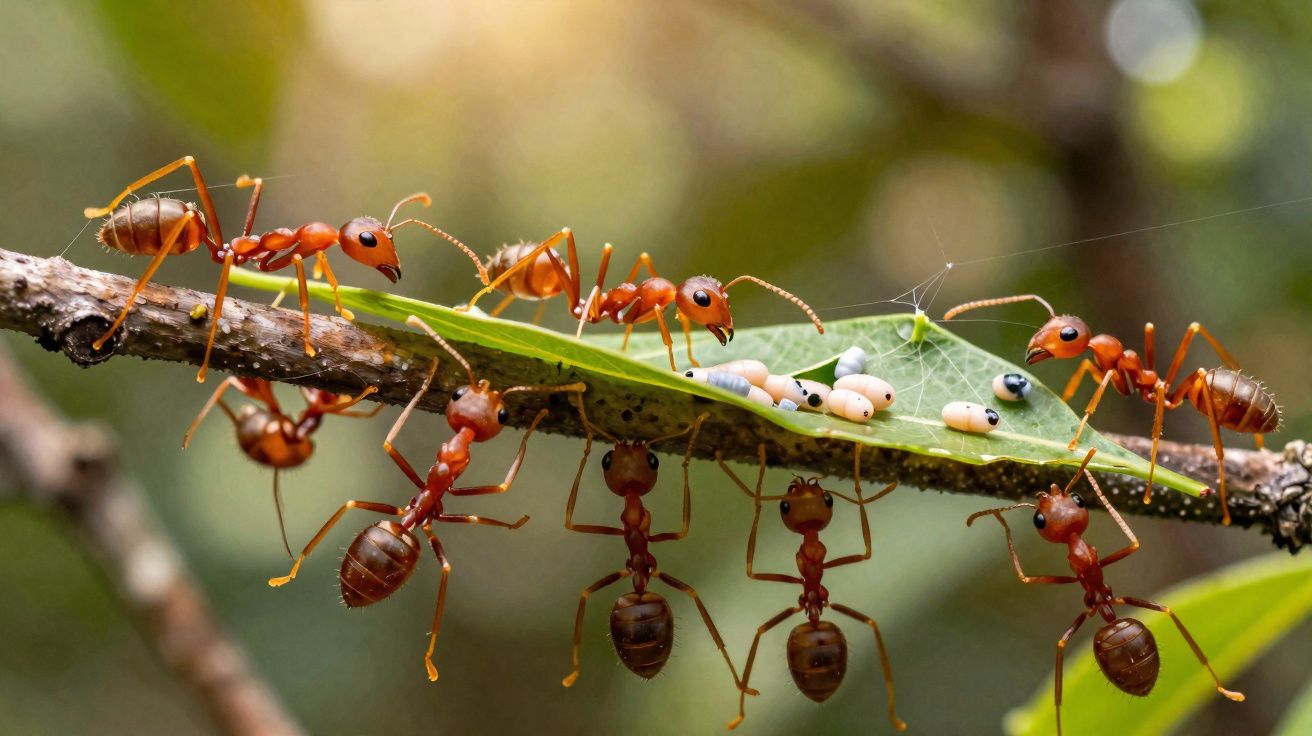
Ants are masters of collective effort, coordinating intricate tasks smoothly even in colonies numbering millions. Among the many ant species, weaver ants (Oecophylla smaragdina) are a particularly striking example.
Weaver ants build nests high in trees by hauling living leaves together and stitching them using silk produced by their larvae. To achieve this, they form "pulling chains" - with each ant gripping another’s waist in its jaws and pulling together in synchrony.
Despite how impressive these chains appear, their mechanical advantage had not previously been examined.
To investigate, we prompted ants to assemble chains and pull an artificial paper leaf connected to a force meter, which continuously recorded the colony’s combined force output. As ants joined and left the pulling team, we could track how the group’s performance shifted in real time.
We predicted that the force produced per ant would fall as chains lengthened - a hypothesis consistent with earlier work on ants. For example, fire ants (Solenopsis invicta) can interlink to form sticky, raft-like balls that help them survive floods.
When researchers pulled apart these balls at different sizes, larger groups appeared to show the Ringelmann effect: as group size rose, resistance per ant declined.
What we found with weaver ants was the opposite. As additional weaver ants joined the pulling team, the total force rose - as you would expect - but the force per ant rose too. Put simply, individual weaver ants became more effective as the team expanded.
In other words, weaver ants seem not only to avoid the Ringelmann effect - they are "superefficient" when working together.
A division of labour
So how do weaver ants become superefficient? Is it simply the result of adding more ants?
Not quite.
Their superefficiency appears to hinge on how the ants organise themselves. Weaver ants performed best when they formed one long chain, rather than splitting into several shorter chains.
We also observed that ants’ body posture changed depending on their position in the chain. Ants at the rear extended their hind legs - a stance that helps them passively withstand the leaf’s counter-force.
Ants in the middle or at the front, by contrast, kept a more crouched posture that is usually linked with active pulling. This consistent pattern suggested a division of labour within the chain.
In our study, we propose a mechanism we call the "force ratchet". The weakest point in these pulling chains is not how well ants cling to one another, but how well they can grip the ground.
When an ant pulls by itself, the maximum force it can generate is limited by slipping. In a chain, however, the ants at the back can function as passive resistors, increasing contact with the ground and reducing slippage.
That, in turn, enables the ants at the front to pull harder, while force is stored and transferred through the chain. This role differentiation effectively locks in the force and stops the team from sliding backwards.
More is different
Although our model is speculative, it offers an intriguing way to think about how teams might avoid the familiar trap of the Ringelmann effect - at least when the task involves applying physical force.
To properly test our force ratchet hypothesis, future experiments will be essential - for instance, changing how slippery the ground is, or altering the weight of the leaf.
The implications may extend well beyond biology, particularly into autonomous robotics. In swarm robotics, large groups of small, low-cost robots are built to cooperate, completing tasks that no single member could achieve alone.
So far, however, teams of pulling robots have typically managed only linear scaling: double the robots and you double the force. That suggests robots may not be experiencing the Ringelmann effect - but they are not "superefficient" either.
If robots were programmed with strategies inspired by ants - such as the weaver ants’ force ratchet - their performance could improve, allowing machines to become more than the sum of their parts.
Our findings also call into question how universal the Ringelmann effect really is. Sometimes, in teamwork, more is different. And for some animals at least, more genuinely is better. If weaver ants were cooks, it would be fair to say they might just make the best broth.
Chris R. Reid, ARC Future Fellow, Behavioural Ecology, Macquarie University and Daniele Carlesso, Postdoctoral Fellow, Max Planck Institute of Animal Behaviour
This article is republished from The Conversation under a Creative Commons licence. Read the original article.



Comments
No comments yet. Be the first to comment!
Leave a Comment