
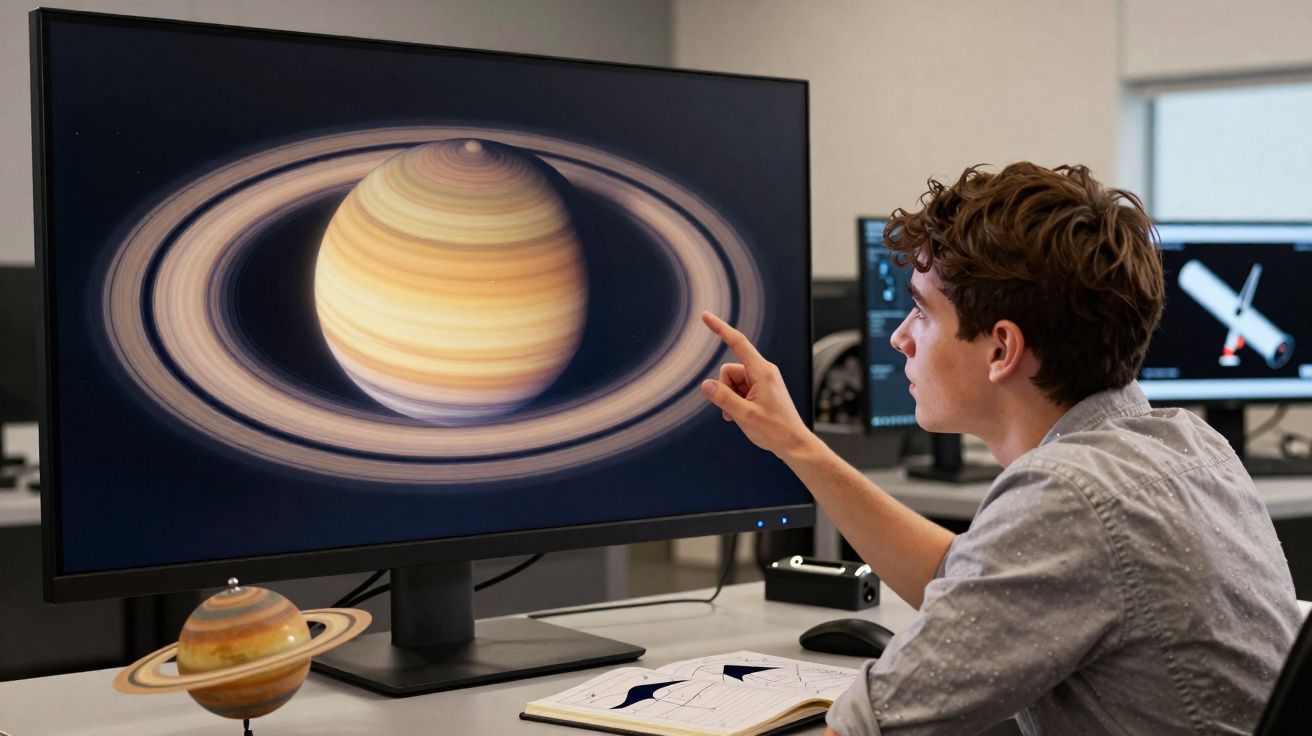
Combined observations reveal Saturn’s structure, storms and jet streams at multiple altitudes
The James Webb Space Telescope (JWST) and the Hubble Space Telescope have teamed up to produce new images of Saturn, showing the planet across different parts of the spectrum. By combining these views, researchers can probe the gas giant’s atmospheric behaviour in far greater depth.
Hubble, observing in visible light, records subtle colour differences in Saturn’s clouds and hazes. JWST, by contrast, detects infrared radiation, allowing scientists to examine atmospheric chemistry and the vertical structure at varying heights. Together, these datasets make it possible to treat Saturn’s atmosphere and its layers as a three-dimensional system.
Saturn’s rings-made largely of water ice-stand out especially strongly in infrared images. In both sets of observations the Sun-facing side of the rings is visible, while the rings cast shadows onto the planet. Differences in ring structure, including spokes and features within the B ring, highlight how each telescope reveals distinct details.
JWST imagery also shows a jet stream in northern latitudes that is driven by atmospheric waves. The same observations capture lingering traces of the “Great Spring Storm” of 2011–2012, along with several storms in the southern hemisphere. These features arise under the influence of powerful winds and waves beneath the cloud layer.
The well-known hexagonal storm at Saturn’s north pole-first identified by the Voyager spacecraft in 1981-can be seen as well. Its persistence over decades underlines the long-term stability of the planet’s large-scale atmospheric processes. However, the next opportunity for close, detailed observations will not arrive until the 2040s, when the north pole is once again lit by sunlight.
Infrared measurements indicate that Saturn’s poles have a grey-green tint. This colouring may be linked to high-altitude aerosols or to auroral activity (the equivalent of Earth’s “Northern Lights”). Such effects are produced when charged particles interact with the planet’s magnetic field.
Observations made in 2024, separated by 14 weeks, record Saturn’s progression from northern summer towards the 2025 equinox. Later on, the telescopes will be able to focus more on the planet’s southern hemisphere as it becomes more strongly illuminated.
Hubble’s OPAL (Outer Planet Atmospheres Legacy) programme has monitored changes in Saturn’s atmosphere for more than a decade, tracking storms as well as seasonal shifts. JWST complements this long-running record with infrared measurements, widening what can be learned about the atmosphere’s structure and dynamics.






Comments
No comments yet. Be the first to comment!
Leave a Comment