
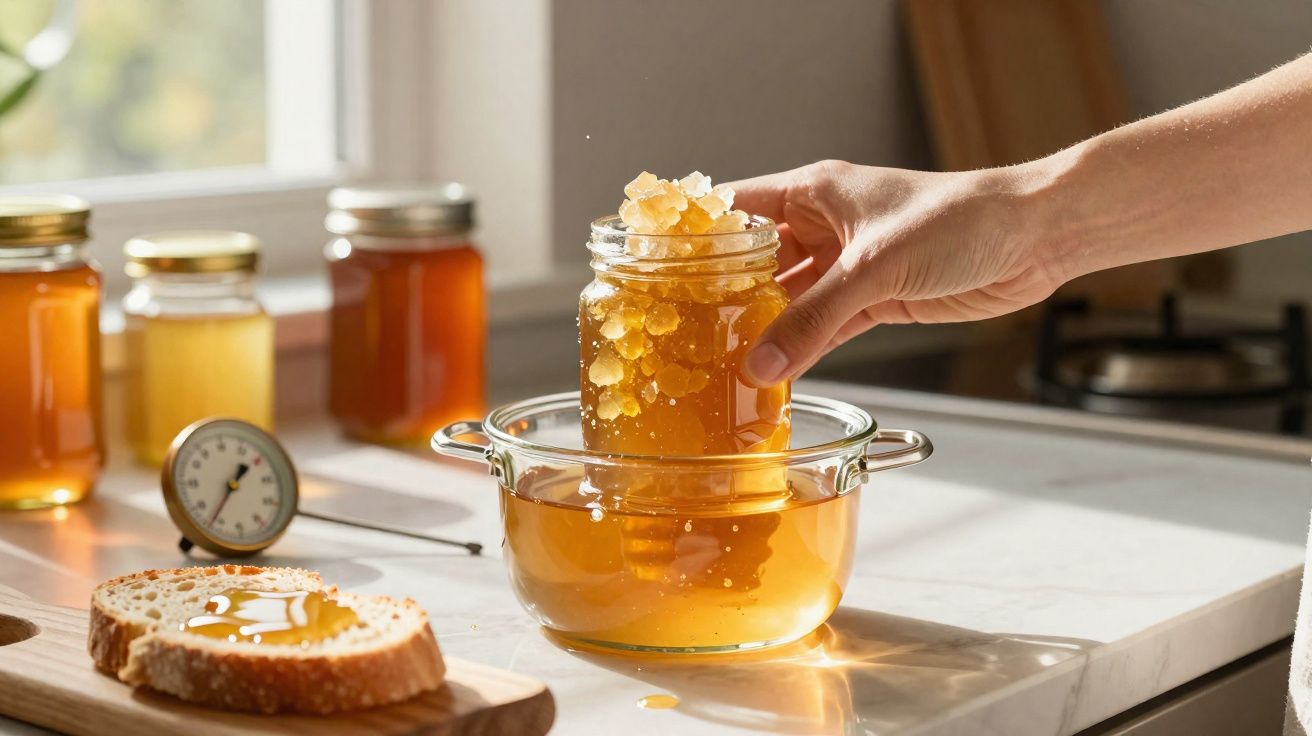
A thick, pale, gritty lump where a golden stream ought to be. You unscrew the lid, thump the base, prod it with a spoon. Nothing budges. It’s as if your honey has quietly jumped forward a decade in a single night.
Perhaps it’s raw honey you picked up at a local market, or a jar you brought back from a trip. You imagined it stirred into tea, spooned over yoghurt, or melting into warm toast. Then everyday life got in the way. A few weeks go by, and one morning you open the cupboard to find it: crystallized, uncooperative, almost chalk-like.
You pause. Has it gone bad? Is it risky? Is it now pointless? You consider binning it, then feel that small pinch of guilt. Inside that hardened jar are bees, blossoms and bright summer mornings, held in place. You just need to learn how to loosen it again-without destroying what makes it special.
Why crystallized honey is not spoiled
The key point is simple: crystallisation is usually a sign of normal change, not deterioration. Honey is largely sugars plus water, and that mixture doesn’t remain perfectly uniform forever. The glucose portion naturally begins to form tiny crystals, rather like frost patterns growing on glass. The more glucose-and the more fine particles suspended in it-the quicker it will set.
Raw honey, with its pollen, enzymes and microscopic flecks of wax, often crystallises more quickly than heavily filtered honey. That’s typically good news: it suggests the jar hasn’t been overheated at industrial temperatures. So when you see that creamy, cloudy appearance, you’re often looking at a food that’s still “alive”, not one that’s died.
Most of us have had the winter moment: you reach for honey to ease a sore throat and discover a solid mass instead. Plenty of people quietly chuck it, assuming it’s gone off. The irony is that supermarket honey can stay runny for months largely because it has been heated and filtered to slow crystallisation.
Beekeepers tend to read it differently. They’ll tell you that varieties such as rapeseed (canola), sunflower or dandelion honey set quickly, while acacia or chestnut honey can remain liquid for longer. In Poland, France and Canada, crystallized honey is spread on bread much like nut butter. The jar that worries you on your shelf would be an everyday breakfast elsewhere.
Chemically speaking, crystallisation isn’t spoilage. Honey has very low water activity, a fairly acidic profile and natural antibacterial properties, which makes it hard for microbes to thrive. Archaeologists have even uncovered honey in ancient tombs that was still edible. Those crystals are simply sugar molecules arranging themselves-not rot, and not mould.
Flavour and texture can shift slightly as a jar sits: an older honey may darken or develop deeper, stronger notes. That’s ageing, not poisoning. Genuine spoilage is uncommon and is more often linked to excess water content than to crystallisation. So when honey turns solid, the bigger risk isn’t what has already happened-it’s how you try to turn it runny again.
How to liquefy crystallized honey without ruining its enzymes
The safest approach is refreshingly plain: warm water and time. Stand the sealed jar in a bowl or saucepan of warm water at about 35–40°C. Think “baby bath”, not “rolling boil”. The aim is to coax the crystals back into solution, not to scorch them into submission.
Keep it in the warm water for 10–20 minutes, then stir gently with a clean spoon. If crystals remain, repeat the process. The mild heat helps the glucose return to a liquid state, while staying below the temperatures at which enzymes begin to break down. In other words, you’re giving your honey a calm soak-not a cremation.
Where most people go wrong is rushing. They blast the jar in the microwave on full power or set it straight on the hob “for a minute”. The centre overheats while the outside still looks set, so they keep pushing the heat. At roughly 45–50°C, important enzymes such as diastase and invertase start to degrade.
Let’s be honest: hardly anyone reaches for a kitchen thermometer every time a jar crystallises. That’s why feel can be a practical guide. If the water is warm enough that you can comfortably keep a finger in it, you’re generally in the safe range. If it feels like an uncomfortably hot bath you can barely tolerate, ease off. It’s a low-tech way to protect the fragile compounds that make raw honey so valued.
Beneath these simple precautions is a basic reality: honey is more heat-sensitive than it appears. Those naturally occurring enzymes contribute to raw honey’s antioxidant profile and its mild antibacterial reputation. Overheat them, and you effectively turn the contents into little more than a sweet syrup.
Some producers use a “low and slow” method, holding honey at around 35°C for several hours to preserve its natural characteristics. You don’t need to be quite that meticulous at home. But once you start seeing honey as a living record of the hive, you tend to treat it with more care. That small restraint can transform a stubborn, gritty mass back into a golden ribbon-without stripping away what makes it distinctive.
“When honey crystallizes, people think something went wrong,” a French beekeeper once told me. “I tell them the opposite: it means the honey is still itself. My job is just to explain how not to ruin it in their kitchen.”
For day-to-day use, it helps to stick to a few easy rules-especially on a bleary morning. First, steer clear of harsh direct heat: no jar perched in a pan over a flame, no boiling-water bath, and no aggressive microwave blasts. Second, keep honey in a cool, consistent place, rather than on top of the fridge or right above the oven, where temperature swings can be severe.
- Use a warm water bath, not boiling water.
- Warm the jar while it’s closed to prevent moisture getting in.
- Stir gently to help remaining crystals dissolve.
- Choose glass jars over plastic if you warm the same jar repeatedly.
- Move older jars to the front so they don’t get forgotten.
These small habits help avoid the loop of crystallise → overheat → damage → repeat. They also encourage a different view of honey: a long-lasting staple, not a throwaway condiment. A jar can travel with you through the seasons, shifting slightly-thickening, loosening, changing texture. The trick is learning its rhythm rather than battling it.
Living with honey that changes over time (crystallized honey included)
Once you accept crystallisation as normal-even comforting-your whole relationship with honey changes. Instead of chasing a permanently perfect, pourable jar, you start using each texture for its strengths. Liquid honey slips easily into herbal tea, blends into salad dressings and glazes carrots in the oven. Crystallized honey spreads beautifully on toast and behaves better in baking because it doesn’t run everywhere.
The worry about “spoiled” honey often masks a different anxiety: wasting money, food and effort. That heavy, grainy jar at the back of the cupboard can feel like a small personal failure. But the story shifts when you know you can gently loosen it, preserve its enzymes, and even enjoy it when it’s half-set. It stops being a ruined product and becomes an ingredient with stages-rather like butter moving from fridge-hard to room-temperature soft.
Our kitchens are full of foods we’ve learned to read: overripe bananas become banana bread, stale bread turns into croutons, wrinkled tomatoes become sauce. Honey belongs in the same category. It doesn’t suddenly rot overnight. It doesn’t quietly make your tea unsafe after a few months. It simply moves and settles, changing its structure while keeping its essence.
The next time you wrestle with a stubborn lid and find a pale, gritty mass inside, you may stop instead of panicking. Those crystals carry a story: the plants the bees visited, a beekeeper’s choice not to overheat, and the months the jar waited in your cupboard. You can melt it back slowly and carefully. Or you can scoop it up and spread it thick on warm bread-crystals and all-and taste the patient work of thousands of wings.
| Key point | Detail | Why it matters to you |
|---|---|---|
| Crystallisation is natural | Sugar molecules rearrange into crystals without contamination or decay | Helps you avoid throwing away perfectly good honey |
| Gentle heat protects enzymes | A warm water bath at about 35–40°C helps keep raw honey’s beneficial compounds intact | You can enjoy a smooth texture without losing the qualities people value in raw honey |
| Storage habits matter | Cool, stable storage and low-heat liquefaction reduce damaging heat cycles | Keeps jars usable for longer and saves money over time |
FAQ
- Is crystallized honey safe to eat? Yes. As long as there’s no mould or a fermenting smell, crystallized honey is safe and often a sign of high quality.
- Can I microwave honey to liquefy it? You can, using very low power in short bursts, but it’s easy to overheat and damage enzymes-so a warm water bath is gentler.
- How can I stop my honey from crystallising at all? You’d need ultra-filtration and higher-heat treatment; that keeps it liquid longer but reduces the “raw” character.
- Does crystallisation mean my honey is raw? Not always, but quick, fine crystallisation often points to minimal processing and higher pollen content.
- How long can I keep a jar of honey? Stored properly, honey can last for years; the texture may change and flavours may deepen, yet it rarely truly spoils.






Comments
No comments yet. Be the first to comment!
Leave a Comment