
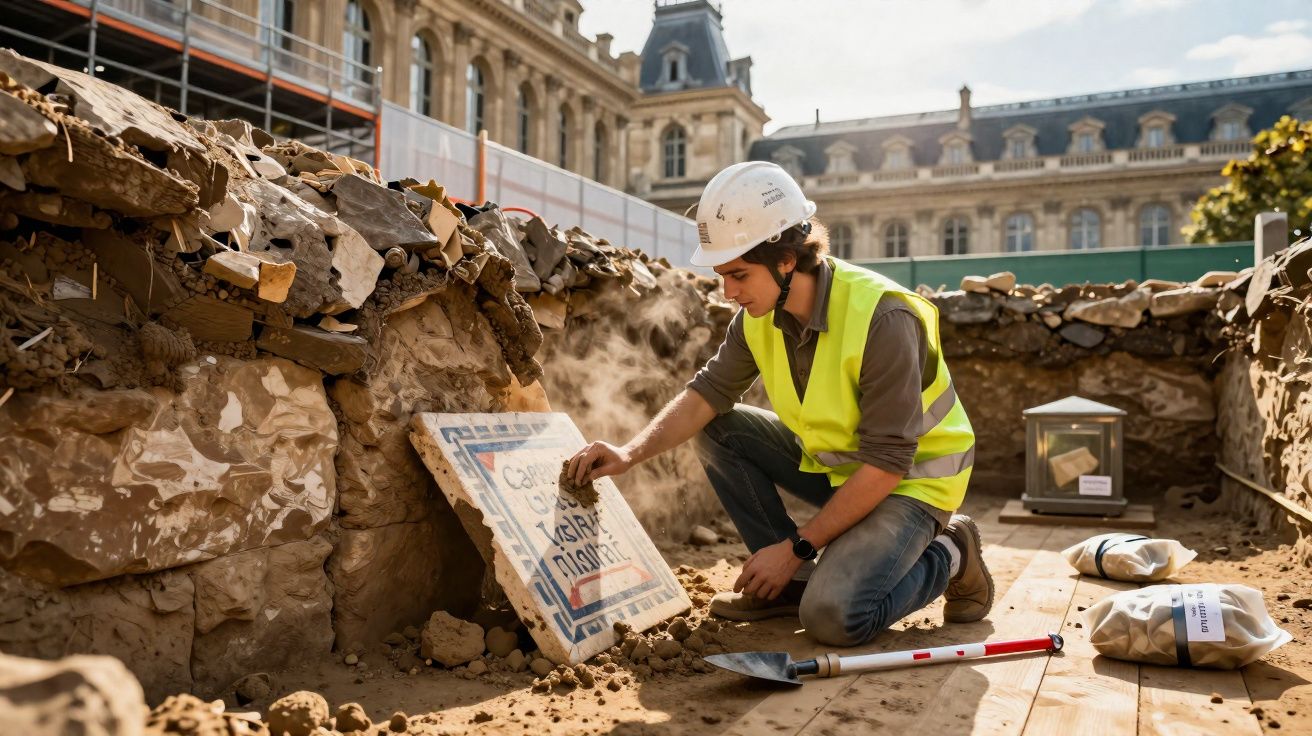
Between scaffolding, power drills and security checks, a long-buried landscape has surfaced within the venerable setting of the Palais de Justice: Roman-era walls, medieval graves and vividly coloured floor tiles. What started as a routine refurbishment job is now forcing more than one chapter of the city’s past to be reconsidered.
The Palais de Justice as an archaeological treasure trove
At first glance, Paris’s Palais de Justice on the Île de la Cité reads as a pure centre of authority: courts, police, controlled access and security zones. Few would expect traces of a Roman frontier town or a royal medieval palace beneath its courtyard. Yet that is exactly where archaeologists from the City of Paris and the French research institute Inrap began work in late summer 2025.
The trigger was planned renovation work. Before excavators and concrete mixers could move in, the ground had to be checked for what might lie below. In France, such “preventive excavations” are mandatory whenever building projects affect historically sensitive areas.
"Across an area of just over 100 square metres, right in the middle of the ceremonial Cour du Mai, an unexpectedly dense sequence of building phases emerged-from Antiquity through to the modern era."
The specialists uncovered far more than scattered pottery fragments and isolated wall lines. Instead, they found near-continuous evidence of use spanning almost 2,000 years. In several places, the discoveries also cut across what established historical plans of the island have long suggested.
The substantial ancient wall line
One of the most striking features is a heavy wall remnant from Late Antiquity. The base measures around three metres wide-far more than a typical domestic wall-pointing to a military purpose or, at the very least, a highly representative structure.
The working hypothesis among the archaeologists is that this wall line formed part of the late Roman defences of the Île de la Cité: the fortifications intended to protect Paris between the 3rd and 5th centuries AD.
"If this connection is confirmed, the accepted course of Paris’s Roman city wall will have to be corrected-right at one of the capital’s most symbolic locations."
Around the wall remnant, the teams recorded roughly twenty pits, several post-holes and at least six inhumation burials in simple earth graves. This kind of evidence implies mixed activity: craftwork, everyday construction and likely small timber-built structures.
Beneath these layers, still older traces appeared. The earliest ditches and cut features date to the turn of the 1st century BC to the 1st century AD. That pushes the island’s earliest evidence of Roman urban development much closer to the very beginning of Roman rule in Gaul.
What this wall remnant changes in our view of Paris
Until now, historians have favoured a specific route for the Late Antique city wall, based on earlier finds and historic plans. The newly identified wall line does not fit neatly into that model, opening up several possibilities:
- The fortification ran differently from what has been assumed.
- There were additional defensive works or outworks.
- Some parts of the island were more heavily fortified than others.
Any of these scenarios would reshape how we understand the city’s layout at the time: Where were the gateways? Which zones were considered secure? How tightly packed was the built-up area?
Medieval splendour beneath the courtyard paving (Palais de Justice)
The excavation did not only produce Roman and Late Antique material. Immediately above the older layers were remains from a very different period: the medieval monarchy on the Île de la Cité.
During removal work, the teams encountered substantial destruction layers. These can be linked to major rebuilding efforts following the devastating fire of 1776. Within this rubble, numerous painted floor tiles were recovered.
"The so-called 'carreaux historiés' from the 13th and 14th centuries feature fleur-de-lis motifs, animal figures and ornamental patterns-a visual language of the Capetian kings that also appears in the Louvre."
Researchers already know comparable tiles from the Louvre’s Cour Carrée. At the Palais de Justice, however, they now appear in a different setting: as traces of the royal palace on the island, long before the court shifted to the Seine bank near the Louvre.
An unexpected cellar space
A medieval cellar area proved particularly significant for urban and architectural historians. Its walls, floor remnants and the shape of the cut in the ground all indicate that a sizeable building once stood here.
What makes it so surprising is that this space does not appear on any of the known historical plans. Despite extensive scholarship on the royal palace’s history on the Île de la Cité, this part of the complex had remained invisible.
The finds suggest that in the High Middle Ages the Capetian palace was more intricately organised than previously thought. Individual buildings were later remodelled, demolished or absorbed into newer structures. The cellar zone beneath the Cour du Mai represents one such “blind spot”, now outlined clearly for the first time.
Graves between courthouse and cathedral
Within the excavated area, archaeologists mapped a total of eleven burials. These are simple inhumations without elaborate grave goods. For now, it remains uncertain whether they belong to a small cemetery, an extension of a churchyard, or a separate burial ground.
| Find category | Period | Possible interpretation |
|---|---|---|
| Wall base (approx. 3 m wide) | Late Antiquity (3rd–5th c.) | Part of the Île de la Cité’s city defences |
| Graves in simple earth | Antiquity to Middle Ages | Small burial zone near ecclesiastical sites |
| Painted tiles with fleur-de-lis | 13th–14th c. | Prestigious fittings in the royal palace |
| Medieval cellar space | High Middle Ages | Previously unknown wing of the palace complex |
The setting is sensitive: between Notre-Dame, Sainte-Chapelle and judicial buildings, many historic functions overlap. Over long periods, the island accommodated law courts, royal administration and religious institutions in parallel. It is therefore no surprise that the traces in the ground are just as varied.
What happens next in 2026
The 2025 excavation represents only the first phase. A second campaign is planned for spring 2026 on another part of the Palais de Justice. There, researchers expect further clarification on the line of the ancient walls and the layout of medieval structures.
Once fieldwork ends, analysis continues in laboratories and archives. Pottery sherds, tile fragments, mortar samples and human remains will be dated, examined and compared with known series. At the same time, historic maps, plans and written sources will be combed through to connect the new evidence with what has been recorded in the past.
"It is precisely the combination of finds from the ground and archival research that can reveal where old drawings are incomplete-and how much the city’s structure has shifted over the centuries."
Why these discoveries matter far beyond Paris
What emerges in a courtyard of the Palais de Justice is not only of interest to enthusiasts of Parisian history. The results feed into multiple research areas: Roman military architecture, early medieval urban development, courtly culture in the High Middle Ages, and rebuilding after disasters such as the fire of 1776.
For Roman archaeology, the wall remnant provides a concrete example of how late Roman cities protected and consolidated their cores. The mix of a broad wall, adjacent pits and nearby burials allows informed inferences about how the edge zones of a fortification were used-military, civilian or a combination of both.
For medieval studies, the cellar, tiles and rubble layers show how royal residences operated: richly furnished, continually remodelled and-after catastrophe-radically renewed. That dynamic is captured directly in the material beneath the Cour du Mai.
Key terms explained: preventive archaeology and “carreaux historiés”
If you do not deal with excavations regularly, specialist terminology can be a hurdle. Two terms recur particularly often in this project.
Preventive archaeology means excavations carried out before construction begins. Developers must establish whether protected remains lie beneath the footprint of a planned project. This is the only way to record and preserve important traces of the past before machinery destroys them irreversibly.
Carreaux historiés are decorated floor tiles, often square and made of fired clay. They carry figurative scenes, coats of arms, plant motifs or animals. In the Middle Ages, ruling dynasties used such tiles to project status and identity. The fleur-de-lis motifs found at the Palais de Justice clearly signal the French monarchy.
What these excavations could mean for visitors and residents
As the scientific assessment progresses, practical questions follow: will any of the discoveries remain visible? Could visitors one day learn more on site about the ancient and medieval layers beneath the Palais de Justice?
Several outcomes are possible. Certain wall sections could be incorporated into future alterations-perhaps via glass flooring or small viewing areas. Digital reconstructions could be built into guided tours or exhibitions to make the successive phases easier to grasp: from Roman defences to the royal palace, and on to today’s judicial complex.
For the city itself, such finds bring both opportunity and disruption. They add valuable knowledge, but they can also slow building timetables. At the same time, they sharpen awareness that historical layers lie beneath even the most familiar surfaces. In the heart of Paris, almost any major construction project can open unexpected windows onto the past-just as has happened now, in the shadow of the courtrooms on the Île de la Cité.






Comments
No comments yet. Be the first to comment!
Leave a Comment