
How can that be?
In the day-to-day life of many couples, there is a gap between what they believe and what they actually do: they talk about equality, yet quietly fall back into the old pattern of “she takes care of it, he helps”. Look a little closer and it becomes obvious that this is not only about the hoover, the laundry basket and lunchboxes, but about recognition, power and money - and, ultimately, whose time is treated as more valuable.
When a partner is reduced to “the helper”
One phrase crops up again and again in supposedly modern relationships: “He helps me a lot.” It sounds positive, but it gives away the central issue. Helping is not the same as owning responsibility. The person who remains “responsible” is often still the woman - the one who keeps track, plans, remembers, nudges things along, and then steps in to do it herself when there is a crisis.
“Most men today objectively do more housework than their fathers - but the direction of everything still often runs via the women.”
Psychologists describe this as the mental load: an ongoing mental strain created by having to hold the whole system together. Someone has to know when the child needs new shoes, when the vaccination appointment is, what groceries are missing, and how to fit school holidays, nursery closures, work projects and sports clubs together like a jigsaw. That invisible organising takes energy - and in heterosexual couples it usually sits with the woman, even when both partners work full time.
“I don’t want to ask for help - I want equality”
A common turning point is when a woman realises: in practice, she has two jobs - one paid and one unpaid. She arranges childcare, finds a babysitter, sorts GP appointments and vaccinations, coordinates school messages, buys birthday presents, washes, cooks, tidies - and still hears: “You only had to say something.”
That is where two mindsets collide. For him, the household is a set of tasks: if you want support, you ask for it. For her, it is a living system that functions only because she is constantly thinking ahead. And when you have to hold the overview all the time, you stop feeling like an equal partner and start feeling like the project manager of a family business.
Why old role models are stronger than we think
Many couples see themselves as progressive - until a baby arrives. Then they often slip, almost unnoticed, into patterns learned from their parents. The woman is frequently the first to cut her working hours, because she earns less or because “it’s more flexible for her”. He “steps in” when it gets tight. On paper it can look fair, but in daily life it quickly creates an imbalance.
There is also a stubborn script running in many people’s heads: the mother is supposed to know instinctively what to do, and to do it better. That is how a sentence therapists hear all the time is born: “I let him do it, but then I end up doing it again because he does it differently.” Behind the constant correcting there is often a need for control - and beneath that, fear: fear of being judged, fear of being a “bad mother”, or fear of chaos.
“Control in the household can look like strength from the outside - but internally it’s often a sign of overwhelm and fear of letting go.”
At the same time, men often play down the workload with a familiar line: “Our mothers managed all of this too.” That ignores how different everyday life used to be. Fewer hobbies, fewer enrichment activities, fewer expectations of constant supervision. Children spent hours playing outside; today, schools, nurseries and clubs expect ongoing involvement, organisation and presence. The demands have risen, but the day has not gained any extra hours.
When he stays at home - and it still explodes
Things get particularly revealing when couples reverse the model: she works, he stays at home with the baby. On paper, it sounds like equality in its purest form. In reality, deeply embedded role expectations collide - for both partners.
Many women suddenly notice how hard it is to give up control: they call from the office, asking whether the child has eaten, whether the hat is on, whether they went for a walk. The man quickly experiences this as a put-down: “If you don’t trust me, then do it yourself.”
Then there are comments from friends, family and acquaintances that hit straight at self-worth. He is seen as “unemployed”, she as a “career woman who neglects her child”. Sex suffers, shame creeps in. He no longer feels “masculine”; from the outside she is told she is a bad mother. What began as a practical arrangement turns into an existential relationship crisis.
An argument about the washing-up is rarely just about the washing-up
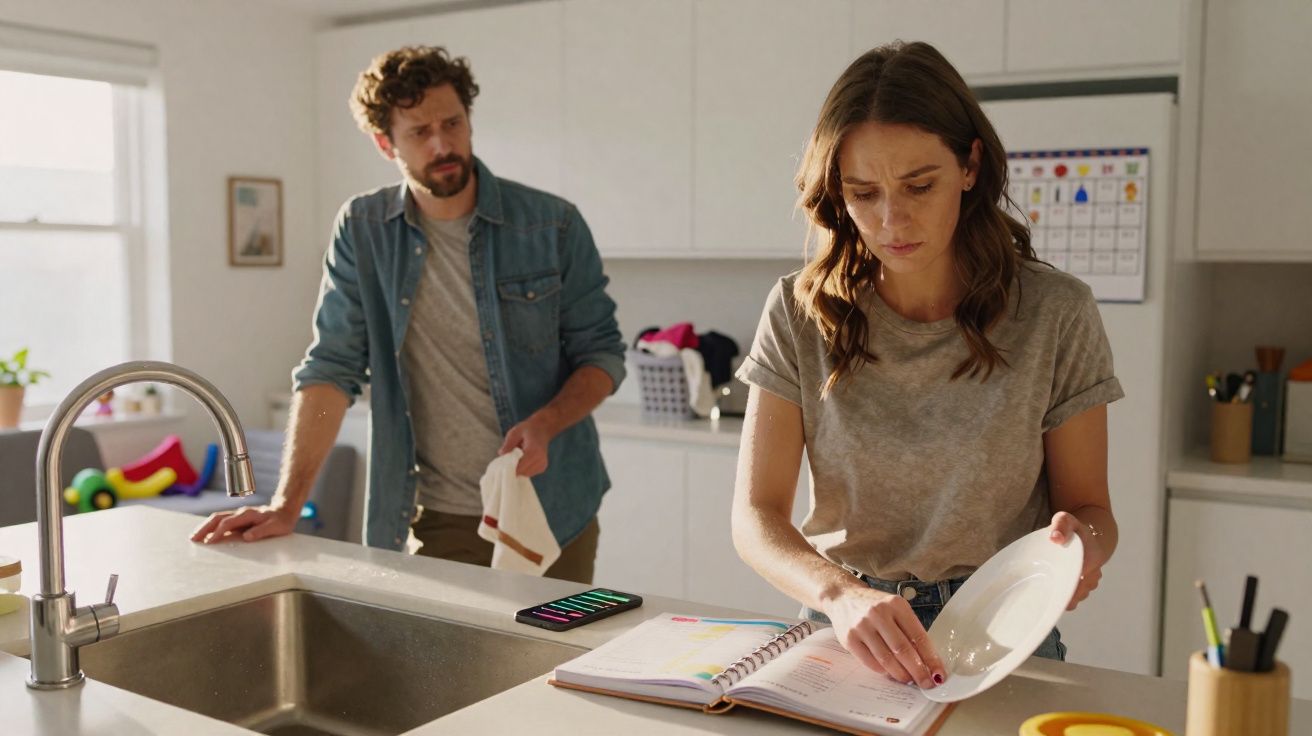
Therapists see a recurring pattern: couples appear to fight about the bins, the dishwasher or the children’s toothbrushing. What they mean is something else entirely: “Do you see everything I do?” - “Are you taking my exhaustion seriously?” - “Do you treat my time as less valuable?”
“Behind ‘You never help me around the house’ there’s often the sentence: ‘I don’t feel seen by you.’”
At this point, many women slip into an internal auditing mode. They list tasks, keep a mental ledger of who did bedtime, who cooked, who hoovered, and how often. Men often respond with a counterattack: “I’m tired too” or “I’ve been working all day.” That creates the familiar exhaustion ping-pong: each believes they are at their limit, and each feels misunderstood.
The sticking point: truly handing over responsibility - and truly taking it
A key shift in couple therapy is this: he should not merely “help”, but take full ownership of entire areas. Not: “Can you do the paediatrician appointments today?” but: “From today, you’re responsible for everything to do with the paediatrician.” Thinking ahead, organising, remembering, attending - the whole package.
That only works if both can tolerate their part:
- He has to accept that he is genuinely in charge - without constant instructions.
- She has to cope with things being done differently from how she would do them.
- Both need to live with the fact that not everything will be perfect, just “good enough”.
This is exactly where many couples slide back into old patterns: he does it “wrong”, she steps back in, he eventually disengages completely. And then the same line returns: “Just tell me what you want me to do.” The mental load lands right back on her shoulders.
Is a real 50/50 household even possible?
It is an appealing idea: both work roughly the same amount, split housework and childcare exactly in half, and everything is fair and balanced. In everyday life, that model can start to feel like a maths exercise with frustration built in.
That is why therapists often recommend a different lens. More important than mathematical fairness is flexibility. In different seasons of life, people have different resources. Sometimes one person is under more pressure at work; sometimes someone is struggling with their health; sometimes a child needs extra attention.
| Rigid 50/50 | Flexible model |
|---|---|
| Every task is calculated precisely | What matters is who currently has more capacity |
| High pressure to be “fair” | Focus on relief and a sense of teamwork |
| High risk of conflict with every deviation | More room for exceptions |
| Risk of constant monitoring | More trust in the other person |
Instead of fixed quotas, experts often suggest a foundational conversation: What values matter to us? What did roles look like in our parents’ homes - and what do we absolutely not want to repeat? Who prioritises career more, and who prioritises time with the children? How do we want to handle money if one person earns significantly less, or nothing at all?
When the traditional model works well - and when it doesn’t
There are couples for whom a classic setup runs surprisingly smoothly: she chooses to stay at home longer or returns only part-time, and he covers most of the finances. Day-to-day conflict is less likely, as long as two things are clear: respect and joint decision-making.
“A traditional household can work - if financial power is not used as leverage and both genuinely want the model.”
It becomes dangerous when money turns into a tool of control: he monitors spending, she has no account of her own, and starts to feel like a petitioner. Historically, these were exactly the reasons many women wanted to leave the single-earner model. Anyone choosing it consciously today should agree clear rules: money is shared, independence remains, and both partners have access to accounts and information.
Why so many women are overwhelmed even as housewives
Even if a woman “only” stays at home, that does not automatically mean she is relaxed. Many who deliberately put their career on hold to be with the children describe a different problem: they do full-time care work, but feel largely unseen for it. Comments like “You’re at home all day anyway” ignore how demanding a day with small children can be - with no breaks, no end of shift, and no pay.
If a couple chooses this model, clear boundaries are essential. That includes the working partner actively taking on children and household tasks after work, rather than hiding behind “But I bring the money home.” Otherwise, the woman can end up not only financially dependent, but emotionally dependent too.
Practical ways to create more fairness in everyday life
How can couples tackle this without every conversation turning into a row? A few approaches that often help in counselling:
- Make invisible tasks visible: sit down together and write down everything you do for one week - including the thinking and planning.
- Assign packages, not one-off tasks: not “you do bedtime tonight”, but “you own the entire evening routine, including toothbrushing, laying out clothes and sorting lunchboxes”.
- Build in regular check-ins: set a fixed weekly time to ask: who is overloaded right now? where does someone need relief?
- Lower perfection on purpose: less judgement, fewer internal comparisons with Instagram mums, more focus on “good enough”.
- Examine your own beliefs: for example, “Only a mother who is always available is a good mother” or “a real man must always be the main breadwinner”.
What “mental load” really means - and how couples can share it more fairly
The term is everywhere, yet it often stays vague. Mental load means the sum of all the invisible planning and organising that keeps family life running. Not the cooking itself, but the questions behind it: What are we cooking? Do we have all the ingredients? Who shops, and when? Does shopping even fit around work and the children’s appointments?
Some of that mental load can be softened with tools - shared calendars, joint to-do lists, reminder functions. But the decisive factor is still mindset: both people have to feel responsible. A shared calendar is pointless if only one person looks at it and does the planning in their head.
It often helps if men are clear on this point: it is not about “helping her”, but about taking responsibility for a shared life. And if women ask themselves: where am I holding on tightly out of fear or perfectionism, and trusting my partner less than I should?
Equality in the household shows up less in perfectly divided minutes of dusting, and more in how both partners can talk about their time, their exhaustion and their needs - and whether they are willing to adjust their model again and again, instead of clinging rigidly to a number like 50/50.






Comments
No comments yet. Be the first to comment!
Leave a Comment