
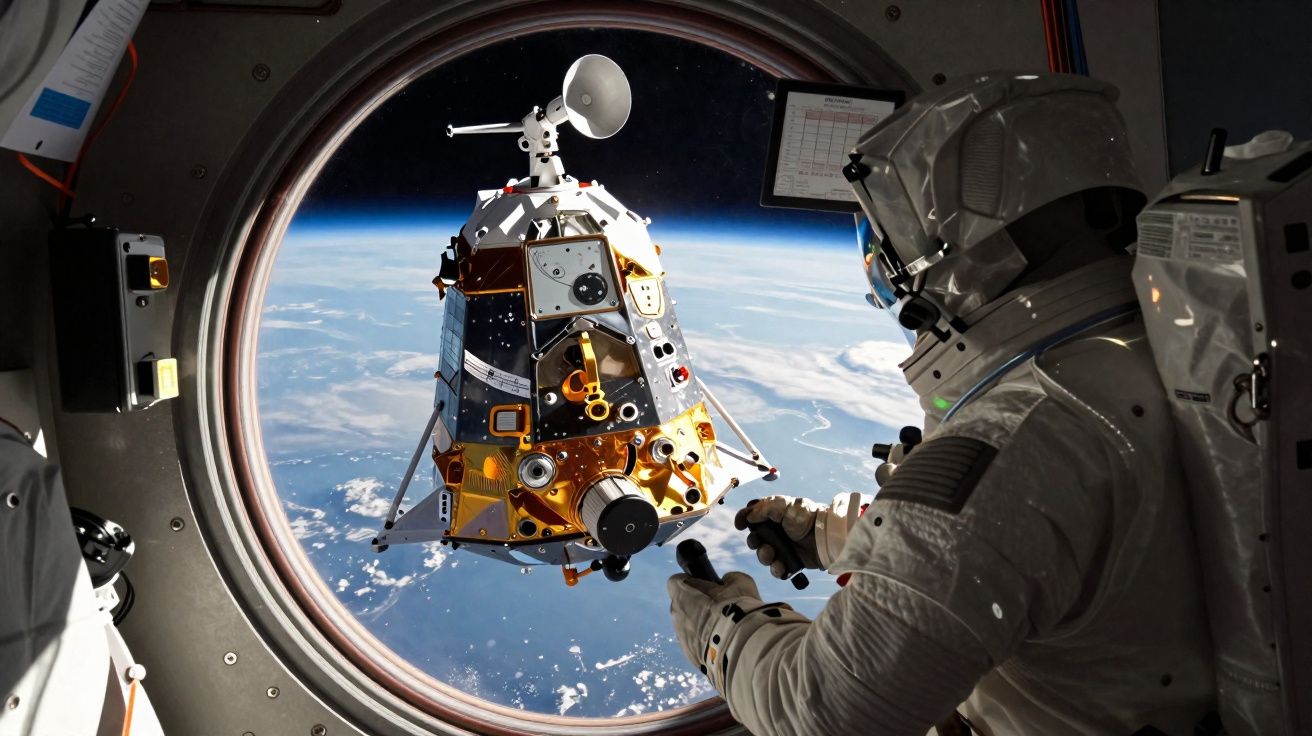
A Russian cargo craft, an awkward antenna fault and a space station that cannot function for long without regular deliveries: what should have been a routine procedure in March 2026 turned into a tense episode in low Earth orbit. A malfunction aboard the Russian resupply ship Progress 94 prevented an automated docking with the International Space Station (ISS) - leaving a cosmonaut on the station to “capture” the multi-tonne vehicle by hand via remote control.
A routine launch with a catch: an antenna refuses to deploy
At first, the mission looks textbook. On 22 March 2026, at 13:59 UTC, a Soyuz rocket lifts off from the Baikonur Cosmodrome in Kazakhstan with the uncrewed Progress 94 freighter on top. The task is straightforward: deliver roughly 2.5 tonnes of supplies, water, propellant and scientific equipment to the ISS.
The ascent is clean, stage separation happens as planned, and the spacecraft settles into orbit. Only around 40 minutes after launch do flight controllers on the ground spot the issue: one of Progress’s docking antennas has not deployed properly. It sounds minor - but it effectively disables the entire autopilot for rendezvous and docking.
The reason lies in the Russian rendezvous package known as the “Kurs” system. It relies on multiple antennas on the freighter and matching targets on the ISS to continuously measure distance, closing speed and alignment. The onboard computer then computes a stream of corrections until the spacecraft locks into the docking port with centimetre-level precision. If a key antenna fails, that radio “conversation” collapses - and the automatic pilot can no longer effectively “see” the station.
"One jammed component is enough to turn a fully robotic docking manoeuvre into a risky manual operation."
NASA quickly reports the fault through its online channels, while stressing that all other spacecraft systems remain stable. With the antenna problem unresolved, the planned automatic docking to the Russian Poisk module two days after launch is no longer an option. As engineers on the ground begin diagnostic procedures, Progress 94 continues closing on the ISS.
Nearly three tonnes of supplies for seven people living in space
To grasp what is at stake, imagine the ISS as a sealed flat with no supermarket deliveries, no DIY shop and no petrol station. Everything consumed onboard must be replenished by cargo flights. Even without an immediate threat to life, any delay disrupts a tightly managed inventory plan.
Progress 94 is carrying about 2,500 kilograms of cargo; some estimates put the total, including technical equipment, at almost three tonnes. The manifest includes food, drinking water, propellant for orbit reboosts, spare parts for life-support systems and equipment for experiments. At the time, seven people are living aboard the ISS: two Russian cosmonauts, one US astronaut, and the four-person crew of a SpaceX mission - three Americans and one Frenchwoman.
The timing is also unforgiving. The previous cargo ship, Progress 92, had departed only days earlier, disposing of the crew’s rubbish during a controlled burn-up in the atmosphere. That rhythm is carefully choreographed: freighters arrive, spend months as storage and as an orbital “bin lorry”, then are deliberately deorbited. A single failure in that chain ripples forward into subsequent missions.
- Supplies such as food and water are planned well in advance.
- Spare parts keep critical systems, including oxygen generation, operating reliably.
- Propellant delivered by freighters is used to correct the orbit of the ageing station.
- Experiments depend on time-sensitive deliveries and returns.
A failed docking, then, would not immediately cut off breathing air - but it would tighten margins, put reserves under greater pressure, and force mission planners to reshuffle upcoming flights and priorities.
When the autopilot cannot dock: a cosmonaut takes control from the ISS
There is an established contingency for exactly this scenario. Once it becomes clear that the Kurs system cannot be relied upon because of the antenna, Roscosmos and NASA switch to “Plan B”. Under that plan, an experienced cosmonaut aboard the ISS manually pilots the incoming vehicle from a telecommand console.
This time, the role falls to Sergej Kud-Swerchkow. Serving as a flight engineer and commander on the current expedition, he already has about half a year of spaceflight experience from an earlier mission. In Russia’s training centre, cosmonauts practise these precise situations for years in simulators: a freighter approaches, automation fails, and a human has to take over.
"On Kud-Swerchkov’s monitors, the Russian freighter looks like a target in a video game - except that real tonnes of mass are moving outside."
Using camera feeds and sensor read-outs, he controls thrusters and attitude on Progress. Formally, the station and spacecraft are orbiting Earth together at roughly 28,000 kilometres per hour, but relative to one another the final approach happens at only a few centimetres per second. Even so, the task remains demanding: a small impulse in the wrong direction can significantly alter the approach geometry.
The ISS telepresence control console relays Kud-Swerchkov’s commands to the freighter with minimal delay. He must continuously track speed, range and rotation, while teams in the mission control centres in Moscow and Houston monitor the same telemetry and provide guidance.
Manual docking of Progress 94: a risk built into the system
To the public, a manual capture in orbit may sound dramatic, yet it is deliberately planned for. Progress and the ISS are designed with layered fallbacks that allow operations to step down from automation to human control. Astronauts and cosmonauts regularly rehearse such “rendezvous under degraded conditions” during training.
Still, every real-world use highlights how quickly a highly automated flight can hinge on one person’s judgement. Unlike in aviation, there is no divert airfield and no option to “pull over” if things deteriorate - only a limited corridor in which the spacecraft and station can be brought together cleanly and safely.
Ageing ISS, setbacks that are becoming more frequent
The Progress 94 incident does not occur in isolation. Even the freighter’s launch had already slipped by months after the Baikonur launch facility was damaged during an earlier attempt. Engineers had to carry out extensive repairs on the affected pad before launches could resume.
At the same time, the ISS itself has been accumulating technical and organisational stress tests. In early 2026, one mission ended abruptly when a US astronaut had to return to Earth unexpectedly for medical reasons - along with the entire team. In previous years, two NASA astronauts remained on the station for months longer than planned after problems with Boeing’s new Starliner capsule led it to return uncrewed.
Specialists note that each disruption, taken alone, remains manageable. Together, however, they reinforce the impression of a platform being operated far beyond its original design life. The ISS began assembly in the late 1990s and was designed for roughly 15 years of continuous operation. It is now approaching its third decade.
By around 2030, the station is expected to be brought down from orbit in a controlled manner. Until then, it remains a logistical megaproject: constant resupply flights, repairs, software updates and emergency drills - and, from time to time, moments when human skill bridges the gap left by imperfect hardware.
How risky are these manoeuvres in practice?
From the ground, it can feel alarming: a cargo ship “racing” towards a space station without an automatic braking and docking sequence. In reality, safety mechanisms exist to avoid collisions. If sensors produce inconsistent values or the approach becomes unstable, controllers can trigger an abort. The freighter then flies past the station, backs away, and later begins a new approach.
Many experts argue that cosmonaut control can even reduce risk, because a person can adapt to unexpected situations more flexibly than a computer limited to well-defined cases. Training centres in Russia and the United States deliberately expose crews to as many “impossible” scenarios as they can, so that in a real emergency they are not trying to recognise patterns for the first time.
The incident also underlines how interdependent international spaceflight remains, despite growing privatisation. Russian freighters deliver propellant and parts used across the station, US capsules carry other cargo and rotate crews, while European and Japanese partners contribute specialist modules and experiments. If one element falters, everyone else has to adjust.
What terms like “Kurs system” and “docking” actually mean
For anyone who does not follow spaceflight day to day, reports like this can be full of technical shorthand. Two terms are central to the Progress 94 case:
| Term | Explanation |
|---|---|
| Kurs system | Russian radar and radio system for rendezvous and docking. It measures distance, speed and alignment between freighter and station and automatically controls the approach. |
| Docking | The mechanical and electrical joining of two spacecraft. Guidance mechanisms bring the two openings together, latches lock, and fluid lines plus data connections link up. |
Docking remains one of the most demanding phases of any mission. Unlike launch - dominated by huge engines and heavy structures - docking is precision work: tiny adjustments using small thrusters, carefully controlled contact speed, and protection measures in case anything binds or misaligns.
A single faulty antenna segment, as with Progress 94, can seem almost trivial. Yet exactly that sort of detail can be the difference between an uneventful routine flight and an operation that sends even an experienced cosmonaut’s pulse climbing - and exposes how thin the comfort margin in space can really be.





Comments
No comments yet. Be the first to comment!
Leave a Comment