
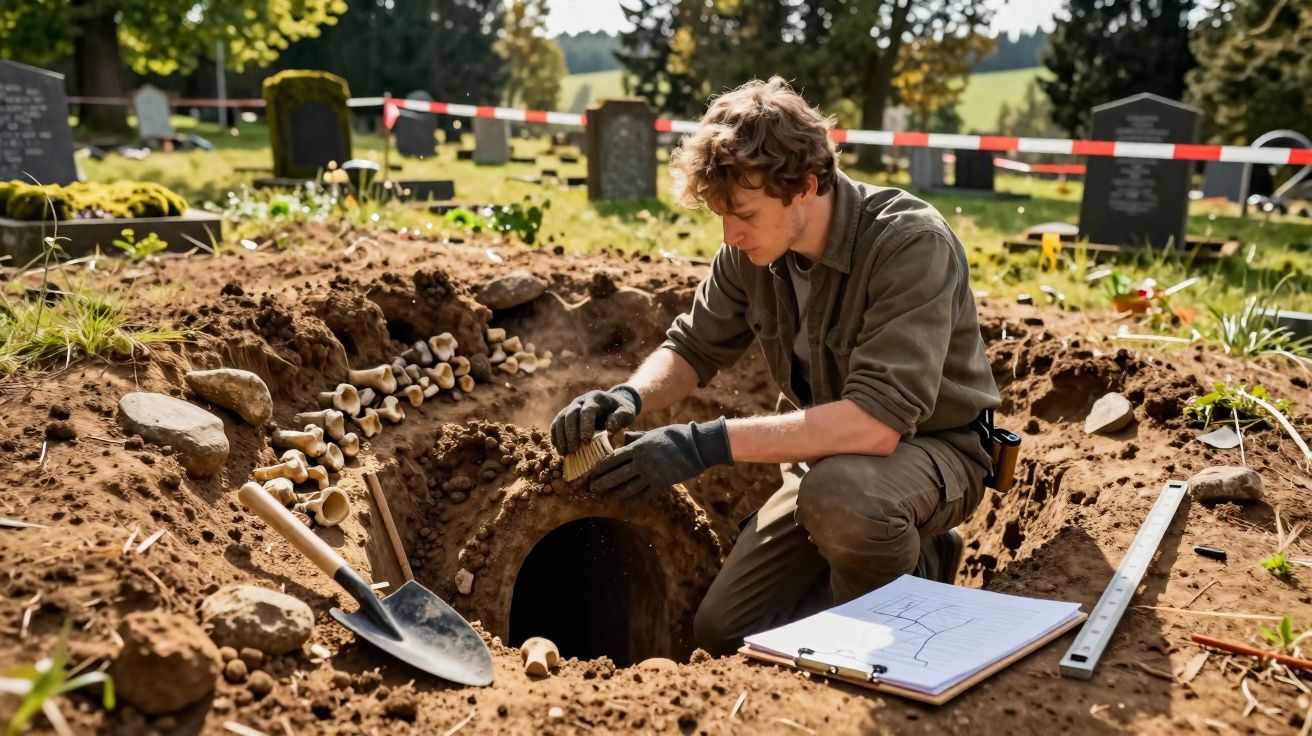
Routine archaeological work ahead of a planned wind farm has led to an unexpected discovery in central Germany: a medieval underground passage revealed beneath a prehistoric burial ground that stretches back as far as 6,000 years. The find highlights how successive communities repeatedly claimed the same hilltop over millennia-first for the dead, later for shelter, and perhaps for rites whose meaning is still unclear.
In Saxony-Anhalt’s Harz district, a “grave” turns out to be a tight passage
The discovery was made in the Harz district of Saxony-Anhalt. The work formed part of standard preventive excavation: before construction begins on a wind farm, specialists check whether the ground contains significant remains. In most cases, teams uncover pottery sherds, old post-holes, or traces of ditches.
Here, the first signs seemed familiar. Excavators found an elongated pit about 2 metres long, carefully sealed beneath a heavy stone slab. At a glance, it looked exactly like a Neolithic burial-an inhumation from the Late Stone Age.
As the structure was exposed layer by layer, that interpretation unravelled. Beneath the slab there was no conventional grave chamber. Instead, the feature continued downward, narrowing and twisting as it went.
"Where a grave was expected, a tunnel appeared that winds like a worm through the hill – clearly made by human hands."
As excavation progressed, it became apparent that this was a classic Erdstall-the archaeological term for narrow, man-made underground passages and small chambers, most often dated to the Middle Ages.
What is an Erdstall underground passage?
Erdställe are known from several parts of Central Europe and tend to share a set of characteristic traits:
- extremely narrow, low passageways, often only passable crouching or crawling
- cut artificially into undisturbed ground, rather than formed naturally
- small widenings that resemble chamber-like spaces
- little to no daylight, with access typically concealed
At Dornberg in the Harz, the specialists involved describe features that fit the pattern closely: tight tunnels, small hollows along the route, stones set in place to reinforce sections, and pottery fragments indicating the Late Middle Ages. Those sherds provide the key evidence for placing the site’s use within a specific period.
The bigger question remains unresolved: what were these cramped passages for? Only rarely do Erdställe yield unambiguous traces-such as stored goods, weapons, or clearly identifiable ritual objects. The Dornberg structure is no exception.
A burial landscape used for 6,000 years at Dornberg
The location of the Erdstall is anything but accidental. The hill known as Dornberg has long been recognised as an archaeological hotspot, with an exceptionally long record of activity.
Below the medieval passages, excavators uncovered multiple layers of earlier remains, including:
- a ditch from the Early Neolithic, attributed to the Baalberg culture
- burials from the Late Neolithic
- remnants of a Bronze Age burial mound
Taken together, these finds show the hill was used as a burial and ritual place for roughly six millennia. Generation after generation returned to the same rise to bury their dead. Many of those graves remained visible in the landscape for a long time-through mounds, banks, edges, and ditches.
"A place where you could almost see the past stayed in people’s memory for millennia – and was reinterpreted again and again."
That long-standing, visibly marked tradition may help explain why someone in the Middle Ages chose precisely this spot to cut an underground passage.
Hideout or ritual space? Two leading theories about the Dornberg Erdstall
Researchers have debated the purpose of Erdställe for years, and the new find adds fresh evidence to that discussion. Broadly, two interpretations dominate.
Hypothesis 1: A refuge in troubled times
Dornberg’s setting already offers a degree of natural defensibility. Ditches, banks and abrupt changes in terrain would make it harder for attackers to approach. In periods of crisis-such as local feuds or raids-a hill with concealed underground voids could function as a retreat.
Arguments in favour include:
- the hidden nature of the entrance
- the ability to vanish completely from view
- the combination of a natural rise with artificial underground spaces
One weakness remains: many Erdställe, including this Harz example, provide very little room for larger groups or supplies. They feel more like short-term hiding places than substantial defensive shelters.
Hypothesis 2: A setting for medieval rituals at Dornberg
The second major reading treats Erdställe as venues for rites-possibly strongly religious or magical in character. The proximity to graves thousands of years old strengthens that case.
A medieval traveller moving through a landscape where ancient barrows, ditches and stones had stood for ages would hardly have experienced such places as “neutral”. They could signify ancestors, something old and powerful-or simply a realm entered only with respect.
In that light, an underground passage beneath such a site might have been designed to tap into the place’s charged atmosphere. The tightness, darkness and silence intensify the sense of crossing a threshold between worlds.
"It seems likely that people did not choose Dornberg by chance, but deliberately restaged an already sacred place once more – in the ground, beneath the old graves."
Layers of history: why the Harz Erdstall matters to research
For archaeology in Germany, the Harz Erdstall is particularly significant for three reasons:
- Rarity: tunnel systems of this type are uncommon, and well-preserved examples even more so.
- Clear context: the passage sits within a long-used burial ground, enabling meaningful comparison.
- Dating: Late medieval pottery provides relatively precise clues to the period of use.
This makes it easier to compare Dornberg with similar sites documented in Bavaria, Austria, or the Czech Republic. Some of those passages occur near old churches; others, as here, lie on prominent landforms with long-standing significance.
How archaeologists read stories from traces in the soil
Anyone who has never visited an excavation often underestimates how little evidence is needed to narrow down a feature’s date and likely function. At Dornberg, the teams could draw on, among other things:
- the shape of the pit and the tunnel
- the feature’s position in the terrain
- pottery fragments within the fill
- the relationship to earlier structures nearby
Together, these elements form a coherent picture: the style and firing techniques of the pottery point to the Late Middle Ages, while the way the passage is set into the hill-and cuts through or overlies older burials-offers clues to people’s intentions. Future laboratory work on micro-finds such as charcoal or animal bone could add further detail.
Why Erdställe are relevant far beyond the Harz
Erdställe force researchers to confront basic questions. How did medieval communities relate to landscapes where traces of much older cultures were still visible? Did they see ancient barrows as places of fear, of veneration, or as useful sources of unease that might deter intruders?
The Dornberg evidence suggests the hill was not used by chance, but chosen deliberately as a place with “history”. Walkers in the Harz today rarely realise how densely time layers overlap there. Beneath modern paths, fields and now wind turbines lie remains that speak of upheaval-from the first farmers settling down to the conflicts and belief-worlds of the Middle Ages.
For future research, the opportunities are clear: the Erdstall can be dated more precisely in the laboratory, reconstructed virtually, and compared systematically with other sites. Patterns may emerge-preferred locations, repeated construction elements, or consistent relationships to older monuments. With each newly discovered passage, the chances improve of understanding these narrow, dark corridors a little better-and, in turn, the people who stood on the same hills centuries ago.






Comments
No comments yet. Be the first to comment!
Leave a Comment