
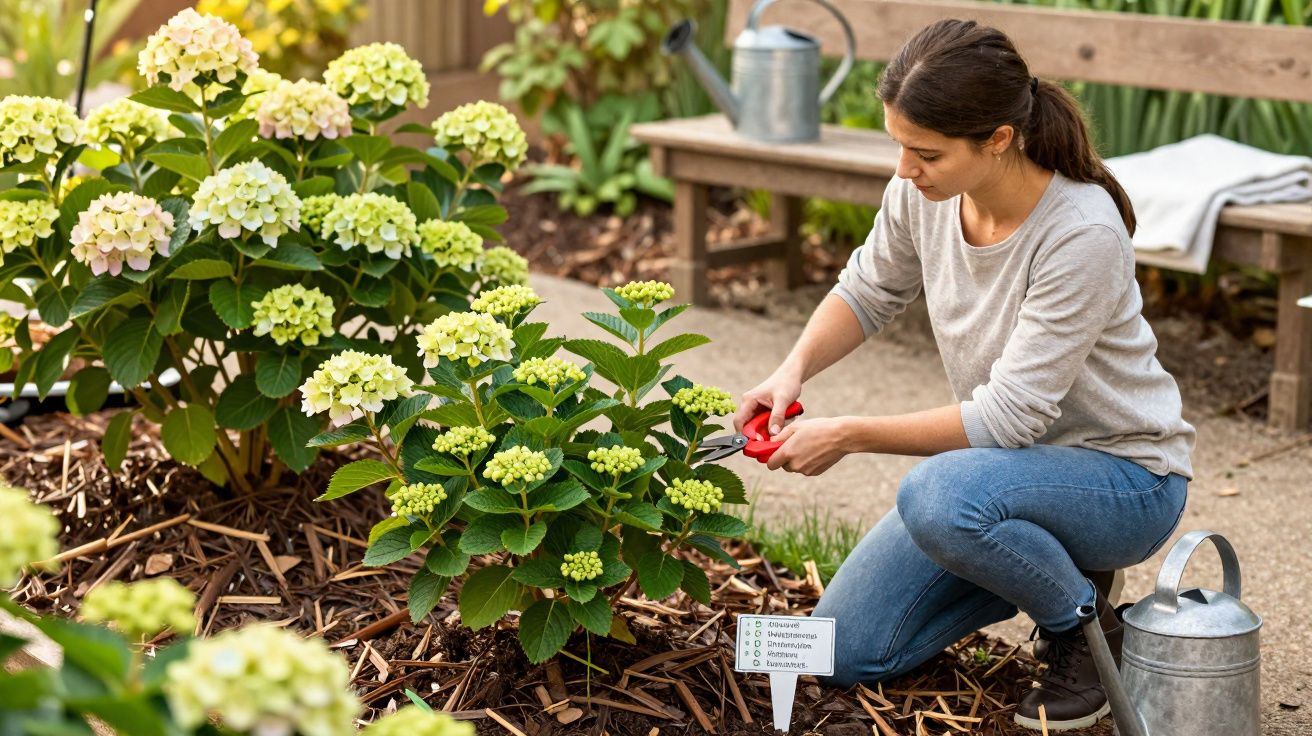
Many amateur gardeners know the disappointment all too well: a few years ago your hydrangeas were a breathtaking sea of flowers, and now you’re left with little more than green balls dotted with a few tired blooms. In most cases, it’s not down to “bad soil” or “the wrong weather”, but to missed-or misguided-care after winter. If you act purposefully in early spring, you can get your hydrangeas back into peak condition for years to come.
Why spring determines your hydrangea flowering
The most important call for flowering is made between late winter and the very start of spring. At this point the buds begin to swell, but they haven’t opened yet. That’s exactly when hydrangeas are extremely sensitive to pruning mistakes-and remarkably responsive to the right approach.
"Most flowering failures in hydrangeas are caused by the wrong pruning at the wrong time-not by the soil or the weather."
Cut back too hard and you simply remove the future flower buds. Do nothing at all and the shrubs become old and woody. Either way, the result is the same: flower heads that get smaller and sparser. The aim is therefore clear: remove old and weak shoots while keeping strong, younger shoots that already carry buds.
Classifying hydrangeas properly: which type needs which cut
Before you even pick up the secateurs, it pays to identify the type you’re dealing with. Hydrangeas can be split into two broad groups, and they must be treated very differently.
Group 1: flowering on last year’s wood
This group mainly includes:
- Bigleaf hydrangea (Hydrangea macrophylla)
- Mountain hydrangea (Hydrangea serrata)
- Oakleaf hydrangea (Hydrangea quercifolia)
- Climbing hydrangea
These varieties set their flower buds in the previous summer. Those buds sit on older wood. If you cut too low in spring, you remove the very buds you’re hoping for-so the plant will leaf out vigorously, but produce hardly any flowers.
With these hydrangeas, the rule is: work gently, remove little, and leave buds deliberately.
Group 2: flowering on this year’s wood
Panicle hydrangeas and the well-known cultivar Hydrangea arborescens ‘Annabelle’ behave differently. They form flowers on new shoots produced in the same year, which makes them far more tolerant of pruning.
Here you can cut back boldly without sacrificing this year’s display. In fact, a strong prune encourages powerful new growth with impressive, globe-like blooms.
Three straightforward pruning rules for years of hydrangea flowers
1) Bigleaf and lacecap hydrangeas: trim with restraint
For all varieties that bloom on last year’s wood, the guiding principle is precision rather than drastic cutting.
- Remove only the dried flower heads-cutting just above a sturdy pair of buds.
- Cut out dead, blackened or very thin wood right down at the base.
- Each spring, remove one to three of the oldest, thickest stems close to ground level to rejuvenate the plant.
This way the flowering wood remains intact, the shrub doesn’t become over-woody, and blooms stay plentiful and evenly distributed. If you avoid pruning altogether out of caution, you risk a dense, woody tangle over time-with ever smaller flowers.
2) Panicle hydrangeas: build a strong framework
Panicle hydrangeas can handle a noticeably harder cut. In practical terms, that means:
- Shorten all shoots by roughly one third to one half.
- Always cut just above a pair of outward-facing buds-this opens the shrub and helps it keep a stable shape.
- Remove crossing or rubbing stems so air and light can reach the centre.
If you cut back more severely, you’ll get fewer flower heads, but they’ll be larger and more striking. A moderate prune produces more blooms, though slightly smaller ones-personal preference can decide here.
3) ‘Annabelle’ can be pruned hard
The popular snowball hydrangea Hydrangea arborescens ‘Annabelle’ is exceptionally tough. Gardeners often cut it back to around 20 centimetres above the ground. It reliably shoots again and produces large, round flower heads in summer.
A practical tip: if the heavy flower balls tend to flop after rain, leave the stems a little longer. The new growth will then be slightly shorter and sturdier; the blooms a little smaller, but less likely to collapse.
Spring care: soil, water and protection
Pruning is only half the job. What you do at ground level straight afterwards often decides whether the hydrangea has enough energy for a long flowering period.
Clear the soil and feed appropriately
Remove old, diseased leaves from the ground. They can harbour fungal spores, which spread easily in a damp spring. Then give the plant a nutrient boost:
- Work a thin layer of mature compost into the soil around the root area.
- Alternatively, use a dedicated hydrangea or rhododendron fertiliser that has a mildly acidic effect.
- Don’t feed right up against the stem; apply in a ring towards the outer root zone-this is where the fine feeder roots sit.
"Fertilising properly once in spring does more than lots of small feeds throughout summer."
Mulch properly and water well
Hydrangeas thrive in fresh, evenly moist soil. Summer heat spells can hit them hard if the ground dries out. If you take preventative steps in spring, you’ll reduce water stress later in the year.
A proven mulch layer can be made from:
- Bark mulch or fine bark
- Shredded leaves
- Conifer needles (for example from pines) on lime-rich soils
Mulch keeps the soil cool, conserves moisture and suppresses weeds. During extended dry periods, it’s better to water less often but thoroughly, rather than “dampening” the surface daily. This encourages roots to grow deeper and become more resilient.
Keep an eye on late frosts
In early spring the swollen buds may look hardy, but they’re vulnerable to overnight frosts. A single hard frost can damage the developing flowers.
Practical protection measures:
- If sub-zero temperatures are forecast, cover shrubs with a light horticultural fleece.
- Move potted hydrangeas overnight close to a house wall or into a carport.
- Avoid frost pockets in the garden-cold air settles there more strongly.
Common mistakes-and how to avoid them
Many hydrangea problems recur year after year. A quick check of the usual culprits can save a lot of frustration.
| Mistake | Consequence | Better approach |
|---|---|---|
| Hard pruning in autumn | Flower buds freeze or are removed | Prune in late winter or early spring, when buds are visible |
| Cutting bigleaf hydrangeas too low | Lush foliage, hardly any flowers | Remove only old flower heads and old wood; leave pairs of buds |
| Over-fertilising with nitrogen | Strong leaf growth, soft tissue, more prone to disease | Feed moderately but purposefully; use a specialist fertiliser |
| Waterlogging | Root damage, shoots die back | Choose a well-drained position; improve heavy soils with compost and sand |
Extras for hydrangea fans: colour effects, companions and risks (hydrangeas)
If you’re keen on hydrangeas, you’re often watching not only the number of blooms but also their colour. Bigleaf hydrangeas, in particular, react strongly to soil pH.
Blue and violet shades develop in more acidic soil where aluminium is available. Pink and red tones hold better in neutral to slightly limey soils. Special “bluing” fertilisers or alum products can influence the colour, but they only work if the variety is naturally capable of turning blue.
The right companion plants can complete the look. Good choices include:
- Hostas and ferns for a shady foreground
- Japanese maples for subtle structure in the background
- Shade-tolerant grasses as a looser contrast to the rounded flower heads
When planting new hydrangeas, keep sufficient spacing in mind. Shrubs set too close together dry out more slowly, and fungal diseases find ideal conditions more quickly. Regular checks for powdery mildew, leaf spots and pests such as aphids are worthwhile-caught early, they can usually be controlled with simple measures.
With a targeted prune in late winter, a bit of feeding, mulch and frost protection, you can keep hydrangeas flowering enthusiastically for many years. Often, a single morning’s work in spring makes the difference between a summer dominated by green-or a garden glowing with large, colourful spheres.





Comments
No comments yet. Be the first to comment!
Leave a Comment