
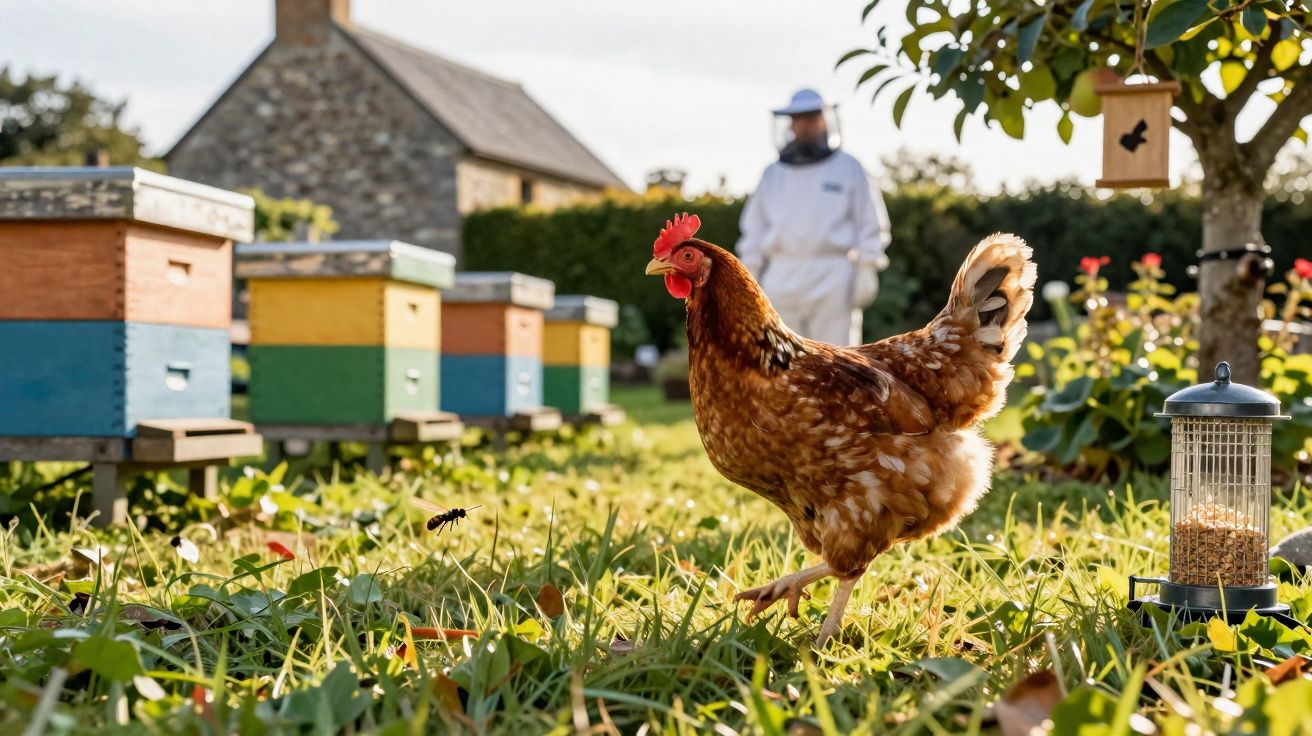
In western France, a heritage chicken breed that had almost slipped into obscurity is unexpectedly proving useful on the front line against a rapidly advancing predator.
With Asian hornets continuing their march across Europe-raiding honeybee colonies as they go-one hardy Breton hen is attracting serious interest from anxious gardeners and beekeepers.
A crisis with wings: why Asian hornets scare beekeepers
The Asian hornet (Vespa velutina) appeared in France in the early 2000s, most likely concealed in a consignment of pottery. From there, it spread through large parts of Western Europe, putting extra pressure on bees and other pollinators already struggling with pesticides, habitat loss and disease.
At the entrance of a hive, the pattern is painfully familiar. The hornet hangs in the air, watching. When a foraging bee returns carrying nectar or pollen, it strikes and seizes the bee. One hornet can kill dozens of bees in a day. When a full hornet colony focuses on a hive, relentless attacks and stress can drive the bees towards collapse.
Many small-scale beekeepers feel they have few options. They set plastic bottle traps, use sugary baits, or resort to aggressive insecticides. Unfortunately, these approaches also catch butterflies, wild bees and harmless wasps. They tackle the symptom rather than the wider problem.
Uncontrolled hornet pressure near hives can cut honey production, weaken colonies before winter and push small apiaries to give up.
The Janzé chicken: a restless Breton treasure brought back from the brink
Into this story steps a striking bird-black plumage with green sheen-the Janzé chicken, named after a small town in Ille‑et‑Vilaine, Brittany. The breed nearly disappeared in the 1980s, until conservation work led by Rennes’ Écomusée and the Bintinais agricultural park returned it to local farms and gardens.
Fully grown hens weigh between 1.5 and 2.5 kilograms. They produce roughly 150 white eggs annually, each weighing 55 to 60 grams. On paper, nothing here looks extraordinary. The difference is in how they behave.
Breeders characterise the Janzé as high-energy, inquisitive and constantly on the move. Locals call it “the great wanderer”. The nickname is well earned: it dislikes being penned in and spends its days roaming, scratching and actively hunting. It checks every corner of orchards, vegetable plots and hedgerows, keyed in to the slightest movement in the grass.
The Janzé chicken works like a small, feathered patrol unit: it walks, scans, pecks, then moves on, hour after hour.
Its sharp vision and quick reactions help it hop and clamber over small obstacles, then snap at low-flying insects. Earthworms, beetle larvae, caterpillars, grasshoppers and wasps are all fair game.
How a farmyard hen tackles the Asian hornet (Janzé chicken in action)
For beekeepers, the most eye-catching moments happen around hives and fruit trees. Asian hornets hover at entrances or circle apples and plums. Janzé hens pick up on the hornets’ distinctive zigzag flight and switch from foraging to hunting.
People watching them describe the same basic sequence. The hen edges closer with her neck extended, waiting for the hornet to drop slightly. Then she delivers a rapid peck, often catching the insect mid-air or at the instant it lands. A second peck follows to crush or decapitate it, and the hen then swallows the protein-rich body.
That nutritional payoff is part of the story. Energetic hens need animal protein for feathers, muscle maintenance and egg production, and hornets offer a dense source. Over time, the habit strengthens: the hornet becomes a rewarding snack rather than something to avoid.
One fertilised Asian hornet queen eaten in spring can mean 1,500 to 2,000 fewer hornets in the landscape later that year.
A trial from an organic orchard in Brittany gives an idea of the potential at larger scale. About 90 Janzé hens were set loose across three hectares of fruit trees. Across the season, growers reported a major fall in insect pests-close to 90 percent-and noticeably reduced hornet activity around the trees.
Nobody suggests hens can eradicate hornets across an entire region. Hornets build nests high in trees, on pylons and on buildings, and many will never come within reach of poultry. Still, around hives and orchards, the birds create a steady, mobile line of pressure that hornets must pass through to feed.
Setting up a feathered anti-hornet patrol
Space, movement and a real hunting field
The Janzé loses much of its usefulness in a cramped enclosure. To chase hornets and keep garden pests down, it needs territory to work. Keepers in Brittany talk about an active “range” rather than a fixed run. The hens naturally sweep along hedges, compost heaps, areas with fallen fruit and sunny margins-exactly where hornets and wasps often congregate.
A modest garden can still suit the breed, provided the birds can reach varied micro-habitats: short grass, rougher patches, low shrubs and a few shaded spots. Tight, bare pens tend to leave them frustrated and bored, with more feather-pecking and less insect hunting.
Feeding strategy: don’t overfill the trough
Fabrice Jan, who runs the agropastoral park at the Bintinais eco-museum, offers a straightforward warning: too much feed dulls the urge to hunt. If hens can eat all they want from a feeder, they linger near it and spend less time working under trees.
The goal is not to deprive them, but to keep part of their daily intake tied to foraging behaviour. A sensible method combines a measured grain ration with daily access to varied ground. The birds’ hungrier periods then encourage them to search for larvae, beetles-and hornets.
- Morning: controlled grain ration to cover basic needs
- Daytime: free ranging around hives, orchards and vegetable beds
- Evening: quick visual check, secure coop against predators
Costs and practical details
In western France, specialist breeders typically sell black Janzé hens for about €30 to €50 each, depending on age and lineage. Younger, lively hens often perform best around hives. Roosters can help preserve the breeding line, but they also bring extra noise-and neighbours may not be equally keen.
| Aspect | Janzé chicken |
|---|---|
| Main role | Insect and hornet predator, egg layer |
| Annual eggs | About 150 white eggs |
| Ideal setting | Free range, orchards, apiaries, large gardens |
| Purchase cost | €30–€50 per hen |
| Extra benefits | Soil aeration, fertilizer, yard “animation” |
Year-round work: more than just hornet control
Although the Asian hornet draws most attention, the Janzé’s influence stretches across the seasons. In spring, hens pick off soil-dwelling larvae and young caterpillars that would otherwise chew leaves and developing fruitlets later on. They also scratch lightly around young plants; that can disturb delicate seedlings, yet it also breaks up crusted ground and improves aeration.
In summer, they continue their circuits in the shade beneath trees and shrubs where hornets, wasps and flies often pause. They also clear fallen fruit before it ferments and attracts more insects. Come autumn, they keep working under the canopy, breaking apart leaf litter and hunting larvae preparing to overwinter.
That constant movement has an added benefit: free fertiliser. Droppings return nitrogen and phosphorus to the soil, and the birds’ scratching helps mix organic matter in quickly. Some growers use movable fencing to rotate hens through different areas, spreading the improvement.
For small farms and serious gardeners, a Janzé flock acts as pest control, soil worker and egg producer wrapped in one lively package.
Limits, risks and how this could translate elsewhere
No form of biological control is without downsides. Hens can wreck delicate borders, pull mulch away from young plants, and consume beneficial insects as well as pests. They are also vulnerable to foxes, dogs and birds of prey. Coops must be secured at night, and fencing needs to be chosen with local predators in mind.
Asian hornets can also adjust their behaviour. Where chickens are common, hornets may hunt higher in tree canopies or closer to water. That makes the hens one tool among several, rather than a cure-all. Targeted traps, nest spotting and community reporting remain important-particularly in towns where keeping poultry is impractical.
The Janzé example points to a broader question for other places battling invasive insects, from spotted lanternflies in the US to stink bugs in southern Europe. Heritage breeds of chickens and ducks often retain strong foraging instincts that many industrial hybrids have lost. Farmers could trial which birds develop a preference for troublesome species, then build them deliberately into pest-management strategies.
For beekeepers interested in trying this method, a small trial is usually the safest route: begin with a few agile hens, watch how they behave near hives from a sensible distance, then fine-tune feeding and fencing. Those simple observations-repeated across many gardens-could help shape the next generation of low-tech, living defences against the hornet’s spread.






Comments
No comments yet. Be the first to comment!
Leave a Comment