
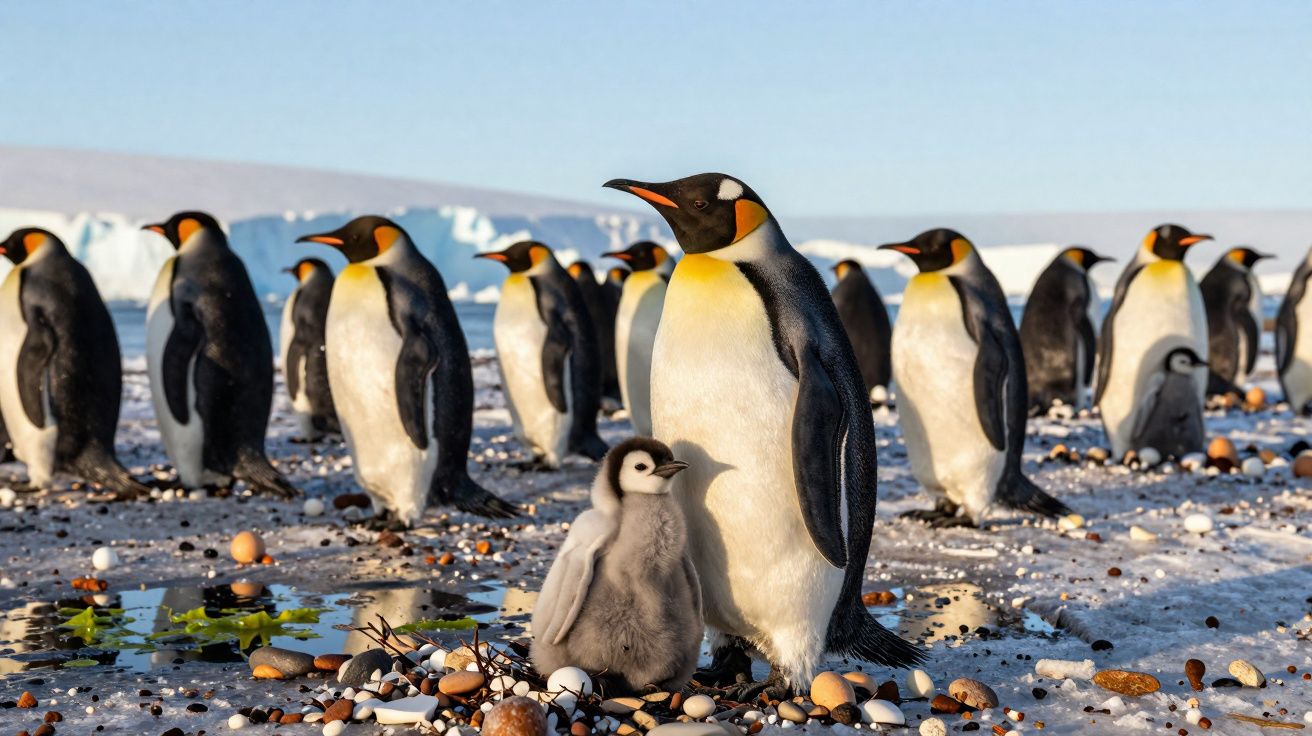
Penguins do not lay eggs at random points in the year. Instead, they align breeding with the seasons so that chicks arrive at the most favourable time, giving the next generation the strongest possible start. In Antarctica’s unforgiving environment, that timing can be critical to a species’ continued survival.
However, climate change driven by human activity may be upsetting this finely tuned schedule.
A recent study led by researchers from the University of Oxford and Oxford Brookes University indicates that several penguin species have altered when they breed. The findings suggest these birds have been able to keep pace with a decade of rapid warming, even though shifting such a carefully timed event could carry costs.
How the Oxford-led study tracked Adélie, chinstrap and gentoo penguins
Seabird ecologist Ignacio Juárez Martínez and colleagues started observing three Antarctic penguin species in 2012. Their team deployed 77 time-lapse cameras across 37 penguin colonies located on the Antarctic Peninsula and on nearby Sub-Antarctic islands.
This camera network offered unusually detailed views of the breeding routines of Adélie (Pygoscelis adeliae), chinstrap (P. antarcticus), and gentoo (P. papua) penguins. It also revealed how chick-rearing patterns for these species have shifted over a decade marked by rapid warming.
Alongside behaviour, the cameras recorded temperature, producing 10 years of site-specific data for the colonies being monitored.
Colony sites are heating up far faster than the Antarctic average
The temperature patterns are concerning for penguins. The study sites at the colonies are warming at four times the average rate for Antarctica: 0.3 ºC per year, compared with 0.07 ºC per year.
That places penguin breeding colonies among the most rapidly warming habitats on the planet. Statistical analyses indicate that these swift changes in temperature are probably pushing the birds to begin breeding progressively earlier each year.
Gentoo penguins and earlier “settlement” dates
In penguin colonies, the annual breeding season effectively begins with “colony settlement” - the point at which penguins start to occupy their nesting grounds. Traditionally, this occurs in spring.
Settlement timing differs somewhat between species, which helps limit overlap and in turn reduces competition for essentials such as nesting territory and food.
Martínez and his team report that from 2012 to 2022, gentoo penguins brought forward the start of their breeding season by an average of 13 days. In some colonies, settlement occurred a full 24 days earlier than prior averages.
The researchers note that this change has unfolded remarkably quickly and could be the fastest phenological shift ever recorded in any animal.
Phenology is the study of how the timing of life-cycle events is linked to environmental signals. Penguins do not use calendars, but when spring increases food availability, conditions become favourable for breeding.
Their physiology responds hormonally to seasonal cues such as day length and ambient temperature. Meanwhile, embryos developing inside eggs require sufficient warmth, and melting ice can uncover the rocky terrain these penguin species prefer for nesting.
Different shifts for chinstrap and Adélie penguins - and the risks of re-timing breeding
Chinstrap and Adélie penguins also adjusted their breeding schedules, but to a lesser extent: on average, they moved their seasons 10 days earlier. This reshuffling in Antarctic penguin timing may represent an attempt to cope with climate change, yet it may also introduce new challenges.
Gentoos appear to benefit from several advantages compared with the other species. Their diet is flexible: they consume fish, squid, crabs, and krill. In addition, as a species associated with more temperate conditions than their relatives, gentoo habitat can expand as Antarctica warms. Gentoo penguins are establishing more colonies across the Antarctic Peninsula, including in locations that were previously occupied only by Adélie penguins.
Over the decade examined, gentoo numbers increased steadily. By contrast, most Adélie and chinstrap colonies included in the study - polar specialists that favour a more stable diet and icy breeding environments - began to decline, with only a small number of exceptions.
"Some of the few colonies that have not experienced a decline are those that have remained phenologically stable [their breeding seasons have not changed], particularly the Adélie colonies in the Weddell Sea, where warming and loss of sea-ice have not been significant," the researchers explain in a published paper.
Martínez says the study’s outcomes imply that gentoo penguins could become a relative “winner” as climate change continues, potentially to the detriment of polar specialists such as chinstraps and Adélies.
"As penguins are considered 'a bellwether of climate change', the results of this study have implications for species across the planet," says zoologist Fiona Jones from the University of Oxford.
The research is published in the Journal of Animal Ecology.





Comments
No comments yet. Be the first to comment!
Leave a Comment