
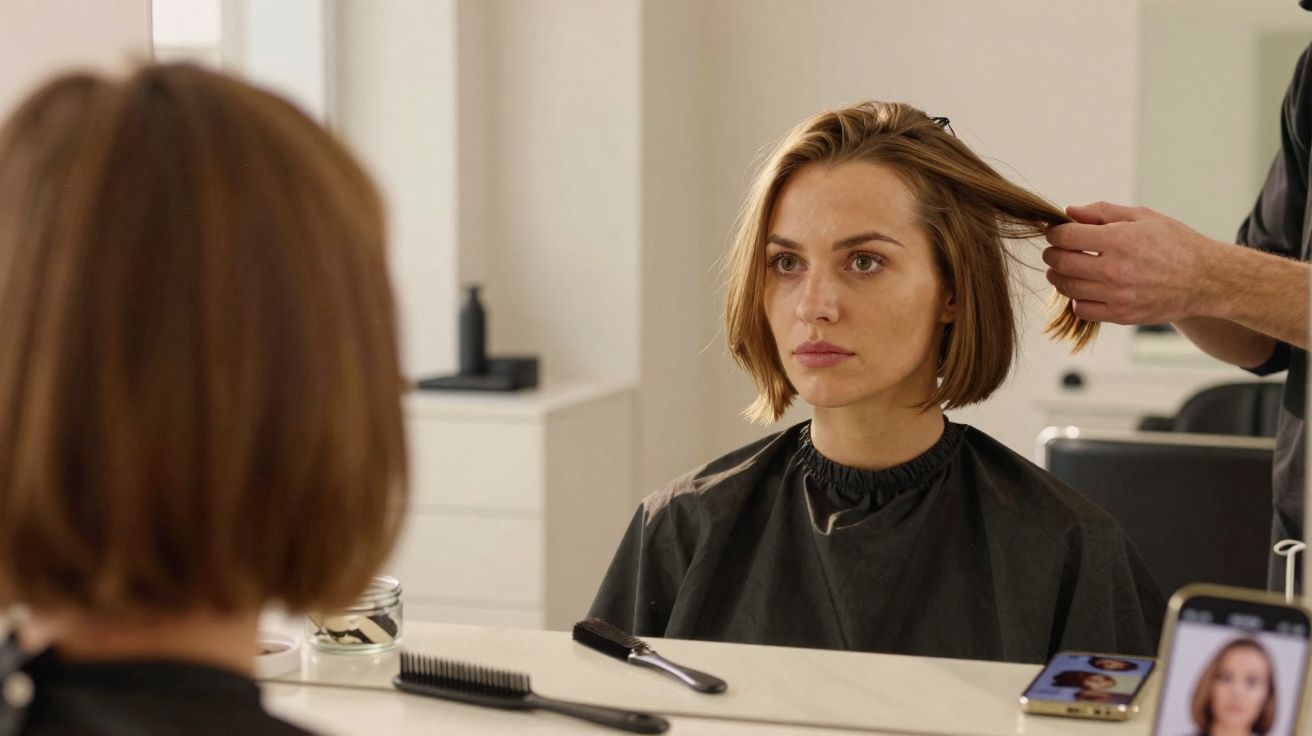
Saturday morning in a packed salon: hair clippings on the floor, chatter bouncing off the mirrors.
In the chair beside me, a woman tilts towards her stylist, drops her voice and murmurs, “I saw this TikTok bob for fine hair… Do you think it would give me more volume?” She fishes out her phone and holds up a perfectly blow‑dried, filtered cut. Then she flinches as her cape shifts and her real hairline shows in the mirror: slightly see‑through at the temples, and a little sparse at the crown.
Her stylist pauses - just long enough to weigh up honesty, and just short enough to sidestep it.
That viral cut might flatter her.
Or it could spotlight every thinning patch she’s spent years trying to disguise.
That bit never makes it into the Instagram post.
The 4 viral short cuts that quietly expose thinning hairlines
Scroll long enough and you’d swear every woman with fine hair is living inside a glossy “French bob” reel. Hair swishing, fringe skimming the lashes, a caption promising insane volume for thin hair. What you don’t get shown is the version a few days later: slightly oily roots, a parting that’s widened just a touch, and an ultra‑blunt outline that suddenly reads like a helmet - with little gaps.
Short cuts really can add bounce and texture. But they can also behave like a spotlight on the areas that are already lighter: temples, hairline and crown.
The gap between “fluffier” and “emptier” is far narrower than the trend videos suggest.
Take the classic chin‑length blunt bob: viral, polished, everywhere. On thick hair it looks crisp and expensive. On very fine hair - particularly if the hairline has started to creep back - that ruler‑straight edge can be unforgiving. The front sections can droop like two flat curtains, and the first gust of wind reveals scalp where you expected “French cool girl”.
The same problem shows up with the ultra‑layered pixie that resurfaces every few months. On camera it looks full because it’s been backcombed, lacquered with spray and filmed from the kindest angle. In real life, those short feathered bits around the hairline can split apart and show more skin than you bargained for.
All at once, the cut you picked “for volume” can feel like you’ve turned up the contrast on your thinning.
There’s a simple reason. Short hair carries less overall weight, so every missing strand matters more. When you lose length, you also lose the camouflage longer hair gave you. The silhouette sits closer to the scalp, so reduced density is easier to see - particularly around the parting and the temples.
Blunt lines catch the light in one clean plane, which makes any gaps pop. Super choppy layers can be just as risky: they create transparency and little “holes”. The viral “butterfly bob”, the shaggy baby wolf cut, the micro‑bob grazing the jaw - these styles depend on sharp outlines or airy separation.
Either way, if your hairline is already a bit fragile, your margin for error shrinks.
How to adjust viral short cuts for fine hair so they don’t give away your hairline
If you’re drawn to short hair, you don’t need to abandon it because your hair is fine or your hairline feels thinner than it used to. What matters is the tiny tweaks. Rather than stopping harshly at the chin, ask for a bob that lands somewhere between the jaw and the collarbone. That extra couple of centimetres lets the ends curve in softly and makes the perimeter look fuller.
Don’t bring only bone‑straight reference photos to your appointment. Instead, ask your stylist to use a gentle point‑cutting method through the perimeter so the line looks softened, not as if it’s been drawn with a ruler. On fine hair, a slightly “broken” edge reduces stark contrast and helps the eye read “texture” instead of “missing hair”.
If you love a pixie, your best insurance policy is at the front. Keep a longer, weightier fringe that can sweep across the hairline, rather than very short, piecey bangs. Think of it like fabric over a chair: it covers what’s underneath and shifts attention to your eyes. Around the temples and ears, request subtle graduation rather than an ultra‑tight buzz.
We all know the moment: you get home, wash your new “volume cut”, and realise you don’t have your stylist’s hands, tools - or 40 spare minutes every morning. Let’s be honest: almost nobody keeps that up daily. A genuinely good short cut for fine hair needs to look decent half‑styled and slightly undone, not only when it’s been ironed into submission under a ring light.
“Fine hair isn’t the enemy,” says Paris‑based hairstylist Lucia Moreno, who sees a lot of stressed‑out clients in their 30s and 40s. “The enemy is a cut that pretends your hair is thicker than it is. A smart cut accepts your density, then cheats with shape, not with fantasy.”
- Go for lengths that skim the jaw or collarbone, rather than going brutally short right where your hair is finest.
- Choose soft, invisible layers instead of aggressive, choppy ones that can create see‑through “holes”.
- Keep a fuller fringe or front section as a built‑in “privacy screen” for your hairline.
- Ask for movement and softness at the ends rather than dead‑straight, highly reflective lines.
- At the salon, ask to see it “unstyled”: shake it out before you commit.
The quiet truth: your cut should suit your hair, not your feed
Once you start looking properly, a pattern appears. The women whose short cuts genuinely work day to day don’t always have the most dramatic shapes. Their bobs are slightly softer, their pixies keep a bit more length through the front, and their layers aren’t so obvious. Their hairlines haven’t magically thickened - their cut simply isn’t fighting what’s there.
That will never trend as hard as a slick before‑and‑after reel, but it holds up far better in your bathroom mirror. A strong short cut for fine hair is like a pair of jeans that fit beautifully: it doesn’t shout, it just quietly does the job - every day.
Off camera, hairdressers are meeting more women in their 20s, 30s and 40s dealing with diffuse thinning and delicate hairlines. Stress, hormones, tight hairstyles and scalp inflammation all leave fingerprints. The answer isn’t living in a bun forever, and it isn’t chasing every viral chop in the hope that the “right one” will somehow change your density. It’s acknowledging what’s happening on your head and designing around it.
That can mean keeping a touch more length than TikTok recommends. It can mean choosing airy, fluffy styling over poker‑straight sleekness - even when “glass hair” comes back around. It might also mean turning down the cut you love on someone else, and saying yes to the one that actually works for you.
Next time the algorithm serves up a “life‑changing bob for fine hair”, you’ll probably still click - curiosity is normal. But you might watch with a sharper eye: where is her hairline? How is the cut working with it rather than against it? Could you live with that shape on a rushed Tuesday, under unforgiving office lighting, after a rubbish night’s sleep?
Short hair can feel freeing when it respects your hairline instead of putting it on display.
Real volume isn’t only in the haircut.
It’s in the quiet confidence of knowing your reflection won’t catch you out once the filters disappear.
| Key point | Detail | Value for the reader |
|---|---|---|
| Cut shape beats trend name | Modify viral bobs and pixies with softened edges, longer fronts and invisible layers | Lowers the chance of emphasising thinning areas while keeping a current, modern finish |
| Length placement matters | Steer clear of harsh chin‑level lines on very fine hair; aim for the jaw–collarbone zone | Builds the impression of thicker ends and frames the face more gently |
| Real‑life styling test | Shake the cut out at the salon and view it without heavy styling or filters | Makes it easier to choose a haircut you can manage on busy, imperfect days |
FAQ:
- Is short hair always better for fine hair? Not necessarily. Shorter hair can create lift, but it also removes the cover that longer lengths provide. If your hairline is very sparse, a slightly longer bob or lob often appears fuller than a micro‑bob.
- Which short cut is safest if my temples are thinning? A softly layered bob that falls between the jaw and collarbone, paired with a side‑swept fringe, is usually a forgiving option. It maintains coverage at the front and doesn’t over‑expose the temples.
- Can a pixie work on very fine hair? Yes - as long as it’s customised. Keep more length and density on top and through the fringe, avoid ultra‑short wispy sides, and prioritise soft texture over extreme choppiness.
- Do I need special products to fake volume? Lightweight root sprays, mousse and dry shampoo tend to help more than heavy creams or oils. Focus application at the roots and mid‑lengths rather than directly on the scalp or the very ends.
- How often should I trim a short cut on fine hair? Every 6–8 weeks is ideal. Fine hair can lose its shape quickly, and regular micro‑trims keep the outline neat without making the ends look even thinner.




Comments
No comments yet. Be the first to comment!
Leave a Comment