
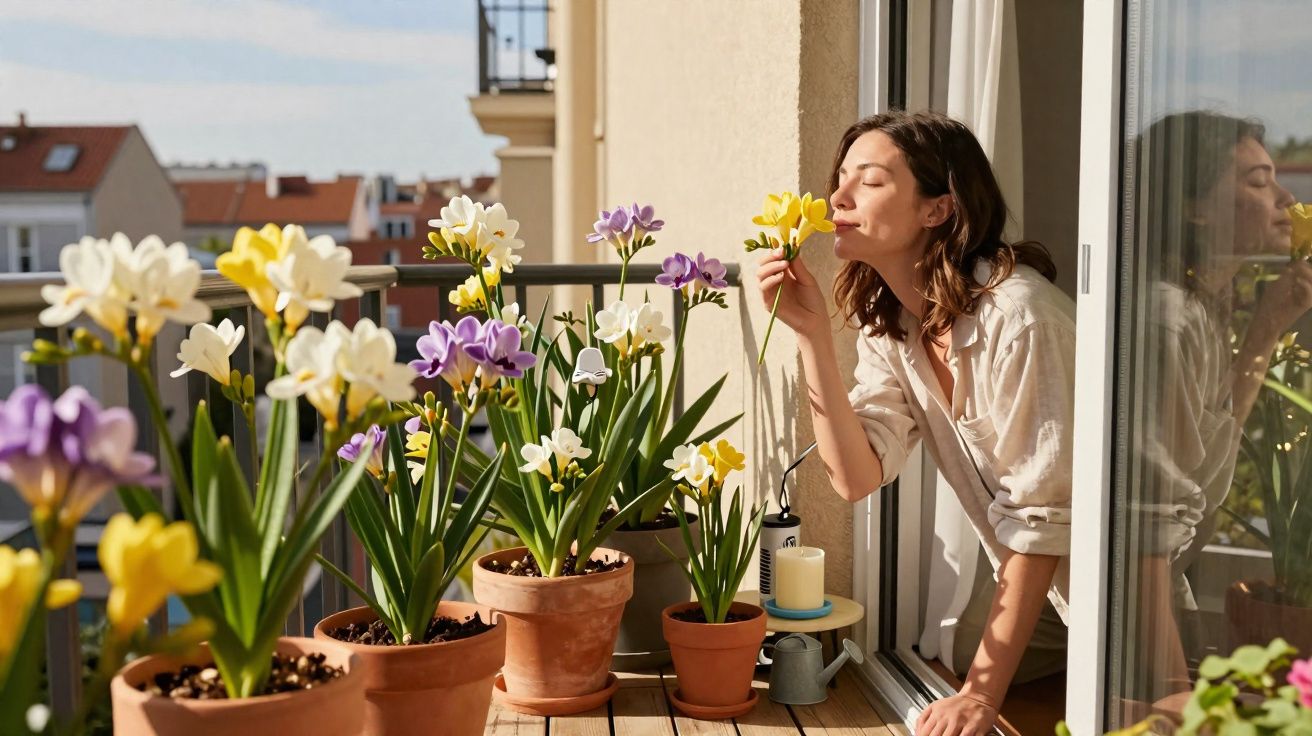
Many city residents know the problem: the idea of a cosy scent haven just outside the door clashes with having only a few square metres of balcony. Pots quickly end up everywhere, plant care eats into your time - and even then, the fragrance often falls short of what you hoped for. In reality, one carefully chosen flower can be enough to perfume the whole space with a delicate, almost perfume-like aroma.
One understated flower that scents the entire balcony: the freesia
The quiet star of a fragrant balcony is the freesia. Originally from southern Africa, it has been valued in the perfume industry for years. Its scent is often described as a blend of honey and citrus - fresh, gently warm, and never overpowering.
"Even just a few pots of freesias can fill an entire balcony or a small terrace with fragrance."
Although it looks delicate, the plant is tougher than it seems. Long, slightly arched stems carry rows of funnel-shaped blooms that sit to one side of the flower spike, like small trumpets. The colour range runs from pure white through yellow, pink and red to deep violet. If you like, you can mix several colours to combine fragrance with a stronger visual impact.
Garden guides regularly list freesias among the most intensely scented potted plants for compact outdoor spaces. On urban balconies in particular - where fragrance doesn’t dissipate so quickly - a small number of plants can define the whole area.
Why freesias are ideal for small balconies
Many balcony owners automatically reach for lavender, jasmine or scented pelargoniums. Those choices can take up space quickly and may make a small balcony feel visually cluttered. With its compact growth, the freesia is far better suited to tight spots - while still delivering a powerful scent experience.
- slender growth, so it needs very little space
- strong fragrance even with only a few plants
- well suited to tubs and window boxes
- long flowering period with the right care
- blooms can be cut and brought indoors as cut flowers
Especially for people who work long hours and don’t want to manage lots of different plants, freesias are a sort of shortcut to a scented balcony: one plant group, one routine, one clear result.
How to plant freesias correctly in pots
Freesias grow from corms (strictly speaking, corm stems). When to plant depends on your location. In areas with mild winters, the corms can stay in the ground. In colder areas, they’re better kept in pots so you can protect them when needed.
Timing
Across most of the German-speaking region, the following approach is worth considering:
- Spring planting: plant corms after the last frosts; flowering follows in summer.
- Sheltered position: in very mild, protected courtyards, autumn planting is also possible; flowering then arrives earlier, in late spring or early summer.
The key point is to avoid hard frost. Temperatures below about −3 to −4 °C will damage the plants.
Pot size and compost
For a balcony or small terrace, one larger tub or several medium pots work well. A container at least 20 to 30 cm in diameter gives the roots enough room.
A very free-draining compost mix is ideal. A simple blend is:
| Component | Proportion | Purpose |
|---|---|---|
| multi-purpose compost | approx. 50% | base nutrients, water retention |
| sand | approx. 25% | drainage, prevents waterlogging |
| light organic matter (e.g. coconut fibre, compost) | approx. 25% | looser structure, nutrient buffer |
In a pot around 15 cm in diameter, roughly five to seven corms will fit. Plant them 3 to 5 cm deep, with the pointed end facing up. Leave about 5 to 6 cm between corms so you get a dense “bouquet” effect without overcrowding.
The best position for maximum fragrance
Freesias love light. A spot in full sun to light partial shade is best. At least 6 hours of direct sun per day strongly encourages flower production.
A sheltered balcony corner or a location near a house wall is ideal. The wall stores warmth, reduces wind and can intensify the scent. If you have a seating area, place the main pot near the table or close to the balcony or patio door - every time you pass, the fragrance is carried indoors.
"One or two well-positioned pots are often enough for you to notice a clear floral scent the moment you open the balcony door."
Watering, feeding, and support
Right after planting, water the compost in thoroughly. After that, keep moisture consistent - but avoid “wet feet”. Let the top layer dry slightly between waterings.
During bud formation and flowering, freesias respond well to regular feeding. A liquid feed with a higher potassium content, applied about every two weeks, supports sturdy stems and abundant blooms.
The stems can grow fairly long and may bend or snap in wind. A discreet cane or small plant rings provide support without spoiling the look.
What happens to the corms in autumn
In cooler areas, freesias in pots are a little more demanding - but still easy to manage. After flowering, leave the foliage in place at first. The leaves pull nutrients back into the corm, strengthening the plant for the next season.
- allow the leaves to yellow gradually
- reduce watering little by little after flowering
- protect the pot from heavy rain so the corms don’t rot
Once the first frosts are forecast and the foliage has mostly died back, you can lift the corms from the pot. After digging them up, brush off most of the compost, dry them in an airy place, and store them at 4 to 10 °C - dry, dark and frost-free, for example in a cellar or garage.
The following spring, plant the corms again into fresh compost. Over the years, a small starting batch can become a handy “scent reserve” for your balcony.
How many pots do you actually need?
On a typical city balcony of 2 to 4 m², two to three medium pots of freesias can scent practically the entire area. Placement matters more than sheer quantity.
One workable arrangement:
- one main tub beside the door, so you get an immediate burst of scent when you open it
- a second tub next to your favourite chair or small table
- optionally a third pot on the railing or in a sunny corner
If you want more visual variety, mix different freesia colours but stick to this single species. That way, care stays straightforward while the balcony still looks bright and lively.
Practical tips for beginners and busy people
Freesias suit anyone who doesn’t want a complicated planting plan. Once you understand how to plant and overwinter the corms, the routine repeats reliably each year.
Useful everyday pointers:
- Use saucers with a slightly raised rim so excess water can drain away.
- Don’t place the pot directly beside a hot south-facing windowpane - the compost dries out too quickly there.
- Link watering to daily habits, such as pressing a finger into the compost after breakfast to check moisture.
- Bring blooms indoors as cut flowers - the plant tolerates this well.
If you’re unsure whether the spot is right, watch what the plant tells you: if stems stay short and flowering is sparse, it usually needs more light. If stems become very long and topple over, it may be a sign of too little feed or too much shade.
For households with children or pets, it’s also worth considering safety. Freesias are generally regarded as low-risk, but small children and animals should not nibble corms or plant parts. As with many ornamental plants, keep pots out of reach and away from play areas.
Combined with simple furniture, warm lighting and perhaps a small set of fairy lights, a plain balcony can quickly feel like a fragrant summer lounge - without overwhelming yourself with too many different plants and care routines. A well-planned freesia corner is enough to make that scented summer morning outdoors feel truly achievable.




Comments
No comments yet. Be the first to comment!
Leave a Comment