
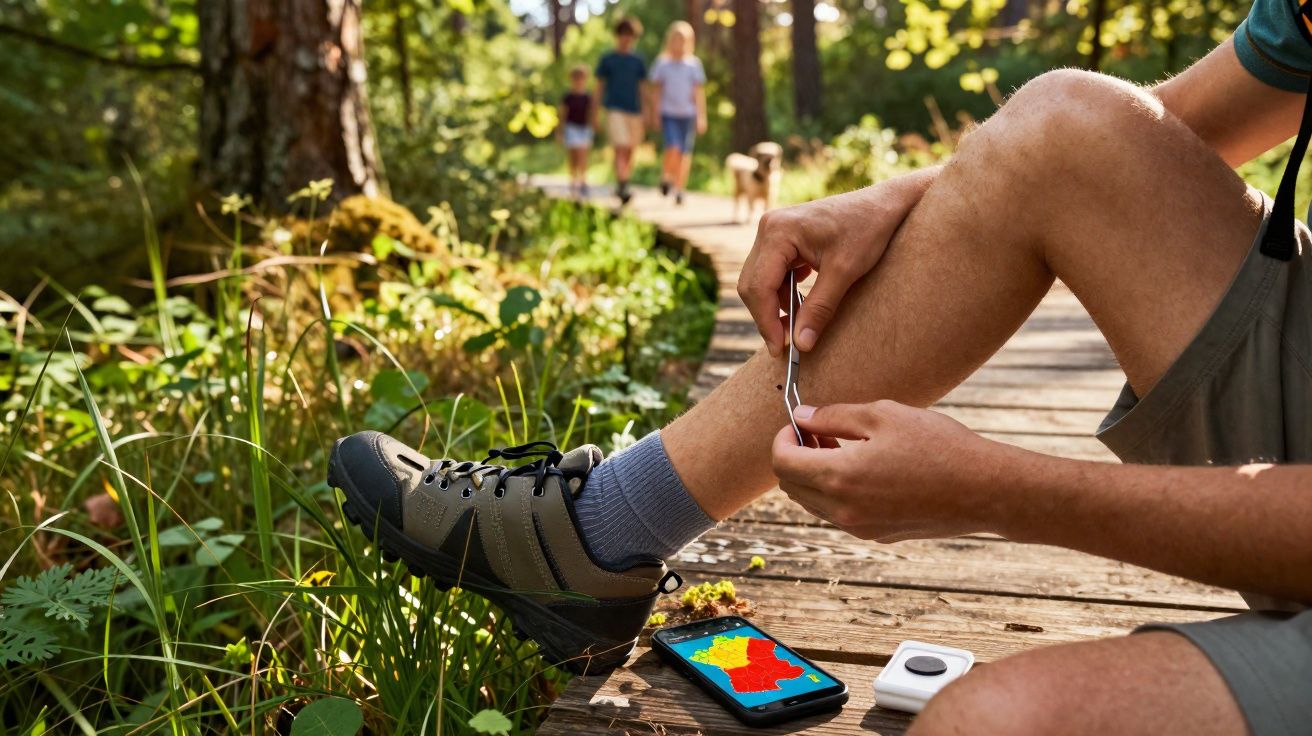
New data from a major citizen-science project reveal which parts of France have ticks that most frequently carry the bacteria responsible for Lyme borreliosis. The findings have surprised even specialists, challenging long-held assumptions about high-risk areas, tick species and even tick larvae.
How researchers built a true tick risk atlas
Between 2017 and 2019, around 26,000 people in France took part in a project called CiTIQUE, run by the INRAE research institute. The concept was disarmingly simple: if someone was bitten by a tick, they were asked not to throw it away, but to post the parasite to the laboratory in an envelope.
This approach allowed the team to collect more than 2,000 ticks caught in the act of feeding. A total of 2009 of these specimens were included in a scientific study published in 2026 in the journal “Ticks and Tick-borne Diseases”.
The ticks analysed were those that had actively bitten people - not specimens randomly gathered from vegetation. The data therefore reflect the real transmission risk at the moment of the bite.
Unlike traditional studies, the researchers did not walk through woodlands dragging white cloths to “flag” ticks from grasses and shrubs. While such “free” ticks often carry pathogens, they are not necessarily the same ones that end up attached to humans. The newer method shifts the emphasis from theoretical presence to practical hazard.
One clear outcome was that about 94% of the analysed ticks belonged to the species Ixodes ricinus. Across Europe, this species is regarded as the main vector of Lyme borreliosis and is also central in Germany, Austria and Switzerland.
Ticks and Lyme borreliosis: one in six ticks carries Borrelia, but the risk varies sharply by region
Across France, 15.4% of the examined ticks carried at least one type of Borrelia bacterium - the agents of Lyme borreliosis. Statistically, that means roughly every sixth tick that bites a person could be risky.
15.4% infected ticks may sound moderate - but the average conceals regions with much higher or much lower risk.
The eastern region of Bourgogne–Franche-Comté stood out in particular, with the share of infected ticks clearly above the national mean. Elsewhere, the situation was comparatively milder. On the researchers’ map, the pattern resembles a patchwork of red and green zones.
The picture becomes even more striking in the detail. Borrelia is not a single uniform organism: according to the study, 15 different Borrelia species circulate in France, with three responsible for the majority of human infections. Their distribution varies substantially from one area to another.
- In Normandy, Borrelia garinii predominates.
- In Île-de-France (the Paris region), Borrelia afzelii is especially common.
- Other species appear locally or in mixed patterns.
These differences are not merely academic. Some Borrelia species are more often associated with neurological symptoms, while others are more commonly linked to skin manifestations or joint problems. In practical terms, living in - or holidaying in - a particular region can subtly shift the pattern of possible illness courses after a bite.
Why some areas are more affected than others
The researchers suspect that so-called reservoir animals play a key role: small mammals, birds and other wildlife in which the bacteria circulate without causing severe illness in the host. Depending on the local fauna, the regional Borrelia profile changes.
Forest structure, hunting practices, agricultural land use and climate add further influences. Ticks thrive in damp, broadleaf woodland areas with plenty of deer and rodents. Drier regions with intensive farming can suppress some tick populations, but may also push them towards gardens and the edges of towns and cities.
More than Lyme: every fourth tick carries additional pathogens
One result likely to catch the attention of many GPs is that 27% of the analysed ticks carried at least one pathogen - not only Borrelia. Some parasites were infected with several microbes at the same time.
Ticks infected with multiple pathogens increase the risk of co-infections, which can make diagnosis and treatment significantly more complicated.
Additional detected pathogens included bacteria that cause anaplasmosis, as well as microorganisms associated with certain fever illnesses. For those affected, this can mean overlapping symptoms, less clear-cut test results and standard treatments that sometimes work more slowly.
In day-to-day practice, this does not mean every tick bite is life-threatening. It does help explain why clinicians ask about time spent outdoors when faced with unexplained fever, neurological symptoms or joint pain - and why a careful history that includes region and travel itinerary remains important.
Tick larvae as a risk: an old model starts to wobble
A particularly unexpected finding concerned tick larvae. For a long time, a straightforward model dominated: larvae bite small animals first, acquire pathogens, then develop into nymphs and adults - with only these later stages considered seriously dangerous to humans.
The new data did not fit neatly into that picture. The researchers detected infected larvae even though, biologically, they should not yet have had a previous host. That calls the idea of a strictly linear transmission pathway into question.
Detecting infected larvae suggests that Lyme pathogens may, in some cases, be passed from the mother tick to her offspring.
In practical terms, this means very small, barely visible tick stages also deserve attention. This is particularly relevant for children who play in meadows or sit in long grass, where a thorough check after being outdoors is worthwhile.
How France is refocusing its prevention strategy
With a far sharper risk map now available, targeted warning and information campaigns become possible for the first time. Health authorities can identify high-prevalence regions and step up guidance there - from appropriate clothing and tick repellents to correct removal using a tick card or tick tweezers.
Clinicians also benefit. They can now see where the risk of Borrelia infection is genuinely above average. This can influence, for example, when a blood test is appropriate or when to offer antibiotics earlier in the presence of typical skin changes such as erythema migrans (the expanding “bull’s-eye” rash).
| Region | Key finding in the study |
|---|---|
| Bourgogne–Franche-Comté | Above-average numbers of ticks carrying Borrelia |
| Normandy | Dominance of Borrelia garinii |
| Île-de-France | Mainly Borrelia afzelii |
| Other regions | Strongly fluctuating prevalences, in some cases below the national average |
The “Tiquothèque”: a living archive for the future
All submitted ticks are not simply discarded; instead, they are stored in a kind of national archive known as the “Tiquothèque”. With every new bite reported and posted in by citizens, this database becomes more precise. The researchers’ goal is analysis down to municipality level, allowing local hotspots to be pinpointed accurately.
The model is increasingly seen as a blueprint: citizen participation, open science and modern molecular analysis working together. Similar approaches are conceivable for other disease vectors - for instance, mosquitoes that carry viruses such as West Nile, dengue or Zika. As the climate changes, such vectors are already shifting northwards, an issue that also directly affects German-speaking countries.
What this means for travellers from Germany, Austria and Switzerland
Many people from the DACH region spend their summer holidays in France - in the Jura, Normandy, Burgundy or around Paris. The new findings provide a much clearer view of risk without fuelling panic.
- Anyone hiking in eastern France should be especially consistent about preventing tick bites.
- In Normandy and Île-de-France, it is worth being aware that symptom patterns after a bite may differ.
- City parks and gardens can also be risk locations, not only remote forests.
The basics remain familiar: long clothing, tucking trousers into socks, light-coloured fabric to make ticks easier to spot, and a careful full-body check after time outdoors. Added to this is a sober look at the statistics: not every tick is infected, and not every bite leads to illness. Recognising bodily warning signs and acting early can markedly reduce the likelihood of severe outcomes.
What the numbers look like in real life: everyday scenarios
One plausible scenario: a family from Bavaria spends a week in Burgundy, going on cycling trips through woods and picnicking in meadows. In the evenings, the children come back with several ticks. After the trip, the father develops flu-like symptoms and mild joint aches, which he initially dismisses as the after-effects of exertion. Only when a growing red ring appears on his leg does he remember the bite. Knowing that Bourgogne–Franche-Comté has an elevated risk makes the decision to seek medical assessment much quicker.
Another example: a student from Zurich starts an internship in Paris and goes jogging regularly in a city park. She is surprised to find a small tick on her hip - right in a metropolitan area. The results from Île-de-France show that such discoveries are no longer unusual. Ticks are moving into green spaces in densely populated areas, and the bacterial profile differs from that in classic forest regions.
Key terms explained briefly: borreliosis, prevalence, co-infection
Borreliosis: An umbrella term for diseases caused by Borrelia bacteria. Lyme borreliosis is the most important form in Europe and can affect the skin, nerves, joints and heart.
Prevalence: The proportion infected within a defined group at a specific point in time. In this study, that is 15.4% of the examined ticks carrying Borrelia.
Co-infection: Simultaneous infection with more than one pathogen. In the context of ticks, it means a single bite can, in theory, transmit more than one disease, making symptoms and treatment more complex.
The French data illustrate how strongly a seemingly small animal can shape entire public-health strategies. Anyone spending time outdoors - whether in France or at home - benefits from staying alert, having a routine for tick removal and seeking timely medical advice if unusual symptoms appear.





Comments
No comments yet. Be the first to comment!
Leave a Comment