
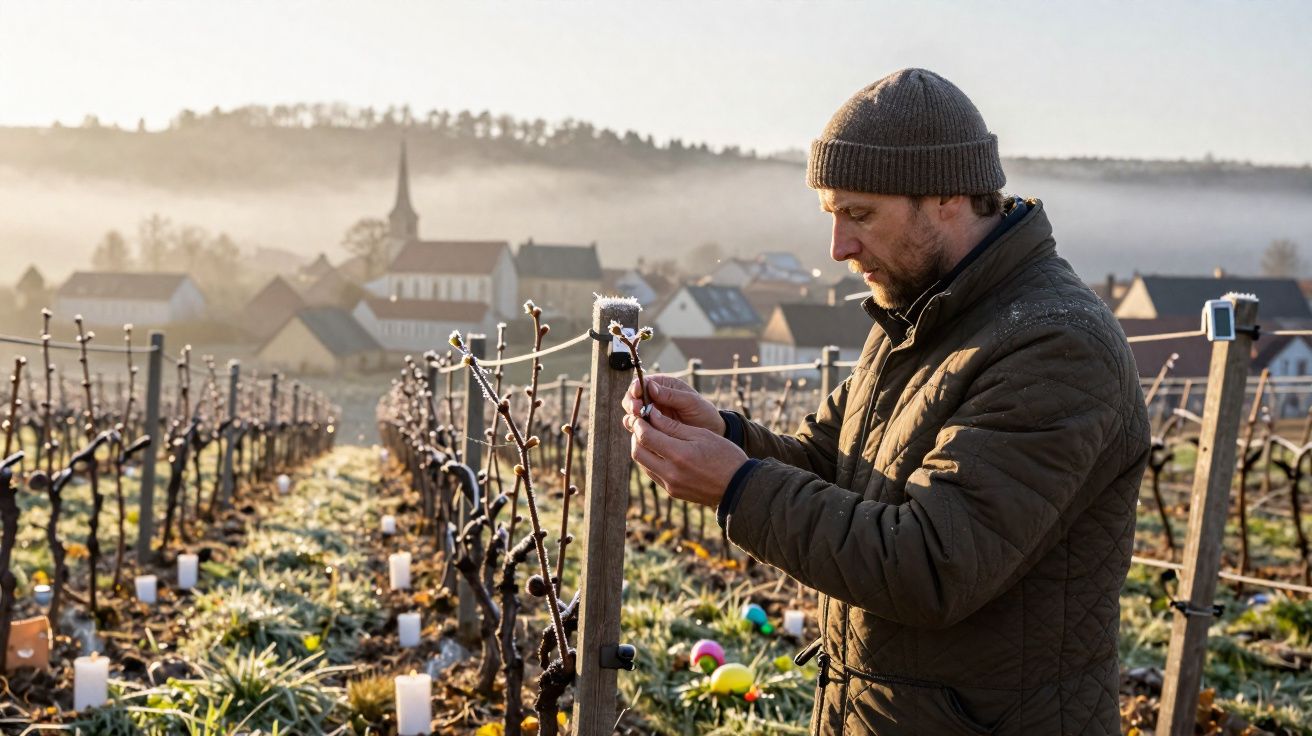
A sharp one–two punch of cold at the end of March jolted Burgundy’s vineyards - but the real test is only expected after Easter.
After two frosty nights in late March, growers in the Côte-d’Or are allowing themselves a cautious breath. Memories of the 2021 frost disaster are still vivid, when entire crops were wiped out. This time the early signs look less severe, yet nobody is relaxing. As temperatures turn milder around Easter, another, more treacherous risk begins to grow.
Late-March frost nights: not a catastrophe, but a serious warning
Across Burgundy, temperatures in the nights of 27 and 28 March dropped well below zero. In the Côte-d’Or vineyards, the picture now emerging is mixed: damage, yes - but outright total loss, generally no.
Chardonnay has taken the brunt. It usually buds earlier in spring than Pinot Noir, which leaves it more exposed when late frosts strike. Many estates are reporting scattered damaged vines and affected buds, though only rarely are more than half the shoots in a given plot impacted.
"The situation is serious, but nowhere near a wildfire across the vineyards: a setback, not the end of a vintage."
For growers, that distinction matters enormously. After 2021 - when whole sites in Burgundy looked as though they had been scorched - simply avoiding mass bud death feels like a modest relief. Even so, the 2024 vintage remains uncertain, because the true consequences of the cold snap often surface only gradually.
Why the Côte-d’Or in Burgundy has fared better than other regions
Compared with areas such as Chablis or Champagne, the Côte-d’Or has been slightly luckier this time. In those regions, temperatures fell further and the damage is already far more obvious. Burgundy was hit as well, but without the same intensity.
The type of frost also matters. Meteorologists and viticulture advisers typically separate two patterns:
- Advection frost: very cold air masses move in, causing a broad, region-wide temperature drop
- Radiation frost: heat escapes overnight and cold pools in low-lying spots, where temperatures fall hardest
The danger rises sharply when the two arrive in quick succession - exactly what threatened at the end of March. In parts of the Côte-d’Or, topography, airflow and soils that had already warmed slightly helped to limit the worst effects. Still, the episode underlines a familiar truth: the vine can tolerate plenty, but not every surprise just after winter has loosened its grip.
Most exposed pockets: where Côte-d’Or growers are checking vines one by one
The clearest symptoms are showing up first in the places that are vulnerable even in normal years - including the Châtillonnais, the Hautes Côtes and the area around Nolay. In these zones, several factors worked against the vines.
At higher altitudes, snow on 26 March amplified the cold. Around Nolay, about 4 millimetres of rain fell before the first frosty night - enough to wet the buds. Moisture on the shoots increases the risk, because damp buds freeze more readily.
In poorly ventilated plots, many buds have already taken on a rusty colouring. It looks worrying, but it is not automatically a final verdict. When such buds are cut open, alongside completely dried-out examples there are often still green, living structures inside.
"The frosty night was only the first part of the test. The true condition of the vines often shows itself only weeks later when you cut the buds open."
Over the coming days and weeks, growers and technicians will work through plots methodically, analysing vineyard by vineyard. Only then will it be possible to estimate, even roughly, how much yield is genuinely at stake.
Easter warmth accelerates growth - and raises the stakes for the vintage
The recent frost effectively stalled vine development for roughly ten days. Forecasts now point to a clear rise in temperatures: averages around 15°C, with daytime peaks close to 23°C. For the vines, that is like pressing a turbo button.
As mild weather arrives, shoots can suddenly surge ahead. Phenological stages - from budburst through to the first small leaves - can leap forward in a short window. That is precisely when susceptibility increases. The further a vine has progressed, the more sensitive it becomes to any renewed frost.
The central fear is that another cold spell after Easter would be far more destructive than the March nights. By then, young, fragile shoots would be exposed along the rows with very little protection. Even a brief frost lasting just a few hours can be enough to scorch this fresh growth.
What growers will be tracking hour by hour
For estates in the Côte-d’Or, the next stretch becomes one of constant monitoring. Several questions will dominate:
- Do damaged buds restart growth, or do they remain dead?
- How quickly is vegetation advancing in the earliest sites?
- Do forecasts indicate further nights with critical temperatures?
Particular attention is on early-ripening parcels in parts of the Côte de Beaune and the Côte de Nuits. These areas are often among the most celebrated sites at harvest time - yet in spring they also carry some of the highest exposure. They bud earlier, which brings them into the late-frost danger zone sooner.
"A weather app in viticulture is no longer a leisure gadget; it is a yield factor - any night can become a turning point."
The implications go far beyond personal comfort. The temperature curve over the next few weeks will determine whether the vintage ends up tight, respectable, or - in the worst case - catastrophic once again.
Filage: the quiet yield killer after extended cold spells
Alongside obvious frost burn, specialists are watching for another phenomenon: Filage. Behind the technical label is a subtle but damaging process. Prolonged cold during a sensitive growth stage can disrupt the formation of flower clusters.
The inflorescences - the structures that later become bunches - may develop unevenly, appear to “draw threads”, or partly lag behind. The result is fewer bunches per vine and, at times, less evenly distributed weights across a plot.
According to estimates from plant physiologists, around 40 percent of the eventual yield is decided between budburst and the stage when the first leaves spread out. If a longer cold period hits in that exact window, the vine often pays the price only months later - at harvest.
| Stage in the season | Impact of cold |
|---|---|
| Budburst to first leaves | Strong effect on yield potential, risk of Filage |
| Flowering | Risk of coulure, fewer berries per bunch |
| Start of ripening | Influence on sugar formation and acid balance |
For consumers, Filage is easy to miss as long as enough bottles reach the shelves. For estates, however, an invisible loss of 10 or 20 percent per hectare can be the difference between a stable year and a financially difficult one.
Easter eggs in the garden, frost sensors in the vineyard
While many families spend the bank-holiday period thinking about coloured eggs and roast lamb, Burgundy’s winegrowers are counting buds and studying forecast maps. The contrast is stark: festive calm down in the valley, tense quiet on the slopes.
Day-to-day work continues, but with an undercurrent of alertness. Vines are inspected, trunks are tied, wires are adjusted - all while temperature probes and weather warnings are checked repeatedly. None of it is particularly spectacular to watch, yet decisions made in these unassuming days can shape both the quantity and the quality of the coming vintage.
What wine lovers should know about frost damage
For drinkers, the practical question is what such frost events mean in the glass. Three points matter most:
- Volume: depending on how extensive the damage is, the number of bottles available may fall and certain sites may become scarcer.
- Price: lower yields combined with steady demand can push prices up - not inevitably, but often.
- Style: in some years, reduced yields can lead to more concentrated wines; in others, balance and harmony can suffer.
Frost is therefore not simply an enemy of quality, but an unpredictable variable. Some celebrated vintages were produced despite difficult springs, while others were badly marked by late frosts and prolonged cold.
Prevention, adaptation and the role of climate change
Over the longer term, growers in Burgundy face a strategic dilemma: how to protect vines without driving labour, cost and energy use to unsustainable levels. Paraffin candles, heating cables, wind machines and sprinkler systems can all help, but they are expensive and power-hungry. Not every estate can - or wants to - deploy them across all holdings.
Climate change adds another layer of pressure. Milder winters and earlier springs push vines to start growing sooner. Buds appear earlier, yet the calendar risk of late frost has not shrunk by much. It is precisely this combination that makes the situation more acute. Some domaines are therefore experimenting with later pruning, different rootstocks, or adjusted canopy approaches to delay budburst slightly.
For now, the mood in the Côte-d’Or remains taut. March’s frost did not hit with the force of 2021, but spring still has a long way to run - and in Burgundy, everyone knows a vintage can turn in a single night.





Comments
No comments yet. Be the first to comment!
Leave a Comment