
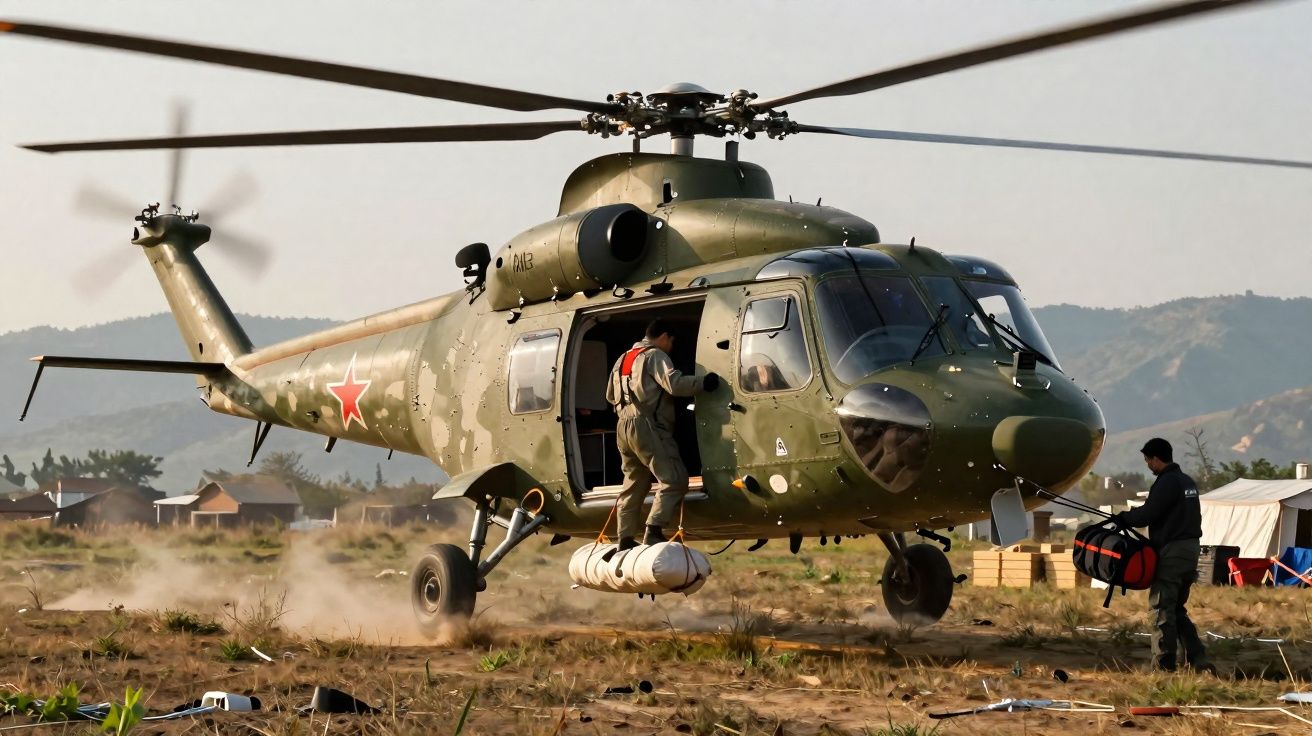
Born in the bleakest phase of the Cold War, this utilitarian aircraft was never intended to look sleek or glamorous. It was built to be hardy, inexpensive to operate and almost ridiculously flexible - and, over time, it has quietly become the most-produced helicopter in history.
A 1960s Mil Mi‑8 design that refuses to retire
The aircraft at the centre of this story is the Mil Mi‑8, a twin‑engine transport helicopter that first took to the air in 1961 in the Soviet Union. At a moment when the space race was gathering pace, Soviet engineers were already laying out a broad‑shouldered rotorcraft meant to move troops, supplies and just about anything else that would fit in its cavernous cabin.
Developed under Mikhail Mil, the Mi‑8 measures a little over 18 metres from nose to tail. It uses two turboshaft engines to turn a five‑blade main rotor, giving it the strength to carry roughly 24 to 32 people or up to three tonnes of payload, either inside the fuselage or slung beneath it.
The Mi‑8 has been in continuous production for more than six decades – an almost unheard‑of lifespan for a frontline aircraft.
Across those decades, aviation has shifted from analogue gauges to glass cockpits, and from map‑and‑compass flying to satellite navigation. Even so, the Mi‑8’s overall shape and layout remain immediately recognisable. For many crews across Eastern Europe, Asia and Africa, learning helicopter flying still often starts with this Soviet‑era workhorse.
A production record that leaves Western icons behind
Hollywood has made household names of the US‑built Huey and Black Hawk, but neither matches the Mi‑8’s sheer production total. Since the early 1960s, more than 17,000 Mi‑8s and closely related derivatives have come off production lines, making it the most-built helicopter ever.
For comparison:
- Mi‑8 / Mi‑17 family: over 17,000 units
- Bell UH‑1 Huey: around 16,000 units
- Sikorsky UH‑60 Black Hawk family: roughly 5,000 units
Collectively, these helicopters have operated - or continue to operate - in roughly 80 countries across almost every continent. Some fly combat sorties on the front line. Others ferry tourists to remote mountain lodges or help evacuate communities during flooding.
From warzones to humanitarian airlifts, the Mi‑8 is one of the rare aircraft flown by both sides of the same conflict.
Mi‑8s are still being assembled in Russia today, primarily at facilities in Kazan and Ulan‑Ude. Even with sanctions and supply‑chain pressures, orders from long‑standing users and states outside the Western orbit keep the lines active.
Simple, rugged and endlessly adaptable
The Mi‑8 was not conceived as a showcase for cutting‑edge technology. Instead, its designers prioritised plain, comprehensible engineering - the sort of machine that could be kept running by mechanics working at isolated strips with limited tools and minimal training. That approach became its biggest advantage.
| Key metric | Typical figure |
|---|---|
| Fuselage length | About 18.2 m |
| Engines | Two turboshafts around 1,500 hp each |
| Passenger capacity | Roughly 24–32 people |
| Useful load | Up to 3,000 kg |
| Top speed | About 260 km/h |
| Typical new‑build price | Equivalent of €6–9 million, depending on version |
Aircrew prize how readily it can operate from rough, improvised landing spots: unprepared fields, muddy riverbanks and frozen lakes. Engineers also value that a great deal of maintenance can be done outdoors using basic kit. Where genuine spares are scarce and budgets are tighter still, practical maintainability can matter far more than glossy sales literature.
A Soviet answer to a presidential helicopter
There is an intriguing turn in the Mi‑8’s beginnings. In 1959, Soviet leader Nikita Khrushchev visited the United States and travelled aboard a Sikorsky S‑58, which at the time was used for VIP movements. He was reportedly struck by the idea of a large, comfortable helicopter capable of moving senior leadership quickly and securely.
Once back in Moscow, the instruction to the design bureaux was straightforward: produce something at least as capable, but shaped around Soviet requirements. The outcome was a bigger, more powerful helicopter that could serve as both a troop carrier and a VIP conveyance, with room to swap between radios, stretchers or plush seating depending on the variant.
Cold War rivalry did not just drive nuclear arms; it also helped give birth to one of the most successful rotary‑wing aircraft ever built.
At first, some Soviet officers were wary, favouring smaller and more familiar helicopters. However, the expanding US use of helicopters in Vietnam - for transport, medical evacuation and gunship work - rapidly shifted attitudes. Soviet planners concluded they needed a comparable aerial workhorse, and the Mi‑8 was driven into mass production.
One airframe, dozens of roles
A major reason the Mi‑8 has endured is how quickly it can be adapted to different tasks. Over time, the same basic airframe has been reworked into a wide range of specialised models.
Main variants you still see in service
- Mi‑8T: standard transport model for troops, freight and civilian duties.
- Mi‑8S: VIP configuration with more comfortable seating and extra fittings.
- Mi‑8MA: adapted for polar operations, with improvements for extreme cold.
- Mi‑8MT: heavy‑lift and cargo variant, often used as a flying crane.
- Mi‑8TZ: aerial refuelling platform supporting vehicles and aircraft at remote locations.
- Mi‑17: export designation for modernised Mi‑8 variants, often fitted with more powerful engines.
In wartime, some Mi‑8s are fitted with rocket pods, machine guns and armour plating. In civilian service, that same airframe can be de‑armed and re‑equipped with medical gear, passenger seating or cargo racks. That reconfigurability helps keep Mi‑8s in the air long after more fashionable designs have been withdrawn.
From Chernobyl to Syria: a controversial workhorse
The Mi‑8’s operational story cuts through some of the late 20th century’s grimmest episodes. After the Chernobyl reactor explosion in 1986, Mi‑8 crews were tasked with dropping sand, lead and boron onto the exposed core. Some aircraft flew through severe radiation; at least one crashed near the site, an unsettling moment captured on film.
Afterwards, Mi‑8s were used heavily in Afghanistan during the Soviet occupation, then in Chechnya, and more recently in Syria and Ukraine. Because the helicopter presents a large target and is comparatively slow, it has been vulnerable to modern air defences, and many have been lost to ground fire and accidents.
The Mi‑8 is both a lifeline and a lightning rod: praised for rescue missions, criticised for its role in brutal conflicts.
At the same time, the Mi‑8 has completed enormous numbers of rescue flights - from mountain evacuations in Central Asia to flood relief in Pakistan. The United Nations and non‑governmental organisations have also chartered Mi‑8s to access disaster areas where few other aircraft can safely land.
In a revealing example of its practicality, US‑backed Afghan forces operated Mi‑17s - direct descendants of the Mi‑8 - for years. Washington assessed that local personnel already knew the type well, and that its rough‑strip performance matched Afghanistan’s terrain better than some Western alternatives.
Modern upgrades for an ageing design
For all its vintage roots, the Mi‑8 has not remained frozen in the 1960s. Modernisation programmes are designed to keep existing airframes operating for another 10 or 20 years. Upgrade packages commonly add GPS‑based navigation, improved radios, cockpits compatible with night‑vision equipment and - on military versions - improved armour and infrared suppression for the engines.
For many users, step‑by‑step improvements are more achievable than buying fleets of brand‑new helicopters that can cost several times more. Even with modest modernisation, a Mi‑8 can still handle most utility work: troop transport, lifting equipment, casualty evacuation and aid delivery.
Why many countries still pick the Mi‑8
- Cost: purchase and operating costs are comparatively low against Western medium‑lift helicopters.
- Training base: pilots, engineers and parts networks already exist across wide regions.
- Rough‑field performance: intended for basic landing sites and demanding climates.
- Payload: strong lifting ability for its price bracket.
For governments under budget pressure, modernising Mi‑8 fleets can be more realistic than starting from scratch with brand‑new Western types.
How a flight on a Mi‑8 actually feels
Travellers often characterise a Mi‑8 flight as loud yet oddly comforting. The cabin is high and box‑shaped, with straightforward seating and visible wiring and structure along the sides. Vibration is ever‑present, and normal conversation generally requires headsets or raised voices. Even so, the aircraft’s robust feel - and its long record in unforgiving conditions - can inspire confidence.
For remote operations, the Mi‑8’s rear clamshell doors plus the side sliding door make loading and unloading quicker. Humanitarian teams can wheel pallets directly into the cabin. Military units can board rapidly with full kit. Medical crews can secure stretchers while still leaving space for clinicians and equipment.
Key terms and risks worth understanding
The Mi‑8 is frequently labelled a “medium‑lift” helicopter. This describes an aircraft that can move several tonnes of cargo while staying in a middle weight category - positioned between light utility helicopters and heavy‑lift machines such as the Mi‑26. For disaster‑response planners, this category is useful because it combines meaningful lifting power with more manageable fuel use and running costs.
However, keeping older designs in service involves compromises. Even after upgrades, ageing airframes can develop fatigue‑related issues. Safety is strongly influenced by maintenance quality, pilot training and access to genuine spare parts. In areas with weak oversight, poorly maintained helicopters - regardless of model - can become a significant hazard.
For governments deciding whether to retain or retire Mi‑8 fleets, the judgement is seldom straightforward. They must weigh budget limits, political relationships, parts availability and the sheer usefulness of a helicopter that has already shown it can land in almost any environment on Earth - from burning reactor sites to drifting sea ice.






Comments
No comments yet. Be the first to comment!
Leave a Comment