
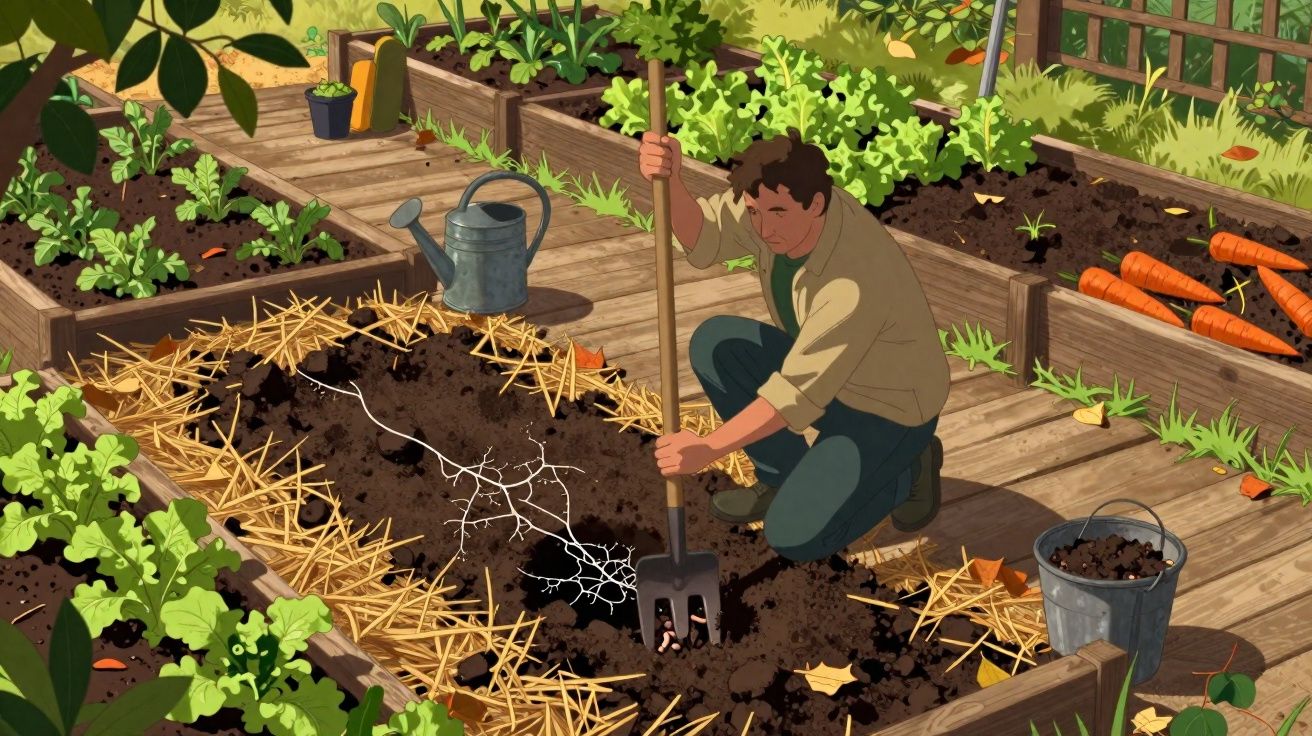
The first warm days arrive, spade in hand, and the soil gets neatly turned over- for generations of gardeners, that has marked the beginning of the season. Modern soil science, however, makes one thing clear: this tradition comes at a significant cost. If you dig over your vegetable garden in the classic way each spring, you wipe out valuable soil life, leave plants less robust, and often end up doing more work overall.
The soil is alive - and it is sensitive to a spade
There is a bustling world beneath our feet. In the top 20 centimetres of a healthy garden soil, countless millions of organisms are hard at work out of sight, performing vital tasks. They loosen the ground, break things down, recycle nutrients and ultimately feed our crops.
"A single gram of fertile soil contains up to one billion bacteria, plus fungi, nematodes, mites, springtails and earthworms - a complex micro-universe."
These organisms are not scattered randomly. Each soil layer has its own regular residents: near the surface are species that can cope with oxygen and fluctuating temperatures; further down live specialists that need little air and prefer darkness. When a spade thoroughly mixes everything, those specialists are abruptly dumped into conditions they cannot survive.
The results include:
- Organisms from deeper layers die off when exposed to air.
- Surface-dwelling creatures are buried at depths they cannot tolerate.
- The finely balanced cooperation between bacteria, fungi and small animals collapses in the short term.
- Natural soil structure is damaged; pores and channels slump and collapse.
Exactly when young plants most need lively, active soil, it has been weakened. Growth becomes slower, plants cope less well with drought, and susceptibility to disease increases.
Mycorrhizal fungi: the hidden internet beneath your beds
One of the biggest casualties of traditional digging is an invisible network: mycorrhizal fungi. Their fine threads wrap around and penetrate plant roots, effectively extending them many times over.
These fungal webs:
- access nutrients that roots could not reach on their own,
- move water across surprisingly long distances,
- improve the soil’s crumb structure,
- sometimes link multiple plant species together.
Each run of spade work tears these networks apart. Instead of benefiting from a stable, established system, both soil life and plants are forced to start again and again. If you stop intensive digging, you allow these networks to build year after year-often resulting in noticeably stronger vegetable crops.
Loosen soil gently: why a garden fork can replace digging
A straightforward alternative to a spade is a robust digging fork (often a specialist garden fork) with several strong tines. It lets you loosen the soil without turning it over. Place the tool vertically, step it into the ground, then gently pull the handle back. The soil lifts and fractures, yet the layers largely remain in place.
"The soil layers stay where they belong - yet air still gets in and compaction is relieved."
Anyone who is no longer in their twenties will notice another benefit immediately: far less strain on the back. Rather than heavy shovelling, you work with leverage. There is much less bending and lifting, making longer sessions more manageable.
Choosing the right moment to loosen the soil
Moisture level matters most. The ideal soil crumbles easily rather than smearing or clumping:
- Too dry: the ground is hard; the tool meets heavy resistance; tines can bend.
- Too wet: clods stick together, smear and compact, then set hard again once dry.
- Just right: often the day after a decent spring rainfall-enough to moisten the soil, not turn it into mud.
If you catch that window, you get maximum impact with minimal effort.
Mulching: the natural protective layer for your vegetable garden soil
While a garden fork can take the place of a spade, another method changes day-to-day work in the vegetable garden even more: mulching. This means keeping the soil covered continuously with organic material.
Common mulching materials include:
- straw or hay (slightly wilted),
- shredded autumn leaves,
- dried grass clippings applied in thin layers,
- woodchips or bark pieces for paths and perennial areas.
"Mulch acts like a protective blanket: it keeps the soil moist, shields it from heat and cold, and at the same time feeds soil life."
If you mulch consistently, you gain several advantages:
First, the soil stays damp for longer and watering can drop by around a third or more. Second, temperature swings are reduced, keeping microorganisms and roots steadier. Third, the surface is less likely to form a hard crust, so rainwater infiltrates more easily.
As mulch slowly breaks down, earthworms and tiny soil animals pull it downwards. Worm castings are among the most nutrient-rich materials in the garden. This is how fertile soil is created exactly where it is needed-without a spade and without turning the ground.
Reduced strain for older gardeners
A mulch-based approach is particularly helpful for people who do not want to spend hours hoeing and watering. Fewer weeds, fewer trips with the watering can, and less heavy work at the soil surface mean a vegetable garden remains realistic even as strength decreases.
How microbes and earthworms improve your harvest
Recent research shows just how strongly healthy soil influences plant performance. Many of these processes are invisible, but they can be measured.
| Organism | Function in the vegetable garden |
|---|---|
| Bacteria | break down organic matter and make nutrients available to plants |
| Nitrogen-fixing bacteria | convert atmospheric nitrogen into forms plants can use |
| Soil fungi | stabilise soil crumbs and form nutrient “bridges” to roots |
| Mycorrhizal fungi | multiply the effective root surface area many times over |
| Earthworms | loosen soil, mix in mulch, and produce nutrient-rich castings |
Where this community can work without disruption, both yield and plant resilience improve. Crops cope better through dry spells, require less added fertiliser, and handle disease pressure more effectively because they establish more strongly from the start.
What to do instead of digging? A step-by-step transition for the vegetable garden
No one needs to abandon every habit overnight. A sensible changeover can be done in simple stages:
- Loosen soil only with a garden fork; stop turning it over.
- Early in the year, spread a thin layer of mature compost (about five centimetres) over the beds.
- Cover bare areas immediately with mulch material so the soil is not left exposed.
- On very compacted or heavy clay soils, loosen deeper once as a one-off; afterwards, work only gently.
- Add organic material every year instead of repeatedly digging deeply.
Over time you will notice the soil becoming more crumbly, easier to work, and far less prone to silting and sealing after rain. Many gardeners find that after a few years they can almost entirely avoid heavy, physically demanding soil work.
Common misconceptions about spring digging
A few arguments in favour of traditional digging persist. A closer look weakens many of them:
- "It’s the only way to get rid of weeds."
Turning the soil brings countless weed seeds up from deeper layers, where they then germinate. Shallow cultivation combined with mulch often suppresses unwanted growth more effectively in the long run. - "Digging lets more air into the soil."
In the short term, yes. Over time, repeated turning damages soil structure and it slumps. Roots and earthworms create more stable pore spaces if you allow them to do the job. - "Digging helps the soil freeze so pests die."
Severe, deep frosts are uncommon, and many pests survive even in turned soil. At the same time, you remove habitat for beneficial organisms that could otherwise keep those pests in check.
Practical examples of soil-friendly gardening
If you are creating a new bed, you can skip the spade entirely and use a combination of cardboard, compost and mulch. The cardboard smothers existing growth; on top, compost and an organic cover can build an impressively loose layer within a single season.
In established vegetable gardens, it often works well to keep paths permanently covered with woodchips and loosen only the rows where you are actually planting. That way, firm walking areas and living growing zones remain clearly separated, and compaction is reduced in a targeted manner.
Risks of constantly turning soil upside down
One important point is often missed: heavily worked soils lose more carbon as CO₂. When soil is intensively turned, organic matter suddenly meets lots of oxygen; microbes ramp up activity and break it down rapidly. That does not only reduce humus- it also lowers the soil’s ability to hold water.
In the long run, that means the ground dries out faster, watering becomes more frequent, and fertiliser is lost more quickly because there is no stable framework to store nutrients. This becomes very noticeable in years with hot summers.
What beginners should pay particular attention to
If you are switching from the classic method, patience helps. The benefits build gradually. A few pointers can prevent common mistakes:
- Never pile mulch directly against the stems of delicate young plants, or rot can set in.
- Apply fresh, wet grass clippings only in thin layers, or let them dry first, so you do not create foul, airless mats.
- On very heavy soils, use several thinner compost applications over the years rather than one thick layer all at once.
- Check regularly that your garden fork is truly loosening the soil and not accidentally flipping whole clods over.
When you treat your soil as a living partner rather than dead ground, the way you garden shifts naturally. Less spade work, more gentle loosening, and consistent protection with organic material-this is how the vegetable garden becomes tougher, easier to maintain and more productive, without the old spring ritual of deep digging.





Comments
No comments yet. Be the first to comment!
Leave a Comment