
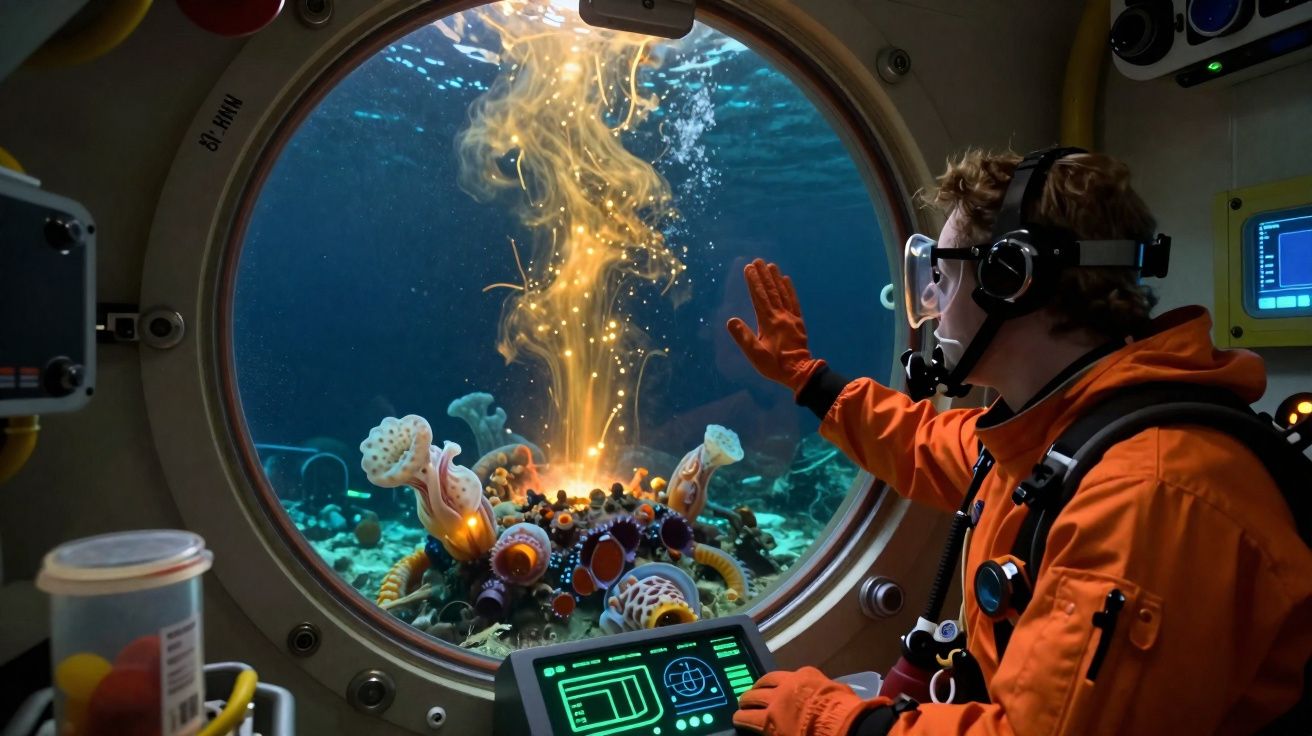
The expedition’s goal was to chart an apparently barren trench bottom. Instead, it encountered flourishing communities of unusual animals living off chemical energy seeping from the seabed, far down in the Kuril trench between Russia and Japan.
A hidden frontier where light disappears
Once you pass 6,000 metres, the ocean drops into the hadal zone: a sunless world named after Hades. Here, pressure rises to well over a thousand times sea-level pressure, and temperatures sit only a little above freezing. For years, many scientists thought these extremes could sustain little more than sparse microbes and the odd scavenger drifting through.
That assumption is now out of date. In 2024, the crewed Chinese submersible Fendouzhe dived beyond 9,500 metres into the Kuril trench. Under its lamps, the seabed looked disturbingly like woodland.
On a plain of dark sediment, dense thickets of tube worms rose like ghostly reed beds, surrounded by bustling swarms of crustaceans and clams.
These animals make up one of the deepest ecosystems known on Earth. Initial mapping indicates that similar habitats may extend for about 2,500 kilometres along the trench system, creating a patchwork of life across the deep-ocean landscape.
Kuril trench chemosynthesis: life built on chemistry, not sunlight
These communities gather around seep sites, where fluids loaded with methane and hydrogen sulphide leak out of the seabed. With no daylight at all, photosynthesis cannot happen. Instead, the food web begins with chemistry.
Microbes in the sediment-and inside the animals themselves-capture energy released when methane and sulphur compounds react with seawater. This pathway, known as chemosynthesis, converts inorganic ingredients into organic matter that other organisms can feed on.
At these depths, bacteria act like underground plants, manufacturing food out of gas and minerals instead of sunshine.
The tube worms (siboglinids) have effectively dispensed with a typical gut. In its place, they house thick masses of chemosynthetic bacteria in a specialised organ: the microbes supply nourishment, while the worms provide a protected home and access to chemical fuels. Giant clams and other bivalves rely on a comparable partnership, concentrating beneficial microbes within their gills.
The Kuril trench: a scar on the seafloor, loaded with energy
Geologically, the Kuril trench is striking-reaching more than 10,000 metres deep in some areas. It sits where the Pacific tectonic plate is forced beneath the smaller Okhotsk plate. This subduction breaks rock, warms fluids trapped within the crust, and helps drive seepage.
Aboard the research vessel Tan Suo Yi Hao, scientists examined water and sediment retrieved from the seep sites. Their tests showed elevated methane with a chemical signature consistent with microbial production. Put simply, microbes buried in the mud are converting carbon dioxide into methane, which then escapes upwards.
This seepage is more than an oddity: it is the energy supply that keeps these trench communities functioning. Shrimp-like amphipods, sea cucumbers (holothurians) and other scavengers feed on bacterial mats or filter organic debris falling from above, linking the seabed’s chemical engine to the broader deep-sea ecosystem.
- Depth: more than 9,500–10,000 metres below the surface
- Conditions: total darkness, near-freezing water, crushing pressure
- Key energy source: methane and sulphide-fuelled chemosynthesis
- Dominant animals: tube worms, clams, crustaceans, sea cucumbers
- Geological setting: active subduction zone with fluid seepage
A rethink of where life can function
Discovering such intricate communities at these depths compels scientists to reconsider where life can persist. The Kuril trench systems demonstrate that environments which look uninhabitable can still support stable, long-lived ecosystems-provided there is a consistent supply of chemical energy.
Hadal trenches start looking less like dead pits and more like hidden corridors of activity threaded along tectonic boundaries.
For biologists, this matters in two major ways. First, it extends the recognised limits of animal life on Earth, both in depth and in the ability to endure extreme pressure. Second, it strengthens ideas that life could begin-or continue-far from starlight, at rock–water interfaces energised by geochemistry.
Lessons for Mars, Europa and beyond
Astrobiologists are watching closely. Several Solar System bodies may contain underground or ice-covered oceans: Mars, with briny subsurface pockets; Jupiter’s moon Europa; and Saturn’s moon Enceladus, where internal seas may be warmed by tidal flexing.
None of these worlds offers easy access to sunlight. Even so, they may provide rock, water and chemical gradients-the same basic ingredients that sustain Kuril trench microbes. The hadal findings offer a working model of what alien ecosystems might resemble: slow-growing, microbe-led communities clustered where fluids circulate through fractured rock.
Upcoming missions that sample Enceladus’s plumes or drill through Europa’s ice will be searching for chemical signs akin to those now recorded above the Kuril seep sites-unusual methane patterns, sulphur compounds out of chemical balance, or complex organic molecules that suggest active metabolism.
A fragile stronghold under rising pressure
Although these hadal communities are far removed from day-to-day human activity, they are not beyond the reach of human choices. Interest in deep-sea mining is increasing, driven by demand for metals used in batteries and electronics. Most proposals currently focus on shallower abyssal plains, but the deep ocean remains poorly mapped and unevenly understood.
The Kuril trench ecosystems surfaced just as industry eyes the seabed, underlining how much remains unknown in the planet’s largest habitat.
Disruption in one area of the deep ocean can resuspend sediment, change chemical circulation and disturb food chains stretching for thousands of kilometres. Communities built around seep sites may be especially vulnerable, because their survival depends on a fine balance between geology, fluid movement and microbial processes.
How chemosynthesis actually works
Chemosynthesis can feel intangible, so it helps to think of it as an underwater production line powered by redox reactions. Microbes use substances such as methane, hydrogen sulphide or hydrogen as electron donors, and oxygen, nitrate or sulphate as electron acceptors.
In the Kuril trench, common pathways include bacteria oxidising methane with sulphate, or using hydrogen sulphide where oxygen diffuses down from upper waters. The released energy drives the creation of sugars and other organic molecules from carbon dioxide-broadly paralleling what green plants do with light and chlorophyll.
| Process | Main energy source | Where it dominates |
|---|---|---|
| Photosynthesis | Sunlight | Surface oceans, land plants |
| Chemosynthesis | Chemical gradients (e.g. methane, sulphide) | Hydrothermal vents, cold seeps, hadal trenches |
What this means for climate and future research
Methane detected in the Kuril trench also connects the deep ocean to climate science. Some of the gas remains locked in sediments as methane hydrates-ice-like crystals that trap greenhouse gases. Some leaks out but is consumed by microbes before it can rise far. Tracing these routes helps improve estimates of how much deep-sea methane ultimately reaches the atmosphere.
Scientists are now planning repeat expeditions to see how steady these seep ecosystems are through time. Do they intensify and then diminish as tectonic activity shifts? Could a large earthquake reroute fluid flow, depriving one tube-worm “forest” while triggering another kilometres away?
A practical way to understand the scale, for non-specialists, is through pressure. At 10,000 metres, each square centimetre of an animal’s body bears roughly a tonne of force. Under that load, proteins and cell membranes would typically fail. Hadal species endure by adjusting their chemistry-packing cells with pressure-stabilising molecules and subtly modifying key enzymes.
These adaptations are already drawing attention from biotechnology and medicine. Enzymes that remain reliable under extreme pressure could be useful in industrial settings, from food sterilisation to drug production, where high-pressure techniques are employed. The Kuril trench communities may yet influence technologies on land, even as they continue their quiet lives in permanent darkness.





Comments
No comments yet. Be the first to comment!
Leave a Comment