
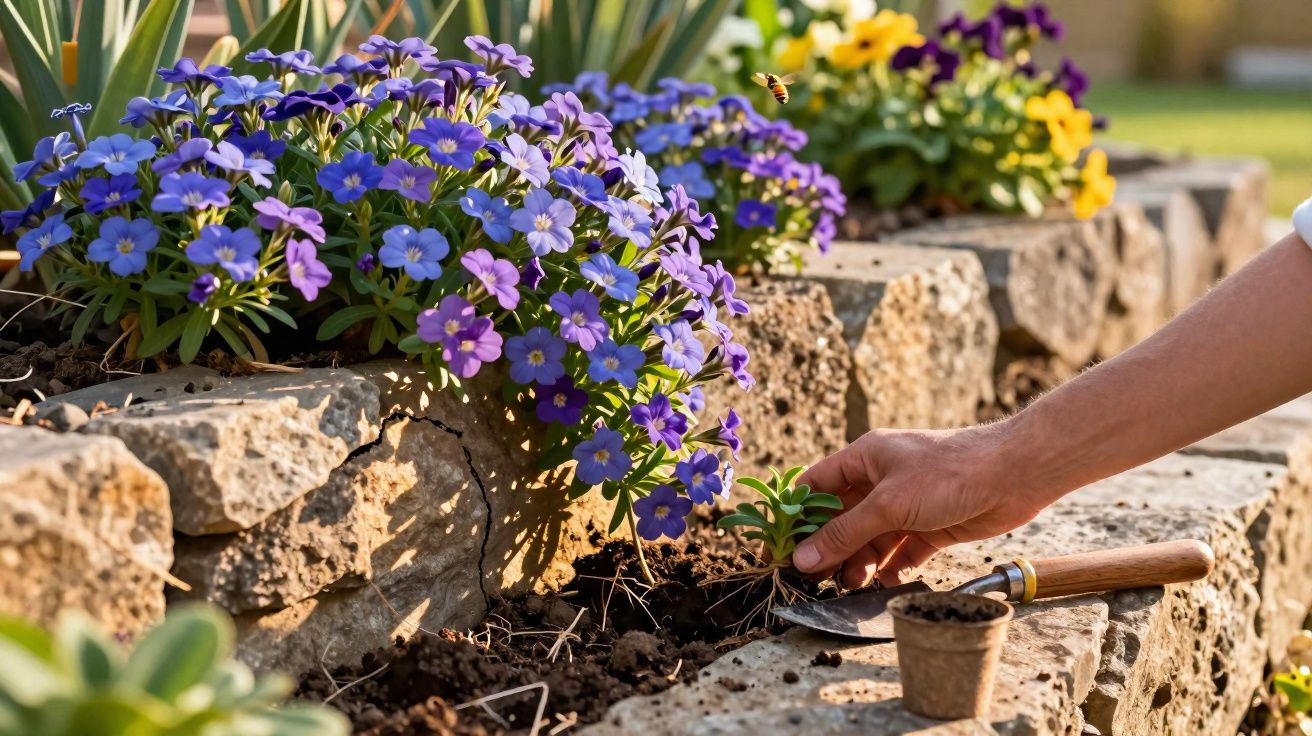
With the right perennial, an eyesore can become a bright, living feature.
Many gardens have one: a plain retaining-wall strip made from concrete blocks or rough stone-grey, angular, purely functional. It may do its job structurally, but visually it often feels like an interruption. Especially in spring, when borders and lawn are coming into their own, a bare wall can look completely out of place. Yet it only takes one remarkably tough cushion plant with purple flowers to turn that hard edge into a lively focal point in a short time.
The heroine of stone crevices: why Aubrieta (Blaukissen) thrives on walls
The plant in question is usually sold as Blaukissen. Botanically it is Aubrieta deltoidea, also known in German as Steinkresse. It is a perennial, low-growing plant that forms dense cushions. It reaches around 10 to 15 centimetres in height, but spreads outwards across stones and joints.
From roughly mid-April into early summer, Aubrieta covers itself in countless small blooms. Depending on the variety, they shine in violet, purple or a violet-pink tone. At peak flowering, you can barely see the foliage-the plant becomes one continuous carpet of colour.
"A grey stone wall turns into a flowing veil of flowers that visually dissolves the hard edge completely."
Aubrieta’s natural habitat is rocky slopes and scree. That is exactly why it feels so at home along the top of a retaining wall. It prefers:
- poor, sandy–gravelly soil
- excellent drainage with no waterlogging
- plenty of sun and warmth
- dry spells once it has established
Its flexible shoots push into the smallest gaps, take root there, and then trail down in loose garlands. Over time it drapes the wall area without loosening or damaging the stones.
The best spot: where Aubrieta (Blaukissen) really takes off on a wall
If you want to “green up” a harsh, bare patch in the garden, location matters. Aubrieta works particularly well for a retaining-wall planting in places such as:
- the top edge of a dry-stone wall
- the capping of a concrete block wall
- gaps between larger natural stones
- crevices on sunny stone stairways
A south- or west-facing aspect is ideal, where the plant receives several hours of direct sun each day. East-facing positions can still work quite well, while north-facing walls tend to produce paler growth and fewer flowers.
Just as important: water must not sit around. The roots can rot easily if rain or watering collects in pockets behind the wall. A wall top where excess water runs off quickly is perfect.
Step by step: how to plant Aubrieta on top of a retaining wall
Creating a flowering ribbon along a wall sounds more complicated than it is. With a few simple steps, you can set the foundation for many years.
1) Choose the planting time carefully
Two windows are particularly suitable:
- Spring: after the last heavier frosts, once the soil has dried out
- Autumn: during a mild spell, so the plants can root in before winter
In both cases, normal weather is enough for young perennials to establish. After that, they need very little attention.
2) Prepare the soil
On the wall-or directly behind it-make small pockets where the plant can anchor itself. Proceed like this:
- Briefly lift loose stones or lightly scrape out joints.
- Loosen any old, compacted material a little.
- Fill with a mix of garden soil, a little well-rotted compost, and plenty of grit or gravel.
The mix can-and should-be fairly lean. Too many nutrients encourage soft growth with fewer flowers.
3) Use small potted plants instead of seed
On a wall, young plants in pots (usually a 9-centimetre pot) are the most reliable option. Seed dries out easily in cracks and germinates unpredictably.
When planting, do the following:
- Gently tease the root ball.
- Position the plant so it leans slightly towards the wall edge.
- Firm the soil so there are no air gaps.
- Water thoroughly once to ensure good contact with the soil.
Afterwards, allow the top layer to dry out between waterings. Aubrieta copes surprisingly well with short dry periods.
Low-maintenance, but not “no-maintenance”: keeping the flower carpet dense
Once established, Aubrieta demands very little. Even so, it should not be left entirely to its own devices, otherwise the cushions gradually become woody and tired.
Cut back after flowering
Straight after the main flowering period in May or June, it is time for the shears. A confident cutback of roughly half the shoot length encourages the plant to form new, fresh cushions.
"If you cut your Aubrieta back once a year, you’ll be rewarded with a dense, rich green carpet and often a light second flush."
The cut does not need to be perfectly precise. What matters most is shortening old, brown sections noticeably. It can look drastic at first, but within a few weeks you will see strong new growth.
Watering, feeding, winter: what the plant can handle
- Watering: only necessary during longer hot spells, especially in the first year.
- Feeding: a light sprinkle of compost in spring is enough; complete mineral fertilisers tend to weaken the plant rather than help it.
- Frost: Aubrieta comes through even cold winters without protection, as long as waterlogging is not freezing around it.
In winters with little snow but lots of wet weather, a loose layer of leaves can help protect the roots from ice pressure. As soon as temperatures rise and it starts to thaw, remove the leaves again so nothing begins to rot.
Which plants pair particularly well with Aubrieta (Blaukissen)
A wall planting looks even more alive when a single species is not doing all the work. Aubrieta combines well with other drought-tolerant perennials.
| Plant | Character | Visual effect alongside Aubrieta |
|---|---|---|
| Houseleek (Sempervivum) | Rosette-forming, extremely tough | Sculptural accents among the violet flower carpet |
| Stonecrop (Sedum) | Succulent with yellow flowers | Strong colour contrast from yellow stars in summer |
| Cushion phlox | Low, mat-forming plant | Complementary flower colours such as pink or white |
| Thyme varieties | Scented, hard-wearing cushions | Fragrance and fine flowers for insects, especially by steps |
With neighbours, the key is shared preferences-lean soil, sun, dryness-and avoiding anything too vigorous, so Aubrieta is not pushed aside.
Benefits for insects and for the wall’s stability
The violet carpet is not only attractive. It also provides food and shelter for many insect species. Bees and hoverflies visit the flowers heavily in spring, because at that time nectar is not yet abundant everywhere.
At the same time, the root system helps stabilise the uppermost soil layers on the wall top. The plant does not replace structural calculations, but it does reduce the way small amounts of soil are washed away during heavy rain. That means less erosion and less loss of grit.
Common mistakes-and how to avoid them easily
When people begin using Aubrieta on walls, the same issues tend to crop up. Three points come up again and again:
- Soil that is too rich: produces lots of leaves, fewer flowers, and increases susceptibility to disease.
- A position that is too shady: makes the cushions fall apart and results in only scattered blooms.
- No cutback: leaves plants hollow in the middle, and eventually they start to collapse and split.
If you keep these stumbling blocks in mind, Aubrieta on retaining walls rarely causes serious trouble. It even tolerates the occasional forgotten watering-or a few weeks of complete neglect.
Who a “Blaukissen wall project” is worth it for
This plant is especially appealing for homeowners with sloping plots that have been secured with retaining walls. Rather than replanting containers every year, Aubrieta forms a long-lasting wall edge that is close to self-maintaining.
Even with only a few square metres of garden, a narrow strip of Aubrieta along a driveway or basement steps can create a surprisingly strong effect. It makes use of vertical surfaces in the garden, instead of leaving them as plain grey walls.
One more practical bonus: on slopes where traditional beds dry out constantly, these cushion plants provide long-term colour without needing continual watering. For anyone who does not want to stand on a hillside every evening in summer with a hose, that is a real advantage.






Comments
No comments yet. Be the first to comment!
Leave a Comment