
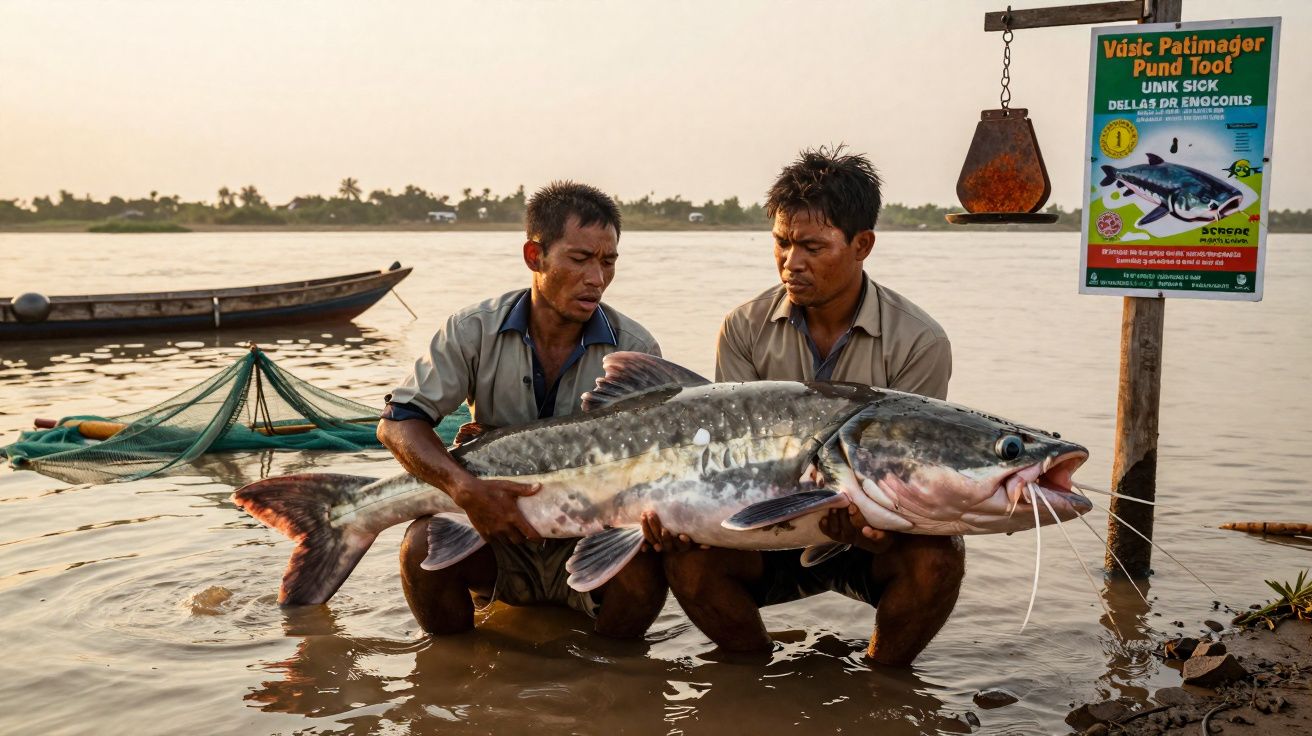
In the summer of 2005, a moment in a small village in northern Thailand played out in a way that would make headlines around the world. Local fishers hauled a Mekong giant catfish from the river-an animal so enormous it seemed to exceed anything previously recorded. What began as a remarkable local catch quickly became a symbol of how vulnerable one of the planet’s most spectacular freshwater species has become.
The record-breaking catch in Hat Khrai
The scene unfolded in Hat Khrai, a village on the Mekong not far from the border between Thailand and Laos. Several men found themselves battling an opponent on the line that was almost beyond belief. The fish was so powerful that no single fisher would have stood a chance alone.
Working together, they eventually dragged the animal onto the bank. Only then did the full scale become clear: around 646 pounds-just under 293 kilograms-in weight, and roughly 2.70 metres long. A biologist later compared its girth to that of a grizzly bear; in freshwater, sights like that are virtually unheard of.
The record catfish of 2005 is among the largest reliably documented freshwater fish in the world.
Experts and conservation organisations listed the catch as the heaviest verifiable Mekong giant catfish recorded at the time. Individual fish may grow longer, but the weight-and the fact it was properly measured and documented-makes this story exceptional.
Village fishers, tradition, and a missed opportunity for the Mekong giant catfish
This was not a staged moment featuring professionals from a television programme. The people involved were ordinary village fishers. For them, the Mekong is a daily livelihood rather than an adventure playground. Giant fish are, above all, a rare but valuable source of protein.
As word of the huge animal spread, officials and conservationists arrived quickly. Their aim was to keep the fish alive, move it into a suitable holding tank, and later release it so it could reproduce. Every breeding-capable Mekong giant catfish mattered, because even then the population was already considered severely threatened.
But time was against them. The stress of capture, transport, and handling was immense. Before any return to the river could happen, the fish died. For many scientists, it was a sobering moment; within the village, however, a different tradition took over.
The residents butchered the carcass, selling and sharing the meat. This aligned with local custom: an animal of that size can feed many households, strengthen social ties, and is seen as a rare gift from the river.
How large a Mekong giant catfish can really grow
The 2005 fish was extraordinary, yet it also demonstrates what remains biologically possible. Under favourable conditions, Mekong giant catfish grow extremely quickly. In around six years, they can reach 150 to 200 kilograms. Exceptional individuals can push well beyond the 270-kilogram mark.
- Maximum length: up to around 3 metres
- Typical weight of large fish: 150 to 200 kilograms
- Record range: over 270 kilograms, very rare
- Growth rate: only a few years to reach triple-digit kilogram weights
In appearance, these fish stand out for a massive head, a broad, barrel-like body, and a powerful tail fin. Their skin is smooth and pale-almost washed-out compared with many other catfish species.
A giant without a predator’s instinct
One of the most striking details is that fully grown Mekong giant catfish are not typical predators. Juveniles still have teeth, but they lose them as they age. As adults, they feed mainly on algae, fine plant matter, and other organic material. The idea of the "river giant as a herbivore" does not fit the usual monster narrative-yet it is precisely what makes the species even more unusual.
A delicacy with a guilty conscience?
For communities along the Mekong, the giant catfish has appeared on menus for generations. The meat is considered mild, firm, and versatile. A single large specimen can supply a village during celebrations, giving weddings and religious festivals an added symbolic layer.
Over recent decades, however, the situation has changed dramatically. Specialist bodies now classify the Mekong giant catfish as "critically endangered". Biologists clearly advise against eating wild-caught fish, regardless of how important the meat may be in daily life.
Every wild fish eaten today means an extremely rare, reproductively viable line disappears.
Why the population is collapsing
Several pressures are hitting this river giant hard:
- Overfishing: Decades of intensive harvesting-also using nets and traps-have removed many older fish.
- Dams: Migration routes to spawning grounds are interrupted, and young fish can no longer reach key habitats.
- Habitat loss: Bank development, sand extraction, and river engineering destroy calm areas the catfish use to grow and to rest.
- Pollution: Run-off from agriculture and industry lowers water quality and makes reproduction more difficult.
- Climate change: Shifts in river level and water depth alter flow patterns and temperature profiles.
The result is stark: large spawning fish are increasingly rare, juveniles struggle to find suitable areas to survive, and entire year classes fail.
Conservation programmes for a living myth
The story of the 2005 "bear catfish" did more than inspire awe-it also fuelled political debate. Since then, regional governments and conservation organisations have been trying to stabilise the population.
Key measures include:
- Designating protected zones and no-fishing stretches of the Mekong
- Seasonal fishing bans during migration and spawning periods
- Breeding programmes in aquaculture to rear juveniles
- Releasing captive-bred fish into selected river sections
- Education campaigns in villages focused on sustainable fishing methods
These initiatives repeatedly sit at the tension point between species protection and the realities of life on the river. If a family depends economically on the chance of landing a big fish, appeals alone will not change behaviour. That is why projects creating alternative income-such as eco-tourism or support for sustainable fishing-are often seen as particularly effective.
Why this species strikes such a chord
The Mekong giant catfish ticks many of the boxes that turn an animal into an icon. It is huge, rare, and elusive, spending most of its life in the river’s murky depths. Only on rare occasions does one surface-or end up on a hook.
For biologists, it is an ideal flagship species for showing how fragile large river ecosystems can be. When a top river resident struggles, it signals broader problems throughout the system. Issues like dam construction and water pollution become easier to explain when framed through the fate of such a striking animal.
What recreational anglers and travellers should keep in mind
Tourists who fish on the Mekong-or book angling excursions-can influence outcomes through the choices they make. Responsible operators typically commit to:
- A "catch-and-release" approach for large fish
- Avoiding targeted fishing for Mekong giant catfish
- Using fish-friendly hooks and keeping fight times short
- Not keeping fish out of the water for long photo sessions on land
For travellers, it pays to ask questions before booking. Companies that advertise "monster catches" and push trophy photos often do not act in the interests of protection.
Reading a river through a single fish
The 2005 record catch remains a powerful image: a huge, pale body that several men can barely carry. Today, it stands for a wider question. Can the remaining giants be protected-or will the "bear catfish" soon exist only in stories?
Anyone who wants to protect the Mekong giant catfish ultimately has to think in terms of the whole river system: from dam projects to wastewater management and local fisheries policy. One gigantic fish becomes a kind of gauge for how much strain a river can still withstand.
For many people in the region, the catfish remains a temptation despite every warning; for scientists, it is a treasure. Between those two perspectives lies the decision of whether future generations will see true river giants again-or only look at photographs from 2005.





Comments
No comments yet. Be the first to comment!
Leave a Comment