
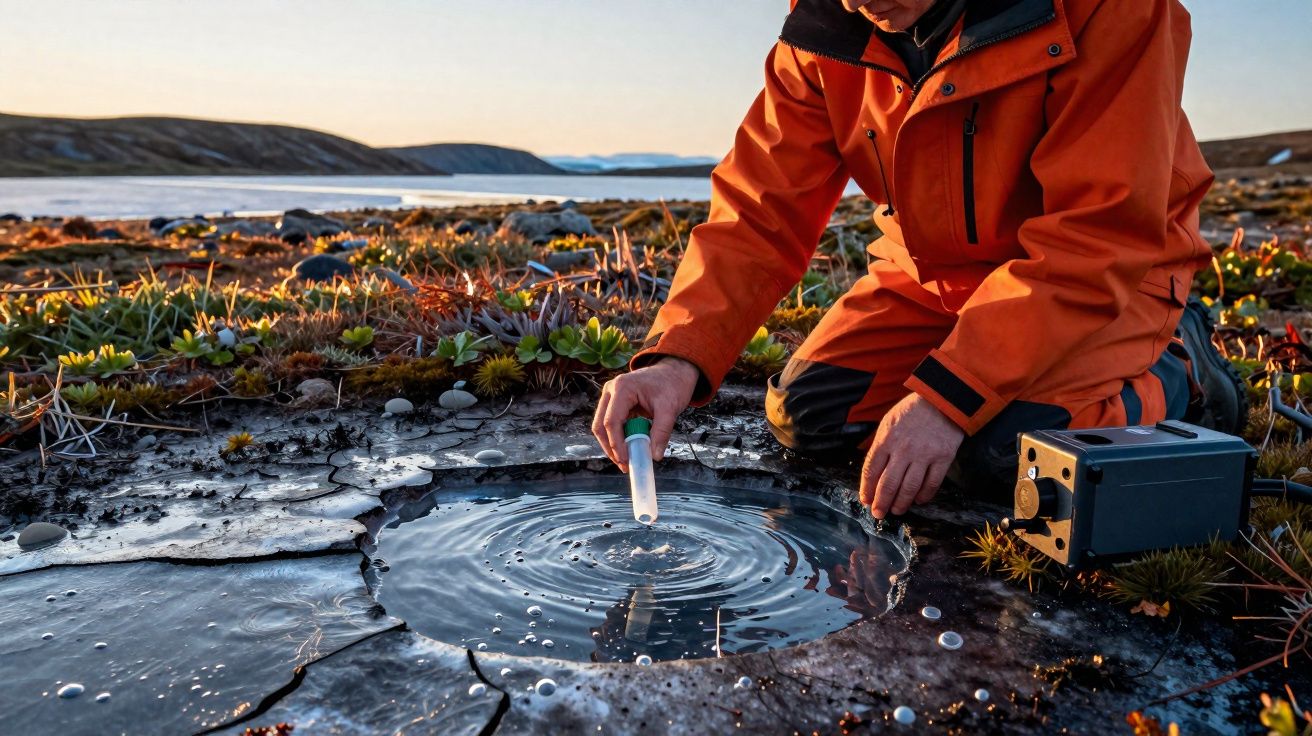
People tend to picture coal-fired power stations or gridlocked motorways when they think about greenhouse gases. Yet research is increasingly homing in on another, far quieter player: the permanently frozen soils of the Arctic. New studies suggest that, as these soils thaw, they may release not only the expected quantities of carbon dioxide and methane, but substantially more - because soil microbes are far “hungrier” than experts assumed for a long time.
What is really stored in permafrost
Permafrost is the name given to ground that stays frozen continuously for at least two years. Across large parts of Siberia, Alaska, Canada and Scandinavia, this subsurface has sat beneath the landscape for millennia like a gigantic deep-freeze.
Locked inside it is an enormous stock of ancient plant and animal material that never fully decomposed. Specialists estimate that permafrost holds more than twice as much carbon as is currently found in the entire atmosphere. As long as the ground remains frozen, that carbon is largely kept out of circulation.
Climate change is rapidly altering this picture. In many regions, the upper layers are already thawing. The ground slumps, lakes form, and buildings start to shift and slide. More worrying, however, is what happens at the same time out of sight: microorganisms “wake up”.
"When permafrost thaws, microbes begin to ‘breathe’ the organic material that has been frozen for thousands of years - and turn it into greenhouse gases."
The result is that increasing amounts of carbon dioxide (CO₂) and methane (CH₄) enter the air. Both gases intensify global heating, with methane having a much stronger effect than CO₂. Experts describe a feedback loop: more warmth causes more permafrost to thaw; thawing releases more greenhouse gases; those gases then drive further warming.
Arctic permafrost microbes are more voracious than expected
Until recently, most models assumed that only part of the carbon stored in permafrost would be readily available to microorganisms in the short term. A certain fraction was considered “hard to digest” and therefore relatively safely bound in the ground.
A research group at the University of Colorado has now strongly challenged that assumption. The team has shown that microbes in thawing permafrost can access carbon sources previously thought to be scarcely usable - including particular complex plant compounds known as polyphenols.
To put this into context: polyphenols are a large class of substances found in many plants. They contribute bitterness, tannins and pigments. In soils, they were generally seen as a fraction of organic matter that is difficult to break down - at least according to the prevailing view up to now.
"New laboratory experiments show: soil microbes in permafrost can break down polyphenols even under low-oxygen conditions, releasing additional greenhouse gases in the process."
The researchers had initially expected these substances to act like a brake on soil microbes. The thinking was that polyphenols might block enzymes - the microbial “tools” used to break down organic matter. This enzyme “jamming” was supposed to help prevent large amounts of carbon from escaping into the atmosphere.
The new study points in the opposite direction: certain microbial species appear to have specialised in these supposedly stubborn molecules. Rather than being slowed, they use this “sharp” carbon as an additional food source.
The climate impact may be substantially underestimated
So what does this mean for the global climate? Previous estimates suggested that thawing permafrost regions could emit, by 2100, roughly as much greenhouse gas as a major industrialised country. If microbes can exploit more carbon sources, that potential rises markedly.
At present, the additional quantity cannot be put into a precise figure. Climate and soil models still include the microbial metabolism described here only minimally - or not at all. Closing that gap will require more field measurements, a wider range of soil types and temperature conditions, and long-term datasets.
Even so, the direction of travel is already clear:
- More usable carbon means more food for microbes.
- More food increases the soils’ “respiration” activity.
- Higher activity releases more CO₂ and methane.
- That strengthens warming and leads to further permafrost thaw.
What might look like a slow, linear process therefore risks becoming an increasingly self-reinforcing system. Climate scientists talk about a possible tipping point: once a certain level of warming is crossed, the process could continue largely under its own momentum.
Hopes of using permafrost as carbon storage are fading
In recent years, some research teams even entertained the idea of actively using permafrost as a long-term carbon store. By deliberately adding certain plant compounds, the ground was meant to be pushed into a kind of “Sleeping Beauty” state.
The underlying concept was that polyphenols could block microbial enzymes, seal organic matter in place, and keep it in the soil for many decades or centuries. The new study now clearly calls that approach into question.
"Anyone adding polyphenols to thawing soils may end up feeding precisely the microbes that mobilise stored carbon."
Rather than forming a protective layer, such substances could - in particular soils - behave more like extra fuel. The researchers therefore warn against technical quick fixes that rely only on laboratory observations under heavily simplified conditions.
Why methane is particularly critical
When organic matter is broken down in soil, the main products are CO₂ and methane. Both act as greenhouse gases, but in different ways. CO₂ persists in the atmosphere for a very long time. Methane remains for only a few decades, but warms the air far more strongly during that period.
| Gas | Lifetime in the atmosphere (approx.) | Warming effect per molecule compared with CO₂ |
|---|---|---|
| Carbon dioxide (CO₂) | Centuries | 1 (reference value) |
| Methane (CH₄) | ≈ 10–15 years | about 25–30 times stronger over 100 years |
In thawing permafrost, many zones develop where there is little or no oxygen - for example in wet depressions, under layers of sludge, or at the bottom of new lakes. Those are precisely the environments in which methane-producing microbes work especially efficiently.
That helps explain why Arctic ponds and lakes already send up numerous methane bubbles. In winter they freeze in place, forming strange patterns in the ice - striking images, but with a grim message.
What the technical terms actually mean
Permafrost - more than just “eternal ice”
Permafrost is not made up of ice alone. It also contains soil, stones, plant remains, roots and, in places, very old animal bones. When the ground is frozen, ice acts like a kind of glue holding everything together. Once it thaws, entire landscapes lose stability. Buildings subside, roads fracture, and pipelines develop cracks.
Carbon dioxide and methane in everyday life
Carbon dioxide is produced by burning coal, oil and gas, and also by the breathing of humans and animals. In moderation it is part of the natural cycle, but at today’s concentrations it places massive strain on the climate system. Many people know methane from natural gas, from landfill sites, or from livestock farming - particularly cattle.
What this means for climate policy and daily life
The new findings on permafrost illustrate how risky it is to rely on natural stores as a “lifeline”. Forests, soils and oceans absorb a large share of our emissions, but they are sensitive to temperature changes.
The more the planet warms, the more likely these stores are to flip from being a help to becoming an additional problem. Thawing permafrost is an especially clear example.
- Every tonne of CO₂ avoided reduces the risk of extensive permafrost thaw.
- Rapid emissions cuts buy time to develop adaptation strategies in Arctic regions.
- Research stations and monitoring programmes in polar regions become more important for detecting changes early.
For many people, what happens in the Arctic can feel distant from everyday life. But the released greenhouse gases quickly mix through the atmosphere and influence temperatures, rainfall and extreme weather worldwide - including in Central Europe. Hot summers, flood events and shifting seasons are tied to the same climate system that is thawing permafrost.
Why microbes are so difficult to model
Microbes may be tiny, but they drive enormous flows of matter. In permafrost, billions of different bacteria and fungi live in every gram of soil. They react extremely sensitively to temperature, moisture and nutrients. Small changes can completely reshape which groups dominate.
That is exactly what makes forecasts so challenging: if the water table shifts, one group of microbes may suddenly take over and produce methane instead of CO₂. Or new species may move in that can break down substances like polyphenols that were previously “indigestible”.
For climate models, this means biological processes must be represented far more finely than in the past. The latest data from permafrost research provide an important foundation - while also underlining just how large the uncertainties still are.





Comments
No comments yet. Be the first to comment!
Leave a Comment