
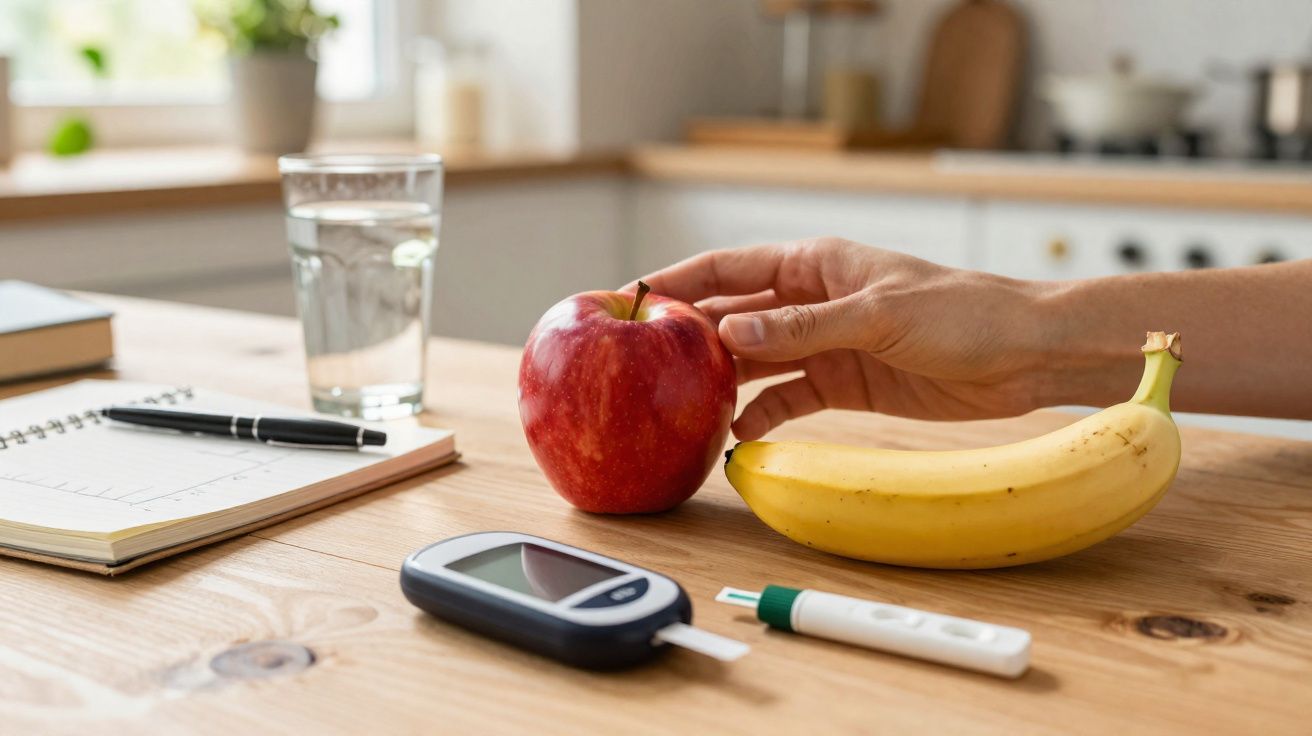
An apple with its crisp bite or a creamy banana: at first glance, both look like wholesome, harmless snacks. But if you struggle with blood sugar spikes, you quickly learn that not all fruit affects you in the same way. Nutrition professionals have therefore compared apples and bananas closely, looking at how each one influences blood sugar and satiety - with a few details that may surprise you.
How fruit affects blood sugar
To see which fruit tends to work better, it helps to focus on two key measures: the glycaemic index and fibre. Together, they influence how quickly sugar moves from the gut into the bloodstream.
"Apples usually raise blood sugar more slowly than bananas - mainly because of their soluble fibre."
The glycaemic index indicates how rapidly a food pushes blood sugar upwards. A typical apple sits at roughly 38, which is on the low side. A banana comes in at about 52, considered medium. So neither is a “sugar shock”, but the apple does have a modest advantage here.
The main reason is fibre: apples contain more soluble fibre, especially pectin. In the gut, these fibres act a little like a fine mesh. They slow down carbohydrate digestion, meaning sugar reaches the blood more gradually. The result is a flatter blood sugar curve.
Apple in detail: the fibre champion of the fruit bowl
A medium apple contains, on average, about 25 g of carbohydrates, including around 19 g of sugar and 4 g of fibre. You get the biggest benefit if you eat the skin too, because a good portion of the fibre and plant compounds sits in or near the peel.
- approx. 25 g carbohydrates
- approx. 19 g natural sugar
- approx. 4 g fibre (with skin)
- glycaemic index about 38
Dietitians point out that this combination usually produces a slower, steadier rise in blood sugar than a banana. If you’re prone to cravings, that can help twice over: you often stay satisfied a little longer because the sugar doesn’t arrive all at once.
Apples also provide polyphenols and other plant compounds that may support blood vessels and metabolism over the long term. For people with prediabetes or type 2 diabetes, eating an apple regularly - as part of an overall balanced diet - can be a sensible building block.
Banana: sugar bomb or reliable energy boost?
Bananas have a slightly different profile. A medium fruit provides around 27 g of carbohydrates, about 14 g of sugar and roughly 3 g of fibre. The gap compared with an apple may look small, but it can matter in everyday life.
| Feature | Apple | Banana (medium, ripe) |
|---|---|---|
| Carbohydrates | approx. 25 g | approx. 27 g |
| Sugar | approx. 19 g | approx. 14 g |
| Fibre | approx. 4 g | approx. 3 g |
| Glycaemic index | ~38 (low) | ~52 (medium) |
It gets particularly interesting when you consider ripeness and size: the larger and riper the banana, the higher the “sugar dose” per snack. Nutrition experts emphasise that a large, very ripe banana can raise blood sugar noticeably faster and higher than a smaller banana that’s still slightly green.
"Green banana contains more resistant starch - this type of starch behaves more like fibre and raises blood sugar more slowly."
As a banana ripens, more of its complex starch is broken down. This creates simpler sugars that the body absorbs faster. The glycaemic index goes up. If you need to watch your blood sugar, a smaller banana that isn’t overripe is generally the better choice.
Bananas also provide valuable plant compounds. Some studies suggest that both bananas and apples may reduce the risk of metabolic diseases over time - provided they replace sweets rather than being eaten on top of them.
Which fruit is gentler on blood sugar - apple vs banana?
If you look only at the raw figures, the apple comes out slightly ahead: more fibre, a lower glycaemic index, and typically a smoother blood sugar curve. In day-to-day life - especially with prediabetes or already elevated blood sugar - it often has the edge.
That doesn’t make the banana automatically “bad”. It delivers quick energy and can work well before exercise or when you need something more filling between meals. The key is choosing wisely:
- pick a smaller banana instead of a very large one
- prefer yellow with minimal green patches rather than heavily brown-speckled
- pair banana with protein or fat (e.g. natural yoghurt, a handful of nuts)
If, however, your goal is to keep blood sugar as steady as possible throughout the day, you’re often better served by an apple - ideally with the skin.
How to eat apples and bananas in a blood-sugar-friendly way
What matters isn’t only which fruit you choose, but also how you eat it. Specialists strongly advise against snacking on larger amounts of plain carbohydrates on their own. They refer to this as “naked carbohydrates” - sugar without a brake.
"A combination of fruit, protein and fat is ideal: it keeps you full, slows sugar absorption and reduces blood sugar spikes."
Practical snack ideas for steadier levels (apple and banana)
- apple slices with a tablespoon of nut butter (e.g. almond or peanut butter)
- a small banana with natural yoghurt and a few nuts
- a piece of fruit together with a small piece of cheese
- fruit after a main meal rather than alone in the afternoon
A 10 to 15 minute walk after eating can provide extra support: muscle cells then pull more glucose from the blood without the pancreas having to release large amounts of insulin. A short loop around the block can measurably smooth out blood sugar levels.
What people with diabetes or prediabetes should keep in mind
For those affected, what ultimately counts is the total carbohydrates across the day. An apple or a banana rarely breaks the bank - problems tend to arise when juices, sweets, refined white-flour products and too little movement come into the mix.
Useful strategies include:
- measure portions: one apple or one small banana per snack is enough
- chew fruit rather than drink it: smoothies and juices raise blood sugar much faster
- rotate varieties: don’t always choose the same fruit; add berries, citrus fruit or kiwi
- measure blood sugar: test your personal response to different fruits
Many people notice with a glucose sensor that their response depends on sleep, stress, time of day and physical activity. Some tolerate a banana very well after exercise, yet see a strong rise if they eat one in the evening while sitting on the sofa.
What terms like “glycaemic index” really mean
The glycaemic index describes only how quickly blood sugar rises - not the total amount of carbohydrates. Two foods can share the same index while containing very different amounts of carbs. That’s why “glycaemic load” also matters in real life: it factors in how much carbohydrate you actually eat.
For example, a small banana with a moderate index may ultimately have less impact than a very large slice of cake with a similar index but far more carbohydrates. So when planning your diet, it’s worth paying attention to portion size and frequency, not just table values.
A practical everyday guide
If you’re standing undecided at the fruit bowl or supermarket shelf, a simple rule of thumb can help:
- For the steadiest blood sugar - for example during a typical office day: choose an apple.
- For quick but not extreme energy, such as before training: choose a small, not-overripe banana.
- In both cases: combine with protein or fat and add a little movement.
Both apples and bananas can fit into a healthy diet, even with diabetes. If you portion them sensibly, pair them with other foods and stay regularly active, you can enjoy fruit without worrying about dramatic blood sugar spikes.






Comments
No comments yet. Be the first to comment!
Leave a Comment