
In a nutshell
- Cooler outdoor air that warms up indoors typically drops in relative humidity, nudging surfaces above the dew point and cutting condensation and mould risk.
- Use short, purposeful purge ventilation after dusk: cross-vent for 10–20 minutes, take advantage of the stack effect, keep trickle vents open, and use gentle micro-venting in bedrooms.
- Pros vs cons: strong RH reduction, better indoor air quality, and improved fabric health; trade-offs include potential heat loss, noise/security concerns, and smaller gains on very humid nights.
- Real-world check: a Salford flat fell from 67% to ~50% RH and reduced dew point by ~5°C after an 18‑minute night purge, with only ~1.4°C cooling-an energy impact that stayed modest.
- Act on measurements: use a hygrometer, time purges after cooking/showering, run extractors, and avoid drying clothes on radiators to prevent overnight moisture accumulation.
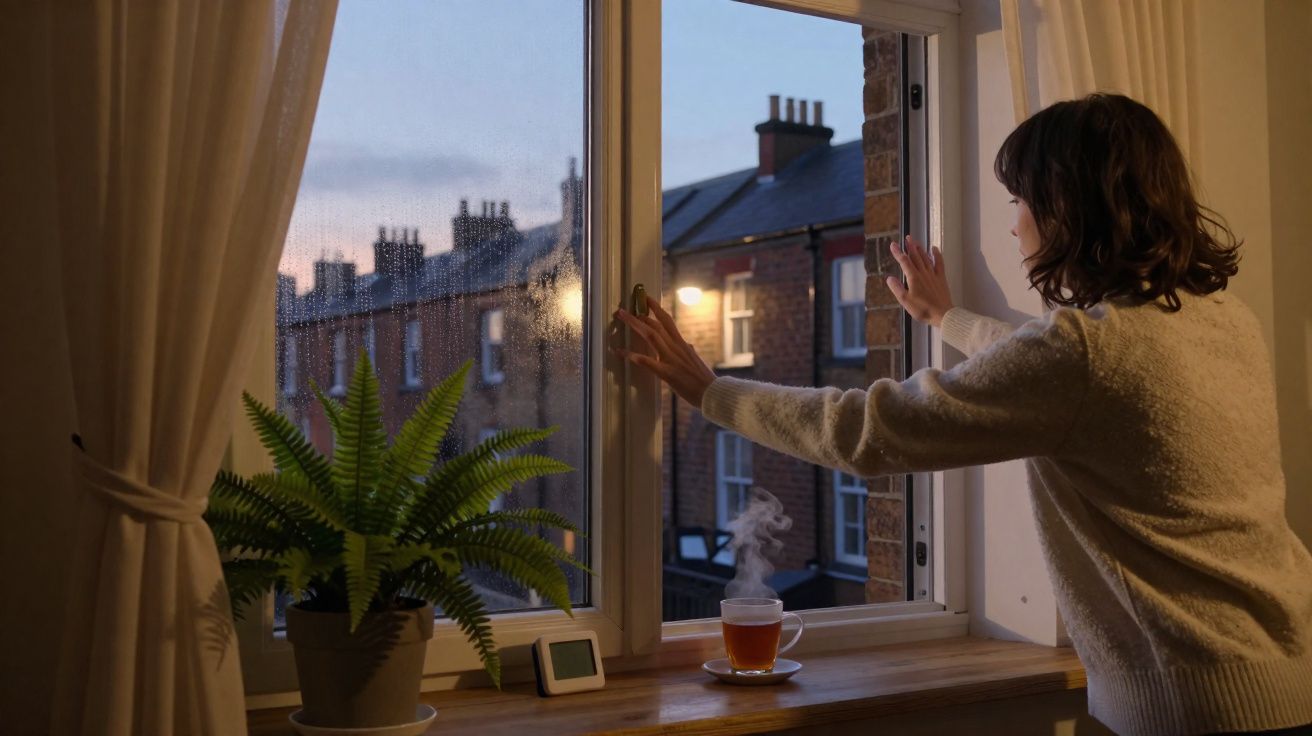
British evenings often bring a familiar winter pattern: the heating comes on, windows cool down, and condensation appears-soon followed by peeling paint, musty smells and, in the worst cases, mould that can aggravate asthma and allergies. One of the most effective low-cost interventions is deceptively simple: ventilate after dusk, when the outdoor air is cooler, and let physics do the heavy lifting.
When colder outside air is brought indoors and warmed by a few degrees, it can end up with a lower relative humidity than the air it replaces. That shift helps damp surfaces (glass, cold corners, thermal bridges behind furniture) move from “condensing” to “drying”. Used well, night ventilation can lower indoor moisture without sacrificing comfort or running up bills-provided it’s done in short, targeted bursts rather than as an all-night draught.
Why cooler night air cuts condensation (relative humidity, dew point, condensation)
Air can hold more water vapour as it gets warmer. That’s why it helps to think in two layers:
- Relative humidity (RH): how full the air is, as a percentage of its maximum at that temperature.
- Absolute humidity: the actual mass of water in the air (grams per cubic metre).
After dusk, the outside temperature drops. If you bring that cooler air inside and it warms up, its capacity increases while its water content barely changes. The practical outcome is a lower indoor relative humidity. With RH reduced, moisture evaporates more readily from windows, walls and fabrics, and the nightly cycle of condensation is less likely to start.
A quick example shows the mechanism. Suppose it’s 10°C outside at 80% RH. That same parcel of air might warm to 19°C indoors. It hasn’t gained much extra moisture on the way in, but because warmer air can “carry” more vapour, its RH drops after warming. This matters because lower RH reduces the dew point (the temperature at which air becomes saturated and water starts to condense on surfaces).
What happens to RH when cooler air warms indoors?
| Scenario | Temp (°C) | RH (%) | Approx. Absolute Humidity (g/m³) | Resulting RH if warmed indoors to 19°C (%) |
|---|---|---|---|---|
| Cool evening air | 10 | 80 | ~7.5 | ~46 |
| Mild evening air | 12 | 75 | ~7.9 | ~48 |
| Damp night air | 8 | 90 | ~7.3 | ~45 |
The key point: cooler outside air, once warmed indoors, often becomes “drier” in RH terms-often enough to push vulnerable surfaces above the dew point, so they stop wetting and begin drying.
How to ventilate after dusk without losing too much heat (purge ventilation, stack effect, trickle vents)
The most effective approach is “purge, then close”: a brief, high-airflow exchange to strip moisture, followed by shutting windows to retain heat. You are aiming for a quick reset of humidity, not hours of cold draughts. The difference between a useful purge and wasted heat is usually down to timing, airflow routes and duration.
Practical methods that suit many UK homes:
- Purge ventilation: open windows on opposite sides for 10–20 minutes after moisture spikes (cooking, showers, indoor laundry). Cross-ventilation clears humid air rapidly.
- Time it after dusk: ventilate when outdoor temperatures are dropping, then repeat before bed if the evening included extra steam.
- Use the stack effect: open an upstairs window slightly and a downstairs one too; warmer, moisture-laden air escapes high while cooler air enters low.
- Manage internal doors: keep doors closed to contain steam in wet rooms during a purge; afterwards, open doors briefly for a whole-home “equalise” pass.
- Keep trickle vents open, and run extractor fans for 20–30 minutes after showering or cooking.
- Micro-vent bedrooms overnight: a small gap (or a tilt-and-turn micro setting) can steady RH with less heat loss than a wide opening.
If you’re on a noisy or polluted road, prioritise the quieter side for air intake and use kitchen/bath fans to exhaust elsewhere. For security, choose top-hung openings or tilt-secure positions and keep gaps small at night. During allergy season, use insect/pollen mesh where possible and schedule purges for lower-pollen hours in your area. The goal is a short exchange of lower-RH air that reduces overnight moisture, not a house that feels chilled.
Pros and cons of night venting (RH reduction, energy)
Night venting works because it supports heating rather than competing with it: you reduce the moisture that would otherwise condense at the first cold bridge, drip onto sills and feed mould. It’s inexpensive, quick and feasible for most households. Even so, it isn’t universally beneficial in every condition.
Pros
- Fast RH reduction without needing to buy a dehumidifier.
- Better indoor air quality through dilution of CO₂ and VOCs.
- Targets the hours when condensation risk is typically highest.
- Helps protect finishes and materials-paint, plaster and timber tend to last longer in drier conditions.
Cons
- Heat loss if windows are left open too long or opened too wide.
- Noise, air pollution and security concerns in some locations.
- Reduced benefit on very warm, humid nights or in fog.
- Won’t solve underlying issues such as severe thermal bridging, persistent leaks or rising damp.
Why “more ventilation” is not always better: if the outdoor absolute humidity is higher than indoors (for example, humid summer nights or dense mist), you can bring moisture in rather than drive it out. A simple hygrometer helps you decide: if the outdoor air is cooler and the indoor RH is higher, a short purge is often worthwhile. Combine that with everyday moisture control-pan lids, extractor use, and avoiding clothes drying on radiators-and you reduce the moisture load before it reaches cold glass.
A small home test: data from a damp-prone UK flat
In a one-bedroom upstairs flat in Salford with regular winter window wetting, I ran a straightforward check using two consumer data loggers. After an evening of boiling pasta and taking a shower, readings were:
- Lounge: 21.0°C and 67% RH
- Bedroom: 20.3°C and 64% RH
I then opened the bedroom tilt window by 12 cm and the lounge top-light by 8 cm for 18 minutes. After closing both windows, I left trickle vents open.
- Before purge: 21.0°C, 67% RH (dew point ≈ 14.5°C)
- Immediately after: 20.0°C, 53% RH (dew point ≈ 10.2°C)
- One hour later: 19.6°C, 50% RH (dew point ≈ 9.3°C); no visible fogging on the coldest corner pane
- Estimated absolute humidity drop: roughly 3–4 g/m³, enough to shift sills from wetting to drying
The air temperature fell by about 1.4°C during the purge, but the boiler brought temperatures back over the next hour without noticeable discomfort. More importantly, the dew point dropped well below the coldest glass temperature, increasing the “safety margin” that prevents overnight wetting and the slow week-by-week spread of mould. This is not a peer-reviewed study, but it aligns with what many energy advisers observe: short, sharp night ventilation can arrest moisture build-up with a relatively small energy penalty.
Two extra checks that make night ventilation more reliable
First, it helps to distinguish between “humid” and “condensation-prone”. Condensation is most likely when the dew point is close to the temperature of the coldest surface (often window corners, external wall junctions, and areas behind wardrobes). If you have an inexpensive infrared thermometer, you can compare surface temperatures with your dew point (from a hygrometer or app). When the dew point sits comfortably below the coldest surface temperature, you are far less likely to see water forming.
Second, ventilation only performs well if extraction actually works. Many bathrooms and kitchens have underperforming fans (blocked grilles, poor ducting, weak flow, or users turning them off too quickly). Keeping fans running for 20–30 minutes after steam, cleaning filters, and ensuring vents discharge outdoors (not into a loft) can make your short purge ventilation far more effective-because you are reducing the moisture entering the air in the first place.
Cooler evening air is often an ally: once warmed indoors, it commonly delivers lower relative humidity, drier surfaces and fewer opportunities for condensation and mould. Combine brief cross-ventilation with disciplined extraction and simple moisture habits, and you tackle causes rather than wiping up symptoms. The essential habit is to ventilate intentionally-briefly, at the right times, and guided by your hygrometer.


Comments
No comments yet. Be the first to comment!
Leave a Comment