
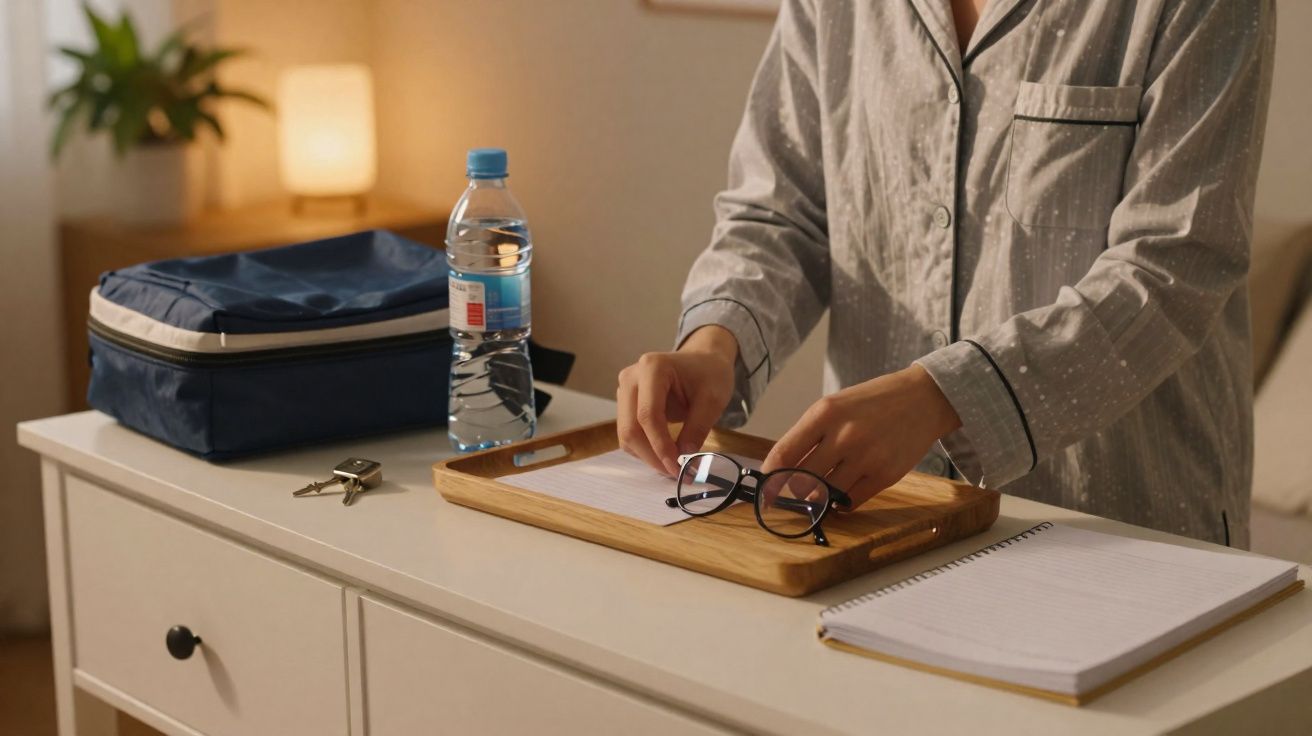
The keys are already in your hand before you even notice it.
That slight jolt in your chest, the rapid sweep across the room - phone, wallet, pass, headphones - and that nagging feeling that you have forgotten something you will only remember once you are on the bus. The front door starts to feel like a dividing line between “I think I have everything” and “it is too late now”.
Outside, people hurry past with the same clenched jaw and the same half-zipped bags. Coffee in one hand, notifications buzzing in the other, bodies moving forward while their minds keep replaying the morning’s chaos. Did I lock the back door? Did I answer that email? Why am I already exhausted and the day has not even properly started?
Stress does not always arrive with a roar. Sometimes it murmurs just before you step outside.
And that is where a tiny, almost invisible habit can change everything.
The moment before the front door: where the day is decided
There is a very brief gap between “I am getting ready to leave” and “I am out of the house”. Most people treat that gap as wasted time. Coat on, shoes tied, bag half-open, messages checked, door clicked shut, gone.
But that small stretch of the morning is often the moment when your nervous system chooses the direction of the day: steady and grounded, or tense and already chasing its tail. One minute can influence your mood more than the next two hours of meetings.
Think about the mornings when everything feels rushed. Your body learns that pace. It carries it into traffic, into your inbox, and into the way you speak to other people.
On a packed commuter train into London, I once watched a man realise he had left his laptop behind. His face told the whole story like a silent film: the blank stare, the blink, the whispered curse, then the frantic glance at his watch as he mentally rearranged the entire day. Nothing dramatic happened. No one raised their voice. Yet his shoulders stayed high for the rest of the journey, his fingers tapped his thigh, and his eyes never quite settled on the carriage. One mistake at the door had become hours of background panic.
We often underestimate how much of our daily stress comes from these tiny moments of uncertainty and disarray. They look small. They feel small. But they build up like pebbles in a coat pocket.
Psychologists use phrases such as “decision fatigue” and “cognitive load”, but you do not need a journal article to recognise the feeling. Every “Have I locked the door?”, every “Where did I put my pass?”, every “What am I missing?” takes a little more of your mental energy.
By lunchtime, you are not necessarily worn out because life is impossible. You are worn out because your brain has been on alert since the moment you left home. That kind of hyper-vigilance may have made sense in the wild. It makes far less sense when you are simply trying to get to work without mislaying your Oyster card.
The quiet truth is this: the first stress of the day is often not your boss or your workload. It is the disorder of how you leave the house.
The 60-second door pause ritual
The habit is almost laughably simple: before you leave, build in a 60-second “door pause” ritual. Not ten minutes of meditation. Not a complete morning routine. Just one minute, at the door, every time you go out.
In practice, it looks like this. You stand by the door with your bag already on your shoulder and your shoes on. You do not touch your phone. You do not keep moving while you do it. You stop. You take one slow breath. Then you work through a short mental checklist you already know.
Keys, phone, wallet or purse, travel card, work pass, lunch, anything else that matters for the day ahead. Then ask yourself one final question: “Is there anything I am already worrying about?” Notice it. Name it. Then open the door.
The strength of this tiny habit is not magic. It is structure. You give your brain a predictable pattern at precisely the point where things used to feel messy. It is rather like laying tracks beneath a train that used to roll over loose gravel.
Most people attempt huge life overhauls in the hope of feeling less stressed, then abandon them by Thursday. This is different. It is so small that it fits even on mornings when you are late, irritated, or running on very little sleep. Let us be honest: nobody does this perfectly every day, but even managing it on four mornings out of seven changes the overall weight of your week.
Over time, the one-minute pause becomes a kind of muscle memory. Your hand reaches for the door handle and your mind automatically slows by a fraction instead of leaping into “go, go, go”.
“The most effective stress tools are often the ones that seem too small to matter,” says a workplace therapist I spoke to. “The brain likes rituals. They act like anchors when things feel rough.”
To make the habit stick, keep it almost ridiculously easy. Put a small note or symbol by your door - a sticker, a word written on masking tape, a tiny drawing - anything that says: pause. Use the same order of checks each time so your brain can learn the sequence.
Here is a simple version of what that can look like:
- Stop at the door and stand still for one breath.
- Run through your mental checklist: keys, phone, wallet, pass, lunch, extras.
- Ask yourself, “What am I already tense about?” and say it quietly in your head.
- Decide on one tiny next step you will take on that worry once you arrive.
- Open the door and leave - without reopening your bag five times.
Why the door pause works on busy mornings
The real advantage of this habit is that it does not ask you to become a different person before breakfast. It simply gives your nervous system a calmer launch point.
On days when you use the door pause, notice what changes. The walk to the bus might feel a little less frantic. You may check the hob once instead of three times. You may handle a delayed train with a bit more ease, because your stress levels did not begin the day already half full.
On days when you forget, that is not failure. It is useful information. You get a clearer contrast between mornings where you rush out in a blur and mornings where you leave with a small ritual in place. That contrast, more than any expert advice, is usually what persuades people to keep going.
If you share a home with family or flatmates, the ritual can still work. It does not matter if the hallway is noisy or the kitchen is full of people. You can choose a pause point two steps before the front door, or even at the end of the corridor. The exact location matters far less than the consistent moment of stopping.
You can also make the evening before work do some of the heavy lifting. Put your keys, pass, and bag in the same place each night, charge your phone in one fixed spot, and lay out anything you know you will need the next morning. The less friction you create overnight, the less your morning brain has to carry.
A calmer start without changing your whole life
Think of this tiny habit less as self-improvement and more as a small favour to your future self a few hours later. You are not trying to reinvent yourself before breakfast. You are just giving your nervous system a gentler runway.
The days you remember to pause at the door often feel different in subtle ways. The commute may feel slightly less chaotic. You may speak to people with a bit more patience. You may find it easier to let a small problem wait until you are properly settled.
And if your stress or anxiety is larger than a simple routine can hold, this ritual is still useful as a steadying point, not as a cure. It can support you, but it is not a replacement for proper help when you need it.
The truth is that small habits matter most when they are repeated in ordinary moments. That is why this one works: it lives exactly where the day usually begins to wobble.
Quick summary
| Key point | Detail | Why it helps |
|---|---|---|
| 60-second ritual | Stand still, take one breath, and run a short mental checklist before opening the door | Reduces forgetfulness, backtracking, and the tension that starts the day |
| Personal checklist | Keys, phone, wallet, pass, lunch, and whatever else your day requires | Frees up mental space so you are not constantly wondering what you have missed |
| Name one worry | Identify one source of stress and choose one tiny action tied to it | Helps stop rumination and creates a greater sense of control |
Frequently asked questions
Do I really need to do this every time I leave the house?
No. Start with weekday mornings, or with the times when you usually feel most rushed. The goal is consistency, not perfection.What if I live with family or flatmates and the hallway is chaotic?
Choose a pause point two steps before the door, even if that is in the kitchen. The important part is the moment, not the exact spot.Is this just another productivity trick in disguise?
It is more of a mental hygiene habit. Less micro-stress at the start of the day means more energy for the things that genuinely matter.How long before I notice a difference in my stress levels?
Many people feel a small change within the first week. The stronger effect tends to build after several dozen repetitions.What if my anxiety is bigger than a simple habit can handle?
This ritual can be a useful support, but it is not treatment. If anxiety feels overwhelming, speaking to a qualified professional is still the best course of action.



Comments
No comments yet. Be the first to comment!
Leave a Comment