
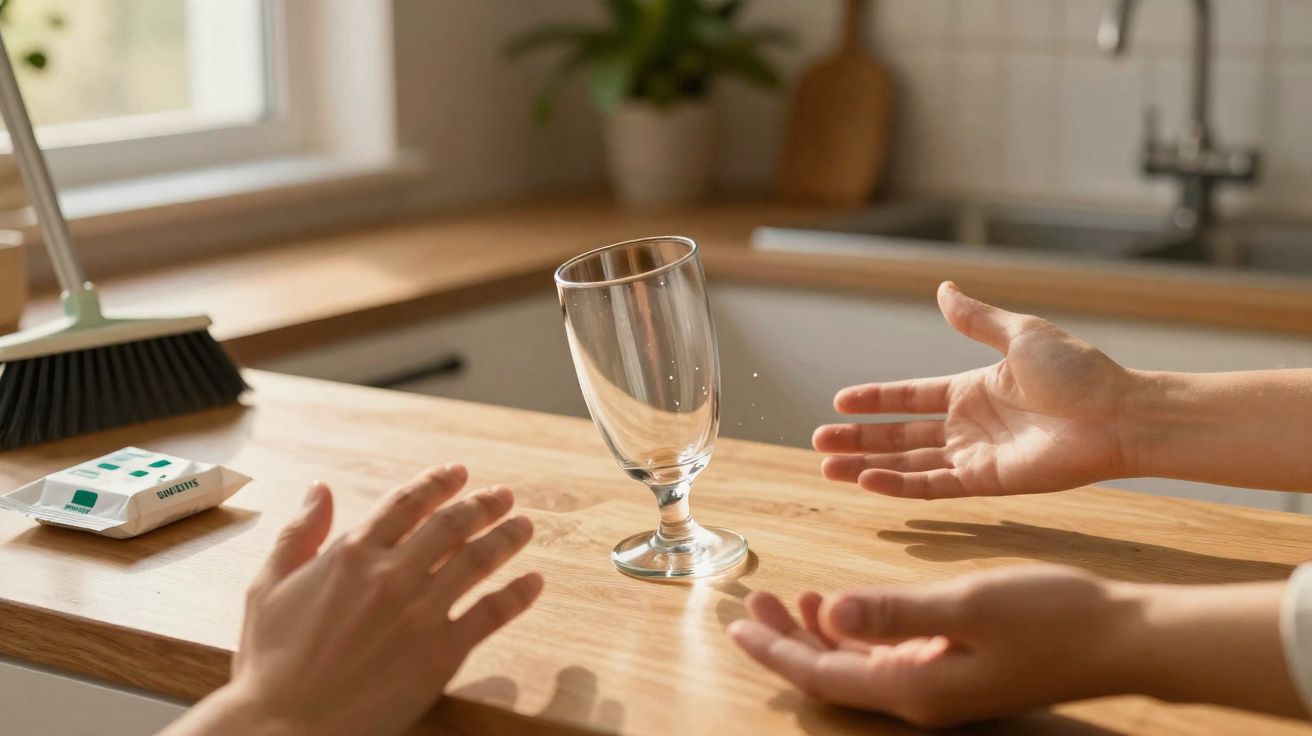
The glass begins to slide.
That tiny jolt of alarm hits your chest and your fingers tense on instinct. In less than a second, your brain has to decide whether to let it smash or try to be a hero with your bare hands. The urge to save it is powerful. It is odd, almost unreasonable. Your body seems to resent the idea of letting anything break.
But on a kitchen floor, a shattered glass is only a few pounds’ worth of mess and a broom. In your palm, a deep cut can mean torn tendons, an operation, months of rehabilitation and a hand that never quite behaves the same again. That is the real bargain you are making when you lunge for a falling glass.
Most people never stop to think about that. Not until the bleeding will not stop and A&E suddenly feels a very long way away.
When a cheap glass is suddenly worth more than your hand
The scene is always familiar: a wet glass, a soapy plate, a packed bar counter. Everything seems to slow as something slips from your grasp and starts that helpless drop to the floor. Your body moves before your mind has a chance to agree. You reach, swipe and clutch at nothing.
Sometimes you “win” and catch it. Sometimes it bursts in your hand, and the sound that follows is nothing like a film scene. It is the sound of your own breath, sharp and startled, when you notice the bright red streak across your palm. One small error, one automatic reaction.
We like to imagine we are fully in charge in our own kitchen. A falling glass shows how false that is. Reflex outruns judgement, speed outruns thought, and your tendons are suddenly in danger.
Accident and emergency doctors see versions of this again and again: a 23-year-old bartender trying to grab a tilting pint, a parent leaning across the sink to stop a tumbler hitting the tiles, a retiree catching at a wine glass that has slid off the table during dinner with friends.
Very often, they arrive clutching a towel that is already soaked through. They are certain it is “only a cut”. Then the doctor lifts the cloth and spots the warning signs: a finger that will not move, a thumb that refuses to bend, numb skin where feeling has disappeared. That is when the word “tendon” enters the discussion.
A French hand surgery unit once reported that kitchen glass and knives were among the leading causes of severe hand injuries. Not industrial machinery. Not road collisions. Just ordinary objects at the wrong moment, and a very human instinct to reach out and save them.
Beneath the skin of your hand, tendons run like fine ropes. Flexor tendons pull your fingers into a fist. Extensor tendons straighten them again. They glide through narrow channels, surrounded by tiny pulleys and nerves thinner than spaghetti. A piece of glass does not need much force to slice through that delicate system.
When a glass bursts against the hand that is trying to catch it, the fragments do not behave kindly. They travel with speed and pressure, driving deep into the palm or fingers. You may see only a small opening on the outside, while inside a tendon has been cut clean through. Suddenly the finger cannot bend or straighten. A movement you have performed millions of times vanishes in an instant.
And once a tendon is severed, no cream, no dressing and no home remedy will make it “grow back”. It usually means theatre lights, stitches finer than hair and a rehabilitation process that lasts for weeks.
Keeping a basic first-aid kit within easy reach in the kitchen can save valuable time if a cut does happen. Clean cloths, gloves, plasters and a torch are simple things, but when panic starts to rise, having them ready makes it easier to act calmly and properly.
Retrain the reflex: let the glass go
The only truly effective “trick” is brutally straightforward: when a glass starts to fall, step back and let it break. Do not lunge. Do not swipe at it. Keep your hands still and move your body out of the impact area. It feels wrong the first few times, as though you have failed some strange test of dexterity.
You can even practise it deliberately. The next time you knock something light from a counter, stop your hands. Watch it fall. Hear it hit the floor. Nothing terrible happens beyond a bit of mess. Your brain starts learning a new rule: falling object = not my problem.
That small rewiring matters, because in the real moment you will have only that half-second. You will not have time to think, “tendons, surgery, rehabilitation”. You will simply follow whatever script you have already rehearsed.
People often feel a sharp pang of guilt when they hear this advice. “So I should just stand there and let it smash?” Yes - you should. Your health is not a fair exchange for a £5 supermarket glass. Your insurer will never thank you for saving the crockery with your hand.
One common mistake is thinking you are merely cushioning the fall with your palm. In reality, your fingers close automatically, turning your hand into a trap. If the glass strikes the edge of the counter or your palm at the wrong angle, it shatters in your grip, and the shards have nowhere to go except into your flesh.
Let us be honest: no one is really pausing consciously before every risky movement. Life is rushed, distracted and full of tiny decisions. That is why a simple, hard rule helps. “If anything glass starts to fall, I move away and do not reach.” Not “perhaps”. Not “if I have time”. Always.
“I tell my patients: your tendons do not know the price of the glass,” says a London hand surgeon. “They only know what it costs to be cut. Months off work, difficulty getting dressed, not being able to hold your child’s hand. If you could see the inside of a damaged palm once, you would never try to catch a falling glass again.”
A few practical habits can reduce the chance that you will ever face that split second in the first place:
- Dry your hands quickly before handling glass or knives.
- Keep only a small number of glasses on the counter at once.
- Store fragile glassware well away from the edge of the sink.
- In a bar or at a party, leave space on the counter and do not stack glasses.
- Talk to children and teenagers about this reflex early.
These are not the habits of nervous people. They are quiet safety rails. A bit like a seatbelt: most days nothing happens, until one day it does. And in that moment, those dull little routines are the difference between sweeping up a floor and rebuilding a hand.
A further useful habit is to decide now what you will do if a break does happen. If a cut is deep, if bleeding will not slow, or if a finger no longer moves properly, do not waste time trying to “wait and see”. Apply firm pressure, keep the hand raised and get medical help straight away.
When broken glass means more than a broom and dustpan
There is a peculiar silence after a glass breaks. The crash lands, everyone gasps, and then the sound seems to drain from the room. That silence is where your choice lives. You can rush in bare-handed and try to tidy it up quickly, or you can pause, breathe and treat the scene as a hazard rather than a small irritation.
Let the seconds stretch out. Look at where the fragments have travelled. Get people away from the area. Put shoes on if you are barefoot. Reach for a thick towel, gloves and a dustpan. In that brief pause, you shift from reflex mode to deliberate action. You stop trying to save the object and start protecting the body.
The more openly we talk about this, the less shame is attached to letting something break. Most of us have absorbed that tiny inner warning: “Be careful with the nice glasses; do not break anything.” It comes from good intentions, but also from a time when replacements were harder to come by and healthcare was less easy to access.
Today, the figures are clear. A serious hand injury can mean thousands of pounds in treatment costs, lost earnings and a long tail of subtle disability. Ongoing stiffness. Odd tingling in cold weather. A grip that tires much too quickly. All because a cheap piece of glass seemed, for one split second, more valuable than your own tendons.
So the next time a glass slips from your fingers, think of every hand you have shaken, every message you have typed, every meal you have cooked. Your hands are the link between your life and the world. The floor will survive a scratch. The cupboard will survive one glass fewer. Your tendons, once damaged, will never be quite the same again.
Broken glass and hand injuries: key points
| Key point | Detail | Why it matters |
|---|---|---|
| Reflex versus judgement | Trying to catch a falling glass is an automatic reaction that exposes delicate tendons to fast-moving shards. | Helps you retrain your response and avoid a split-second injury. |
| The real cost of “just a cut” | Glass cuts can sever tendons and nerves, leading to surgery and long rehabilitation. | Makes the danger concrete, beyond the idea of a harmless cut. |
| A new kitchen rule | Always let the glass fall, step away and then clean it safely with tools. | Gives you a clear, simple habit to share with the whole family, especially children. |
FAQ
Can a small cut from glass really damage a tendon?
Yes. A tendon can be cut through a tiny entry wound. If a finger will not bend or straighten, or feels numb, that is an emergency, not a minor cut.What should I do immediately after a deep hand cut?
Rinse the wound gently under clean water, press firmly with a clean cloth, keep the hand raised and go to urgent care or A&E as soon as you can.How can I tell if a tendon has been injured?
If one finger moves differently from the others, cannot make a full fist, or will not fully straighten, get medical help quickly. Do not wait to see whether it improves.Is it safer to catch a falling plastic or metal cup?
Usually, yes. The real danger comes from brittle glass, which shatters into sharp fragments. Even so, stepping back is still the safest default for any heavy falling object.How do I clean up broken glass without hurting myself?
Wear shoes, use a broom and dustpan, pick up large pieces with thick gloves, then wipe the area with a damp paper towel to catch tiny shards. Put everything into a rigid container before throwing it away.


Comments
No comments yet. Be the first to comment!
Leave a Comment