
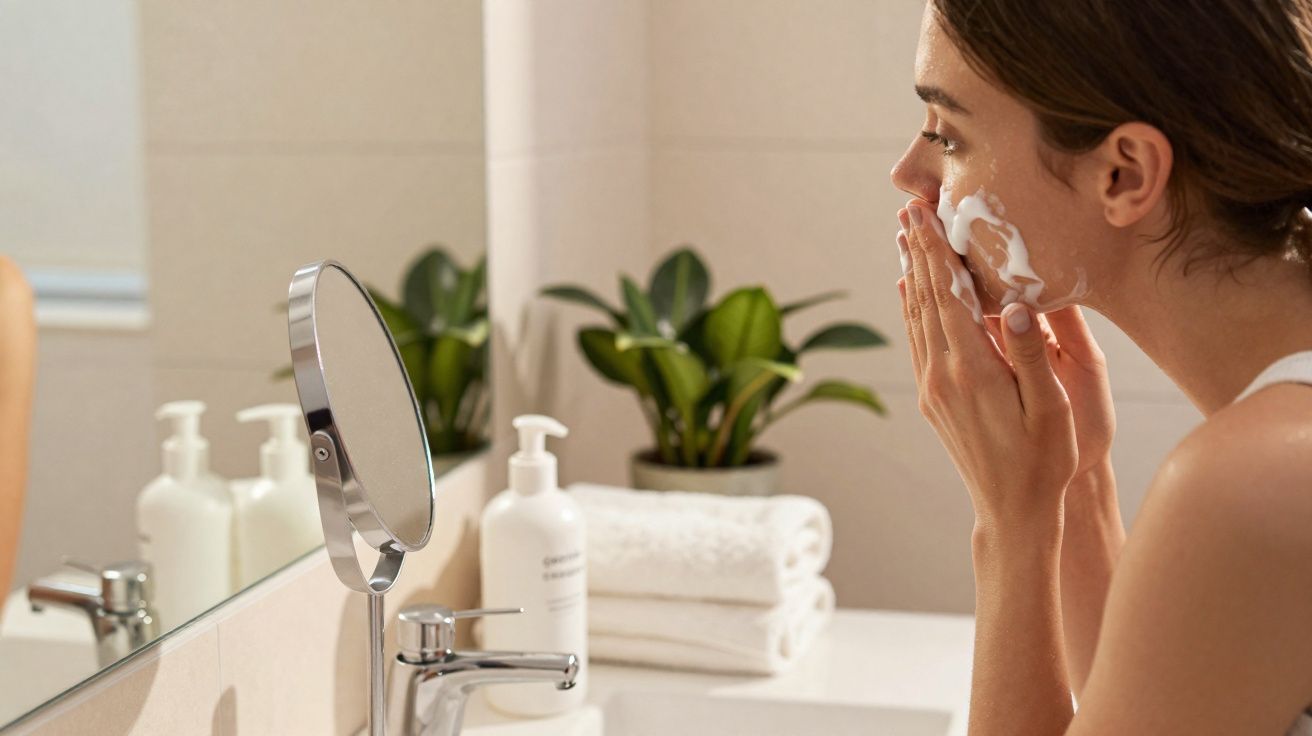
The bathroom mirror can feel brutally honest on a bright morning.
You step closer, expecting smooth, calm skin after last night’s double cleanse, and instead the pores on your cheeks and nose look louder-almost as if they’ve been outlined. So you cleanse again, scrub a bit more, whip up extra foam “just in case”. The harder you try to erase them, the more they seem to glare back.
Online, friends swear that ice cubes, retinol, acids and “pore-shrinking” toners are the answer. You buy, you trial, you wait… then zoom in and find the same tiny pits-sometimes with a little extra redness for your effort. It feels unfair. You’re doing everything “correct”.
What’s usually missing isn’t another product. It’s a quiet, everyday cleansing mistake that makes pores look bigger than they truly are.
The everyday cleansing mistake that exaggerates pores: over-cleansing
It’s easy to assume visible pores mean you’re not washing properly. In reality, the opposite is often to blame: over-cleansing.
When you cleanse too frequently or use a formula that strips the skin, your barrier interprets it as stress. In response, oil glands can ramp up sebum production to compensate and protect. That rebound oil then combines with traces of make-up, dead skin cells and pollution. The mixture settles into pore openings, subtly stretching them so the edges catch the light.
Under LED office lighting, on video calls, and in a magnifying mirror, those slightly stretched openings read as “massive pores”.
And then the loop begins: more scrubbing, more alcohol-heavy toner, more foam-each round leaving the barrier more irritated and the pores more obvious.
A familiar scene looks like this: it’s late, you’re tired, mascara has migrated under your eyes, and you grab a high-foam cleanser you bought in a rush. You wash for 20 seconds, rinse with very hot water because it feels like it “melts” make-up faster, then swipe on a stinging toner that smells clinical.
Your face feels squeaky and tight-so you assume it’s perfectly clean. By the next morning, your T‑zone is shining by 10 a.m., and the pores on your nose look like pinholes on camera. So you repeat the same routine, perhaps adding a scrub “now and then”.
Dermatologists see this pattern constantly. People arrive worried about “huge pores”, but what stands out on examination is usually a compromised skin barrier and inflamed follicle openings-not just age or genetics. The cause is rarely exciting: cleansing habits that drifted into “too much”.
What pores actually are (and what you can realistically change)
Pores are simply the openings of hair follicles and oil glands. Their baseline size is largely determined by genetics, hormones and ageing. You can’t truly shrink them in the way you might shrink fabric in the wash.
What you can control is how large they appear:
- When harsh cleansing dehydrates the skin, the tissue around pores can look flattened and uneven, making the darker centre stand out more.
- When you strip too much oil, the skin may overcompensate with more sebum, which can stretch pores and increase shine.
- Oxidised oil sitting in pores can look darker at the surface.
- Irritation and redness make the whole area look more textured and conspicuous.
So the problem isn’t cleansing itself-it’s cleansing in a way that punishes skin instead of supporting it.
How to cleanse so your pores look smaller, not bigger (gentle cleanser technique)
The most effective reset is surprisingly low-key: choose a low-foam, non-stripping cleanser and treat cleansing like a steady routine, not a race.
Look for terms such as “gel-cream”, “hydrating” and “pH-balanced” on the label. When you use it:
- Start with dry hands and a dry face, then massage the cleanser over the skin.
- Add a small amount of lukewarm water to emulsify.
- Cleanse for at least 45 seconds, using light, slow circles-especially around the nose, chin and between the brows.
- Avoid pressure, harsh flannels and scrubs.
- Rinse with water that feels like a comfortable shower, not a sauna.
Very hot water can encourage temporary swelling and visible redness, and it can make pores look more raised.
After rinsing, pat (don’t rub) your skin dry. Then apply a hydrating toner or essence while skin is still slightly damp. Think of that step as signalling: “You’re safe-no need to overproduce oil.”
The small habits that keep pores looking worse
The most common issues are small but influential:
- Cleansing three or four times a day “because it’s oily”.
- Using harsh, acne-targeting cleansers designed for teenagers on already fragile adult skin.
- Stacking an exfoliating cleanser, an acid toner and a retinoid in the same routine, then wondering why pores look raw and enlarged.
- Treating cleansing like a penalty for wearing make-up or living in a polluted city-scrubbing harder as if effort equals results.
More product doesn’t always mean better outcomes. Often it just means a confused barrier and pores that demand attention. And if we’re honest, hardly anyone follows instructions like an engineer’s manual-most of us mix, match and improvise.
Dermatologist advice on pores is rarely glamorous; it’s usually about changing your relationship with the sink rather than buying another “miracle” bottle.
“When someone asks how to ‘erase’ pores, I look at their cleanser first,” says Dr Laura N., a board-certified dermatologist. “In many cases, pores look better once we adjust how they wash, not when we add more aggressive treatments.”
Here are the practical guardrails:
- Watch the foam: big, fluffy lather often comes from stronger surfactants that remove too much oil.
- Limit active cleansers: if your cleanser contains acids or benzoyl peroxide, use it once daily or only a few times a week.
- Follow with moisture: a straightforward, fragrance-free moisturiser applied straight after cleansing can make pores appear softer and less stark.
Two extra factors that can make cleansing backfire (and how to handle them)
Hard water and long rinsing can leave skin feeling tight and can amplify the temptation to “clean again”. If you live in a hard-water area, keep rinsing brief, avoid very hot temperatures, and moisturise promptly. Some people find a gentle, leave-on hydrating product after cleansing makes a noticeable difference to how pores look under bright lighting.
Make-up removal matters too. If you wear heavy base products or long-wear SPF, forcing a foaming cleanser to do all the work can lead to over-washing. A gentle first step (for example, a cleansing balm or micellar water that you rinse off) can reduce friction and help you keep the second cleanse mild.
Let your pores exist - and they’ll look better
Modern phone cameras are unforgiving, and filters teach us to edit away every dot of texture. On a high-resolution screen, the skin details that used to be invisible can suddenly look enormous. It’s easy to decide your face is “wrong” and your pores must be fixed immediately.
Most of us have had that moment: you zoom too far into a photo and convince yourself you need to replace your entire routine. But skin was never meant to look like glass. It has texture-highs and lows, shadow and light. When you stop attacking pores and start supporting the skin around them, they stop feeling like an emergency and start looking like a normal feature.
Moving away from the harsh “squeaky clean” approach won’t give you a porcelain blur. What it can deliver is better-regulated oil, less irritation around follicle openings, and a surface that reflects light more evenly. From a normal speaking distance, those “huge pores” don’t read the same way.
If your pores feel like they’re shouting, begin with the most ordinary point in your day: the moment your hands meet water and cleanser. That’s often where the story quietly turns around.
Key points at a glance
| Key point | Detail | Why it matters to you |
|---|---|---|
| Over-cleansing stretches pores | Harsh or frequent washing strips oil, triggers rebound sebum, and makes pores look larger | Explains why “trying harder” with cleansing can backfire |
| Gentle, hydrating cleansers help | Low-foam, pH-balanced formulas support the barrier and reduce visible contrast around pores | A realistic routine change without buying an entire new shelf of products |
| Technique matters as much as products | Lukewarm water, 45 seconds of light massage, no scrubbing, quick re-hydration after rinsing | Simple daily steps that can soften the look of pores over time |
FAQ
- Can you actually shrink pores permanently?
Not really. Pore size is mostly genetic. What you can change is how large they appear by managing oil, texture and irritation.- How many times a day should I cleanse if I have oily skin?
For most people, twice a day is enough: morning and evening. If your skin feels tight, sore or easily flushed, you may already be overdoing it.- Is double cleansing bad for pores?
Double cleansing can be fine if both steps are gentle and your skin tolerates it. Problems start when the second cleanser is too harsh or drying.- Do hot towels or steam open pores?
Pores don’t have muscles, so they don’t truly “open” or “close”. Heat can soften sebum, and overdoing it can make pores look more noticeable.- Which ingredients should I look for to help my pores?
Consider salicylic acid in low doses, niacinamide, and hydrating ingredients such as glycerin or hyaluronic acid-ideally alongside a gentle cleanser.



Comments
No comments yet. Be the first to comment!
Leave a Comment