
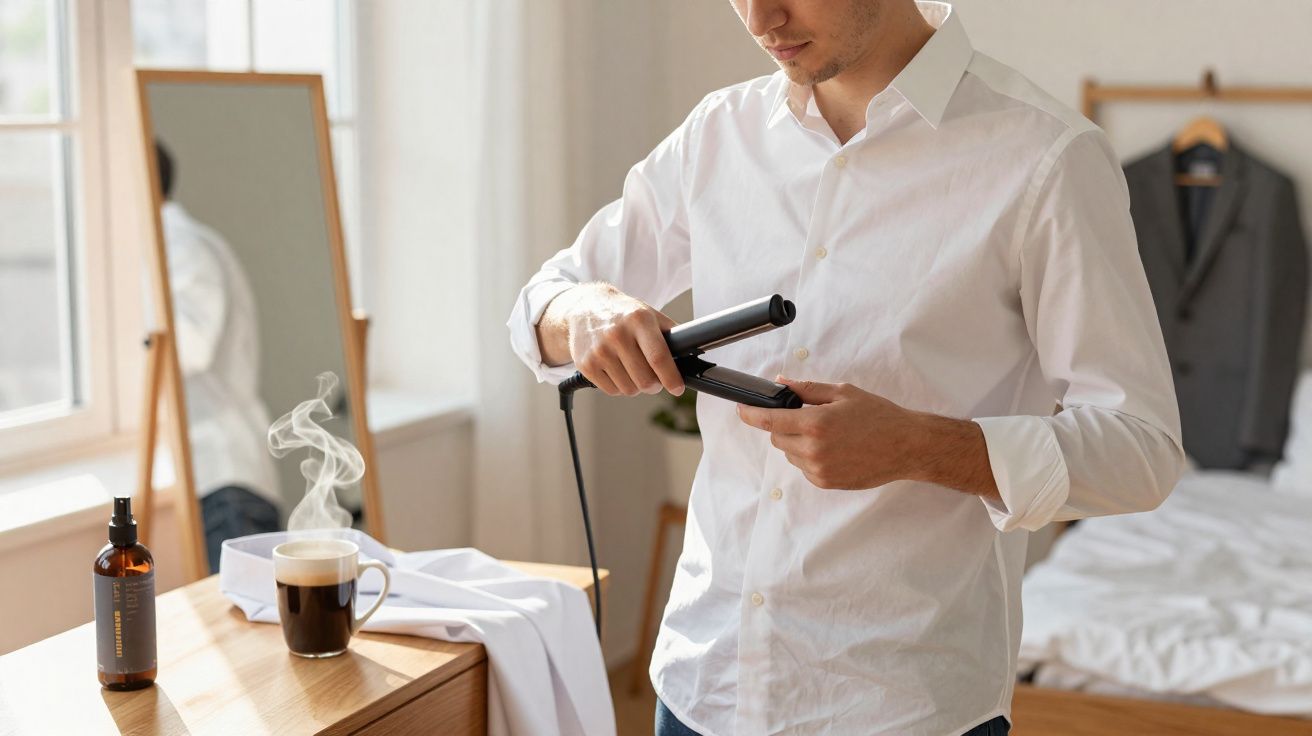
The shirt is immaculate. Or it was-back when you hung it up with the best intentions and plenty of time to spare. Now you’re in the hallway, half dressed and already running late, glaring at a collar that looks like it’s spent the night scrunched up in a gym bag. The iron is buried somewhere in a cupboard, the ironing board exists in that alternate dimension known as “behind the hoover”, and your taxi app is vibrating like a guilty conscience.
You glance into the bathroom and spot something else entirely: the hair straightener you used about ten minutes ago. Hot plates. A firm grip. Already plugged in.
Your brain does that little click it does when an unexpected shortcut presents itself.
When a wrinkled collar wrecks an otherwise perfect outfit
There’s a uniquely irritating kind of annoyance that comes from one crumpled detail. The shirt is clean, the jeans are fine, your hair is behaving for once-and then the collar decides to resemble crushed paper. You haven’t got ten spare minutes; you’ve got one.
At this point, people tend to do one of two things: surrender and claim “casually rumpled” is a deliberate look, or reach for the nearest slightly unhinged solution. That’s where the hair straightener comes in, sitting innocently on the bathroom shelf like a quiet secret weapon.
The irony is that the logic is sound. A hair straightener is essentially a miniature iron with clamps: two heated plates, a controllable temperature, and pressure applied exactly where you need it. Rather than dragging a heavy soleplate across half a shirt, you work like a detail painter-tackling edges, plackets and hems with precision.
For small areas, that accuracy is invaluable. Most people won’t notice if the whole shirt isn’t perfectly pressed; they will notice a collar, the first buttons, a visible hem. That’s precisely where this trick shines: targeted, quick and unexpectedly effective.
Picture this: Monday morning, 08:37, first-day-at-a-new-job nerves in full swing. A young woman I spoke to had already swapped shirts twice, only to discover both collars had picked up creases in the wardrobe. She lives in a tiny flat where an ironing board simply won’t fit. The iron is technically “somewhere”, still wrapped in bubble wrap from her last move.
In a panic, she sees her straightener sitting open on the sink. Purely on instinct, she clamps it over the tip of the collar, pulls slowly, and watches the wrinkle vanish in one smooth glide. Two passes later, both sides look crisp. She still arrives late-but her collar is flawless.
How to “iron” a collar or hem with a hair straightener without ruining your clothes
The motion itself is straightforward. Switch on your hair straightener and choose a medium heat setting-not the maximum blast you’d use for stubborn curls. While it warms up, smooth your shirt on a flat surface: a bed, a table, even the back of a chair if that’s all you’ve got.
Start with the collar. Lay it open and flat, then hold the straightener like a pair of tongs. Clamp gently at the tip of one side, close lightly, and slide in one slow, steady movement towards the centre. One or two passes are usually enough. Repeat on the other side. The same approach works for a hem or button placket: tackle it in short sections, keep moving, and never leave the plates sitting in one spot.
A few small errors can quietly undermine the whole trick:
- Too much heat is the classic one-synthetic fabrics and high temperatures do not mix well. Lower settings are safest, particularly for polyester, viscose or blended fabrics. If you’re unsure, test on an inside seam first.
- Clamping too hard is another common slip. A straightener isn’t a nutcracker. Light pressure is plenty; pressing down too firmly can leave shiny marks on darker fabrics or squash seams in an odd way.
- And, realistically: this is not something most people do every day. It’s an emergency manoeuvre, not a replacement for a proper laundry routine.
A useful extra safeguard-especially on delicate or dark shirts-is to place a thin, clean cotton cloth (a tea towel or handkerchief works) between the fabric and the plates. It slightly reduces the direct heat and helps prevent shine without slowing you down much.
Also, keep safety in mind: don’t attempt this near sequins, plastic prints, glued embellishments or heat-sensitive badges. Those finishes can soften quickly and transfer residue to the plates, which then risks staining the next garment you “press”.
There’s a psychological side to the shortcut, too. Using a hair tool on clothes can feel like crossing an invisible line between “organised adult” and “creative survivor”. Yet once people try it, they rarely go back for small fixes.
“I stopped dragging out the ironing board for one shirt,” laughs Camille, 29. “If I only need the collar and the front to look sharp on video calls, the straightener does the job in two minutes. Nobody knows what’s going on below the webcam frame.”
- Use a clean straightener plate (no product residue) to avoid stains.
- Stick to medium heat or less for synthetic or delicate fabrics.
- Work on dry clothes, never damp, to avoid stretching or warping.
- Focus on visible zones: collar, cuffs, first buttons, hemline.
- Keep the plates moving to prevent shine or burn marks.
Turning a “hair” tool into a quiet ally for last-minute polish
Once you’ve used this trick once, you’ll look at that straightener in the bathroom differently. It stops being only a beauty gadget and becomes part of a modern-life survival kit: Zoom interviews, rushed dinners, surprise invitations, and mornings when everything feels slightly off-kilter.
You won’t always have the time, the space, or-honestly-the energy to unfold an ironing board and pretend you live in a perfectly organised catalogue home. Sometimes you’re simply grateful for anything that buys you five extra minutes of sleep while still letting you look as though you made an effort. This small hack lives right in that gap: between compromise and care, between “good enough” and “I still want to look put-together”.
One more practical bonus: it’s particularly handy for travel. In hotels with unreliable irons (or none at all), a hair straightener can rescue a collar or hem before you head out-just remember to let it cool completely before packing it away again.
| Key point | Detail | Value for the reader |
|---|---|---|
| Use a straightener as a mini iron | Medium heat, light pressure, slow movement on collar and hems | Instant fix when you’re in a rush and don’t want the full ironing setup |
| Protect your fabrics | Test on an inside seam, avoid high heat on synthetics, clean plates first | Reduces risk of shine, burns, or product stains on favourite shirts |
| Target only visible areas | Collar, cuffs, first buttons, lower hem line | Maximum visual impact with minimal effort and time |
FAQ
Can I use a hair straightener on any type of shirt fabric?
Cotton and cotton blends cope with this trick best. For silk, viscose or synthetics, lower the temperature and test inside the hem before you touch any visible areas.Do I need a special straightener for clothes?
No. A standard ceramic straightener works well. Just wipe and clean the plates first so no styling product transfers onto the fabric.Will this replace a real iron completely?
No-it’s better thought of as an emergency hack. For fully crisp shirts or linen items, a proper iron still produces stronger, longer-lasting results.Can I use steam with the straightener?
Don’t spray water directly onto the plates. If you want extra smoothness, lightly mist the fabric, wait a few seconds, then glide the straightener quickly.Is there a risk of burning the shirt?
Yes-if the heat is too high or the plates sit in one place. Keep them moving, stick to medium heat, and avoid pausing on the fabric.



Comments
No comments yet. Be the first to comment!
Leave a Comment