
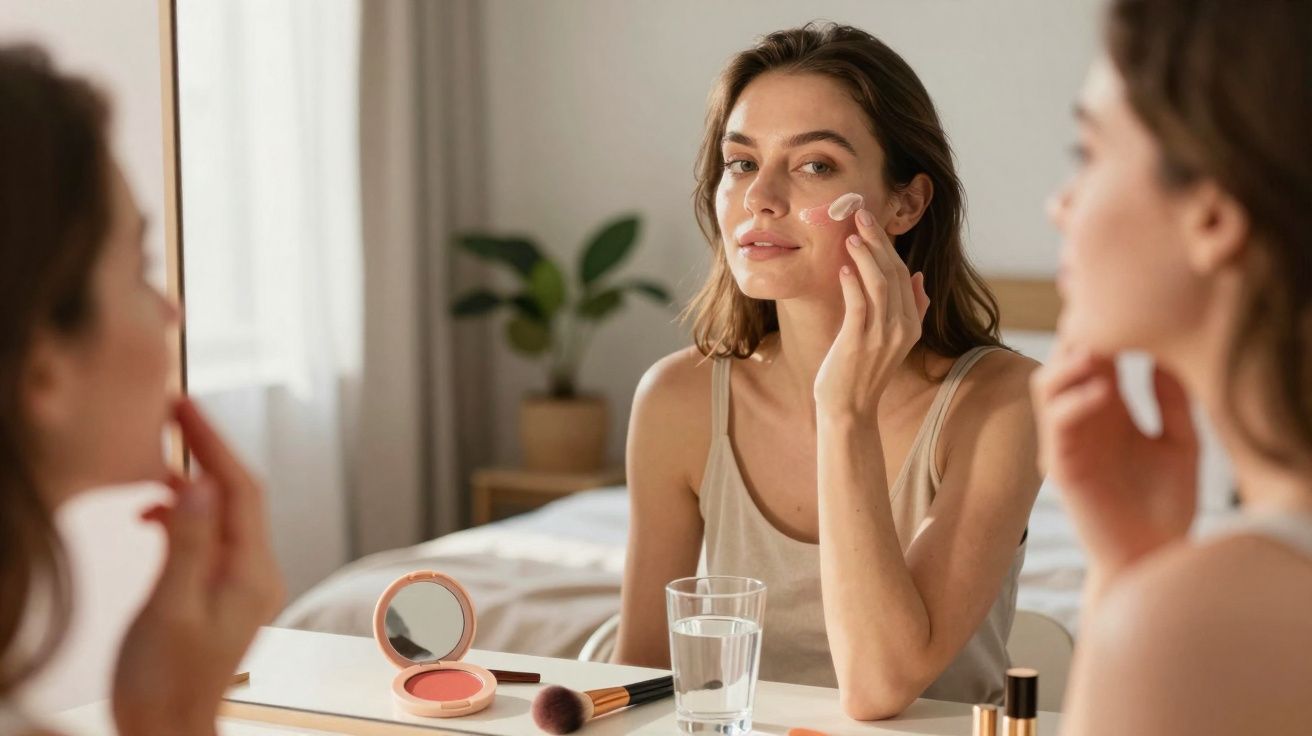
The woman looking back from the bathroom mirror is almost the double of her 25‑year‑old self - but not entirely.
Her cheeks now sit a little lower; the rounded “apples” that once popped up when she smiled seem to soften and blend into her jawline instead. She dips her trusted blush brush into the same old compact, does her usual “smile and tap” right on the apples of the cheeks… and then stops.
Rather than a lifted, healthy flush, the colour appears to pull everything down. Under‑eye shadows read more strongly, and the centre of her face looks slightly fuller. She wipes it off, tries again, and nudges the blush placement a fraction higher. All at once, her cheekbones look more defined, her face appears lighter, and her eyes look brighter.
Same blush. Same woman. A completely different effect.
The product didn’t change. The blush map she was following did.
The moment blush stops working the way it used to (blush placement after 30)
At a certain age, your makeup routine can start to feel oddly uncooperative. There’s rarely a single “before and after” line - more a quiet realisation of, “Why doesn’t this look right anymore?” when you repeat techniques that used to be foolproof.
Blush is often the first thing to betray you. When it’s applied low and in a rounded patch, it can make a 32‑year‑old look like it’s 4 p.m. and she’s running out of steam. The shade that once looked fresh on the apples can now sit nearer soft nasolabial folds and fine lines. Instead of shaping the face, it can start to gather and look heavy.
That’s when placement begins to matter more than the blush itself.
A make‑up artist in London once told me she can often estimate a client’s age from a single habit: where their hand naturally puts blush. Younger faces tend to press colour right into the centre, almost like following a child’s drawing of rosy cheeks. Many people over 30 keep doing that out of muscle memory - even though gravity has subtly redrawn the canvas.
She described two sisters who booked in together, aged 28 and 38: same palette, same lighting, similar skin tone. On the 28‑year‑old, a bright touch on the apples of the cheeks made the whole face look perkier. On the 38‑year‑old, the identical placement made slight under‑eye hollows look more noticeable.
When the artist moved the 38‑year‑old’s blush higher and slightly towards the temples, it was as if she’d slept for ten hours. The colour behaved like a soft‑focus veil, drawing attention towards her eyes and cheekbones rather than the centre of her face.
The reasoning is straightforward, even if we don’t usually say it plainly. After 30, your bone structure remains, but the fat pads over it begin to shift and redistribute. The “apple” of the cheek sits a bit lower over time. Meanwhile your hand still wants to smile and follow the old apple - so you end up placing colour exactly where things are beginning to descend.
Put blush there and you can visually pull the face down. Lift it a little higher and further out and you create the opposite illusion: the face reads more up and back. You’re not changing your features; you’re changing where someone’s eye lands first.
That is the real power of a small sweep of pink.
The simple blush map that quietly lifts everything
The technique make‑up artists keep repeating at the moment is almost laughably simple. Instead of smiling and aiming for the apples, keep your face relaxed and look straight ahead. Then picture a diagonal line running from the top of your ear towards the side of your nostril.
Apply blush along the upper half of that line, closer to the ear than the nose. Aim for a soft, angled “C” shape that curves towards the outer corner of the eye. Blend upwards into the temples - not down towards the middle of the cheek. Let the colour fade as it moves towards the hairline, like a watercolour wash.
On many faces over 30, this alone brings back cheekbones you’d forgotten were there.
A second small adjustment can have an outsized impact: leave a clean space between the under‑eye area and where the blush begins. A finger‑width of bare skin helps stop colour sitting in fine lines or drawing attention to dark circles. If you love a youthful, outdoorsy flush, you can add the tiniest hint on the bridge of the nose - but keep the main intensity high and outward.
Many people over 30 describe the same push‑pull: they want glow, but they dread “clown cheeks”. It’s a reasonable fear. One heavy swipe too low and it can look as though last night’s wine has lingered on your face.
That’s why the amount matters less than the placement. Start with much less than you think you need. Press and tap rather than dragging the brush across the skin. Build in thin, sheer layers instead of laying down one thick stripe. Cream blushes are often more forgiving on changing skin texture because they melt in, rather than sitting on top.
And let’s be honest: hardly anyone is doing this every morning with a pro brush set and 20 uninterrupted minutes at the mirror. You might be applying blush one‑handed while replying to a message with the other. So choose one rule you can actually remember on a busy Tuesday - something like “higher and further back” - and drop the rest.
Your face will tolerate plenty. It does not tolerate blush in the wrong postcode.
One make‑up educator I spoke to summed it up without much ceremony:
“After 30, your blush either lifts your face or drags it down. There’s not much in between.”
It sounds dramatic, but side‑by‑side photos of different placements make the point quickly.
There’s an emotional element too. On a low‑energy day, that slightly higher sweep can feel like someone has quietly turned up the dimmer switch on your expression. You suddenly resemble the version of yourself you still feel like inside.
A practical add‑on: check your blush map in the same kind of light you’ll be seen in. Bathroom lighting can be unforgiving or oddly flattering; daylight by a window (or a quick photo outside) tends to reveal whether the colour is lifting the face or weighing it down. If you wear glasses, put them on before you decide the final placement - frames can change where the face looks most balanced.
Another helpful consideration is undertone. As skin tone and pigmentation shift over time, the same blush shade can read differently. If a once‑favourite pink now looks harsh, try a softer rose, a muted berry, or a peach‑toned blush that mimics natural warmth - then keep the placement high so the effect still reads lifted.
- Think angle, not circle: place blush on an upward diagonal instead of a round patch.
- Keep intensity away from the nose and mouth area.
- Blend into the temples to visually lift the outer face.
- Choose creams or liquids if powder settles into texture.
- Revisit your blush map every few years: faces change, and routines should change with them.
When blush becomes a tiny rebellion against the mirror
There’s something quietly bold about changing how you use a product you’ve applied the same way for 15 years. It’s a gentle acknowledgement that your face has evolved - and a decision to work with it rather than wage war against it. One subtle diagonal sweep becomes a small negotiation with time.
Friends often chat in bathrooms about “looking tired” or “not quite like myself”. Frequently it isn’t that the face has changed overnight; it’s that light and shadow now travel differently across it. Shift where you place colour, and you shift where the light appears to land. In a strangely philosophical way, the map you draw on your skin changes the story your face tells before you say a word.
Most of us know the shop‑window moment: you catch your reflection and think, Who is that? A new blush map doesn’t erase that jolt. What it can do is soften it. The right placement quietly says, You’re still here. It doesn’t pretend you’re 22; it highlights the structure, experience and expression you’ve earned, without pulling everything down.
It’s also one of those techniques that spreads easily. Once you’ve tried the higher, lifted placement and seen the difference, it’s hard not to show a friend, a sister, or your mum. People end up doing the half‑and‑half test: one cheek the old way, one cheek the new. The contrast usually explains more than any tutorial can.
Blush becomes less about chasing trends and more about reading your own architecture. Where does your face hold colour best? Where does it look instantly brighter and less weighed down? There isn’t a single universal diagram, just a guiding principle: colour that travels upwards tends to read as youth and energy; colour that collects in the centre tends to read as fatigue.
Perhaps that’s why this method keeps resurfacing no matter what contouring or highlighting trends come and go. It’s simple, quick, and doesn’t require buying anything new. You’re just moving what you already own a few millimetres north.
And in that tiny distance, your reflection shifts too.
| Key point | Detail | Benefit for the reader |
|---|---|---|
| Place blush higher | Apply on the upper portion of the ear‑to‑nose line, towards the temples | Creates a visual lift without procedures or filters |
| Leave space under the eyes | Keep a finger‑width of bare skin between under‑eye circles and blush | Reduces emphasis on dark circles and fine lines |
| Prioritise angle over the “apple” | Use a soft diagonal shape rather than a round spot on the cheek | Refines features and avoids a “drooping cheeks” effect after 30 |
FAQ
- Should I still smile when I apply blush after 30?
Ideally not. Keep your face neutral and look straight ahead. Smiling lifts the apples temporarily and can trick you into placing colour too low, which may drag the face down once you relax.- What type of blush is best for skin over 30?
Cream and liquid blushes are often more flattering because they melt into the skin and cling less to texture. Sheer powders can also work if you use a soft brush and build gradually.- Where exactly should I stop my blush?
Stop before you get close to the nose and mouth. Keep the strongest colour on the outer half of the cheek, blend towards the temple, and leave the centre of the face cleaner to avoid heaviness.- Can this lifted blush technique work with strong, bright shades?
Yes - use a very small amount and blend thoroughly. Vivid shades placed high and diffused can look chic and sculpted; the same shades applied low and round can overwhelm the face quickly.- How do I know if I’ve placed it too low?
Take a quick photo in natural light, looking straight ahead with a relaxed face. If the deepest part of the blush sits closer to your nose than your ear - or merges with smile lines - it’s probably too low. Next time, move it higher and further back.


Comments
No comments yet. Be the first to comment!
Leave a Comment