
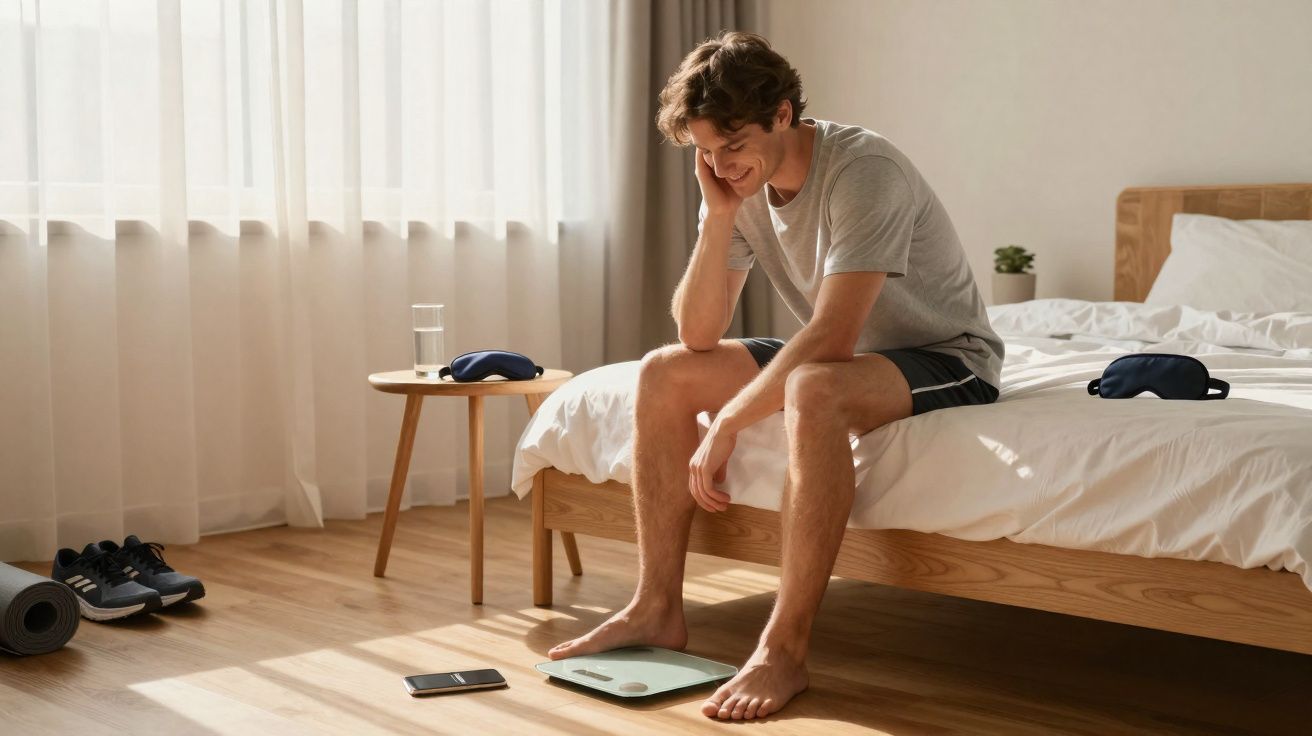
You know that grim, stomach-dropping moment when you glimpse yourself in a shop window and think, “Hold on - when did I start looking like that?” You run through the past few months: you haven’t been living on takeaways, you’ve been walking a bit more, you even installed a fitness app (that you’ve opened, what, twice). And yet the number on the scale has quietly edged upwards as if it’s got a grudge.
If any of that sounds familiar, try blaming something you probably haven’t considered: the squashed pillow on your bed, and that half-finished mug of late-night tea on the bedside table.
We obsess over calories and carbs, gym plans and “good fats”, but almost nobody asks the obvious question: are you getting enough sleep, and is the sleep you get actually doing its job? Not the kind of sleep you boast about at work (“I can cope on five hours”), but the kind that makes you feel human rather than like a walking email inbox. Because your weight pays far more attention to your nights than your willpower does. The connection between sleep and your waistline is more powerful than most diet advice - and once you notice it, you can’t ignore it again.
The night I worked out my diet wasn’t the issue
The penny dropped for me during a week that felt fuelled entirely by coffee and quiet self-disgust. I was filing stories late, doomscrolling under the duvet, and promising myself I’d “catch up at the weekend” (as if that ever happens). On paper, my food looked “healthy”: salads, yoghurt, the occasional pasta dinner. Still, I kept waking up feeling swollen and heavy, as though I’d spent the night under a lead blanket. My jeans felt snugger, my face looked a touch puffier, and there was this constant, low-grade hunger buzzing away behind everything I ate.
Then came the 1:30am kitchen scene. I was standing with the fridge light washing over me like an interrogation lamp. I’d already brushed my teeth. I’d already gone to bed. But I’d hauled myself back out for “just a little something”. You know the kind: a mindless handful of crisps, a slice of cheese straight from the packet, whatever is within arm’s reach. Chewing half-awake, I had an unsettling feeling that I wasn’t driving the car. It was like the sensible part of my brain had clocked off and handed the keys to a sugar-addicted teenager.
That was the first time I started asking a different question - not “What am I eating?” but “When am I letting my body properly recover?” It wasn’t some dramatic revelation, just an exhausted person staring at a nearly empty biscuit tin and thinking: “What if I’m not greedy - what if I’m simply shattered?” When I started talking about it, I heard the same confession again and again: “I’m fine all day, then at night I turn into a snack goblin.” The pattern wasn’t just food - it was fatigue wearing a sandwich as a disguise.
What sleep does to your weight while you think you’re “doing nothing”
When you drop off, your body doesn’t stop; it starts the shift you never see. Hormones move around like staff changing over on a rota, tidying up, recalibrating, refuelling. Two of the key players are ghrelin and leptin: ghrelin pushes hunger up, leptin signals that you’re satisfied. With decent, regular sleep, they stay in a workable balance. With short, messy nights, ghrelin turns the volume up and leptin fades into the background.
The next day, that can translate into feeling properly hungry - and oddly hard to satisfy. Three biscuits become six, and your usual portion suddenly looks suspiciously small. That isn’t a character flaw; it’s your internal settings being knocked out of place by poor sleep. Research keeps landing on the same theme: people who sleep less tend to eat more - and not extra carrots, but more ultra-processed comfort food. Your brain starts chasing quick energy hits like sugar and white carbs because it’s running on fumes.
The sluggish burn no one warns you about (sleep, weight and insulin)
A quieter change happens underneath it all too. When you’re sleep-deprived, your body often becomes less effective at handling insulin, the hormone that moves sugar from your blood into your cells. Picture your cells acting as if they can’t be bothered to answer the door. The sugar stays in your bloodstream longer, and your body is more likely to store the surplus as fat. Over time, that sluggish handling can contribute to weight gain and can raise your risk of type 2 diabetes, even if your diet hasn’t shifted in any dramatic way.
You may also notice your willingness to move - properly move - draining away. The gym class you booked feels like a punishment rather than a release. Even a post-dinner walk starts feeling “optional”. When you’re already on a low battery, your body guards what’s left. You sit more, fidget less, cancel spin class, and it all adds up in small, almost invisible layers. This is the part people miss: sleep doesn’t only influence what you eat; it shapes how much energy you have to move your body through the day.
“I eat well and I exercise - so why am I still stuck?”
Most of us have had the moment where we think: “Fine. I’m doing everything right and my body is being ungrateful.” You’re tracking steps, scanning barcodes, watching portions. You might even be weighing rice like a calm, organised adult. And yet the scale won’t budge - or worse, it creeps up so slowly it feels like it’s taking the mick. It’s infuriating in a way that polite, grown-up language doesn’t quite capture.
This is where sleep often turns out to be the missing piece. When you cut sleep to squeeze in early workouts or late-night work, your stress hormone cortisol tends to run higher. Cortisol has a purpose - it helps you wake up and deal with pressure - but too much of it nudges your body towards storing fat, particularly around your middle. So you’re grinding out treadmill sessions at 6am on four hours’ sleep, while your body feels cornered, stressed and determined to conserve energy. No wonder it feels like rowing upstream.
The quiet sabotage of “just one more episode”
There’s also a softer, hard-to-spot kind of sabotage. Late nights are rarely fuelled by sparkling water and carrot sticks. They get padded with crisps, a glass of wine, a bit of chocolate, and an extra slice of toast because “the loaf is open now”. Your judgement is fuzzier, your willpower thinner. On top of that, blue light from your phone or laptop persuades your brain it’s earlier than it is, so melatonin (the sleep hormone) gets delayed. You fall asleep later, wake too early, and the loop repeats.
And honestly, hardly anyone lives perfectly “by the book”. A lot of adults are quietly under-slept and over-stimulated, then blaming their bodies for being softer, rounder, more tired. The blunt reality is you can’t force your way into a different body while you’re running on empty. Often, what you need isn’t a harsher diet - it’s a calmer nervous system and more time with your eyes closed. It sounds dull compared with a “28-day shred”, but it’s the kind of change that actually moves things.
How much sleep tends to help with weight?
The figures aren’t sexy, but they’re consistent: most adults function best with 7 to 9 hours of sleep each night - not as a one-off, not only at the weekend, but as a steady pattern. Consistently getting less than 6 hours is strongly associated with greater weight gain, more belly fat and more cravings. On the other side, sleeping a constant 10–11 hours can also be linked with weight gain, often because it hints that something else is going on, such as depression or illness.
The real secret isn’t only the total hours - it’s regularity. Your body thrives on rhythm. Going to bed at midnight one night, 9pm the next, and 2am the next is like hopping time zones without leaving your postcode. Hunger and fullness cues, digestion, and your energy for movement all struggle to settle. Once you anchor your sleep and wake times, your weight often starts to stabilise even before you make big dietary changes.
The quality question
Plenty of people manage 8 hours “in bed” yet still wake up as if they’ve been hit by a lorry. That’s where sleep quality matters. Fragmented nights, noisy neighbours, a snoring partner, or a brain that kicks into overdrive at 3am can strip away the deep, restorative stages of sleep. Those deeper stages are when growth hormone is released, muscles are repaired, and your body does a lot of metabolic housekeeping. If your sleep is light, twitchy and constantly interrupted, your body never fully drops into repair mode.
So when you’re thinking about weight and health, it’s not just “How long was I in bed?” but “Do I wake up even vaguely refreshed?” You don’t need to bounce up like a Disney character, but if you always feel as if you’ve been yanked from a coma, something’s off. Your body can’t optimise its night-time work if you’re only skimming the surface - and that’s when you see the familiar cluster: constant hunger, stubborn weight, low mood, and a heaviness that coffee can’t quite sort out.
One overlooked factor: snoring, blocked breathing and disrupted sleep
It’s also worth mentioning that loud snoring, waking with a dry mouth, or feeling unrefreshed despite a full night can sometimes point to breathing disturbances during sleep (such as obstructive sleep apnoea). Even if you don’t fully wake up, repeated micro-interruptions can wreck sleep quality and leave hormones, appetite and energy regulation in a mess. If any of that rings true - especially alongside daytime sleepiness - it’s worth speaking to a GP rather than assuming you simply need more discipline.
Small, realistic changes that support both sleep and weight
The good news is you don’t need a Pinterest-perfect bedtime routine involving herbal baths and journalling under fairy lights. You need a handful of levers you can pull on a grim Wednesday in February. One of the most effective is setting a rough nightly “shutdown time” - even if your exact bedtime shifts slightly. Choose a point when, most nights, you stop working, stop scrolling for arguments with strangers, and start signalling to your body that the day is winding down.
About an hour before that shutdown time, dim the lights if possible and swap bright screens for something gentler - a book, a podcast, or even a slow kitchen tidy. That small tweak helps melatonin rise naturally, so falling asleep feels less like a wrestling match. You don’t have to be saintly about it; even 20 screen-free minutes before bed beats none. The aim is not perfection - it’s making sleep more likely instead of fighting your surroundings.
Caffeine and alcohol: the two quiet disruptors
If your sleep is fragile, consider timing your stimulants. Caffeine can linger in the body for hours, so an afternoon coffee may still be nudging your nervous system at bedtime, even if you feel “fine”. Alcohol can make you drowsy at first, but it often fragments sleep later in the night and reduces how restorative it feels - which can feed straight into next-day cravings and low energy. You don’t have to cut everything out; simply moving caffeine earlier and swapping that second drink for water can make sleep noticeably steadier.
Food timing that works with your body
Late, heavy dinners can quietly wreck both sleep and weight. Your body doesn’t love doing hard digestion work right as you’re trying to sink into deep sleep. If you can, try shifting your main meal earlier and keeping late-night food lighter. That might look like replacing a 10pm takeaway with something simple at 7pm, or noticing you sleep better if you stop eating roughly two to three hours before bed.
There’s also a strong case for a gentle, balanced breakfast if you’re trying to reset hunger cues. Getting protein and fibre in early - think eggs on wholegrain toast, or Greek yoghurt with oats and berries - can steady blood sugar and make later cravings less chaotic. It’s everyday, unexciting food, but it quietly supports better sleep and calmer eating patterns, which helps your weight feel less like a constant battle.
Movement that doesn’t break you
If you’re absolutely exhausted, hardcore HIIT at 6am can backfire. Your body can interpret it as yet more stress - more demand, less safety. Gentler movement - walking, light strength work, yoga - may not feel as “hardcore”, but it pairs brilliantly with rubbish sleep while you rebuild. It helps regulate appetite, lifts mood, and, ironically, can improve sleep at night without emptying the tank.
Try to move on most days, but pick an intensity that doesn’t leave you flattened. On low-sleep days, allow yourself to do less without guilt. You aren’t weak; you’re responding to the data your body is giving you. As sleep improves, the appetite for harder exercise often returns naturally - and then it supports your progress instead of fighting against it.
When your nights change, your reflection often follows
People often describe a strange moment when they begin treating sleep as non-negotiable. It doesn’t look dramatic at first: food feels slightly less frantic, walking feels more doable than collapsing on the sofa, and the brain fog eases a notch. Over a few weeks, faces look less puffy, clothes sit differently around the belly, and the scale starts shifting without a new “plan” or punishing routine. It feels almost rude that something as unglamorous as going to bed at a sensible hour can make such a difference.
The relationship between sleep and your weight isn’t a moral lecture or another stick to beat yourself with. It’s more like the missing chapter in a book you thought you’d read cover to cover. When your nights get calmer, your days quietly reorganise themselves: eating becomes less of a tug-of-war, movement becomes less of a negotiation, and your body feels less like an enemy you’re stuck with.
You don’t have to overhaul everything tonight. Maybe you shut the laptop 30 minutes earlier, swap that second glass of wine for water, or leave your phone in another room and let the steady hum of the boiler send you off. These choices are small enough to seem pointless - but, over time, they can change what you think when you catch your reflection in that shop window: from “When did that happen?” to “Oh - there you are.”






Comments
No comments yet. Be the first to comment!
Leave a Comment