
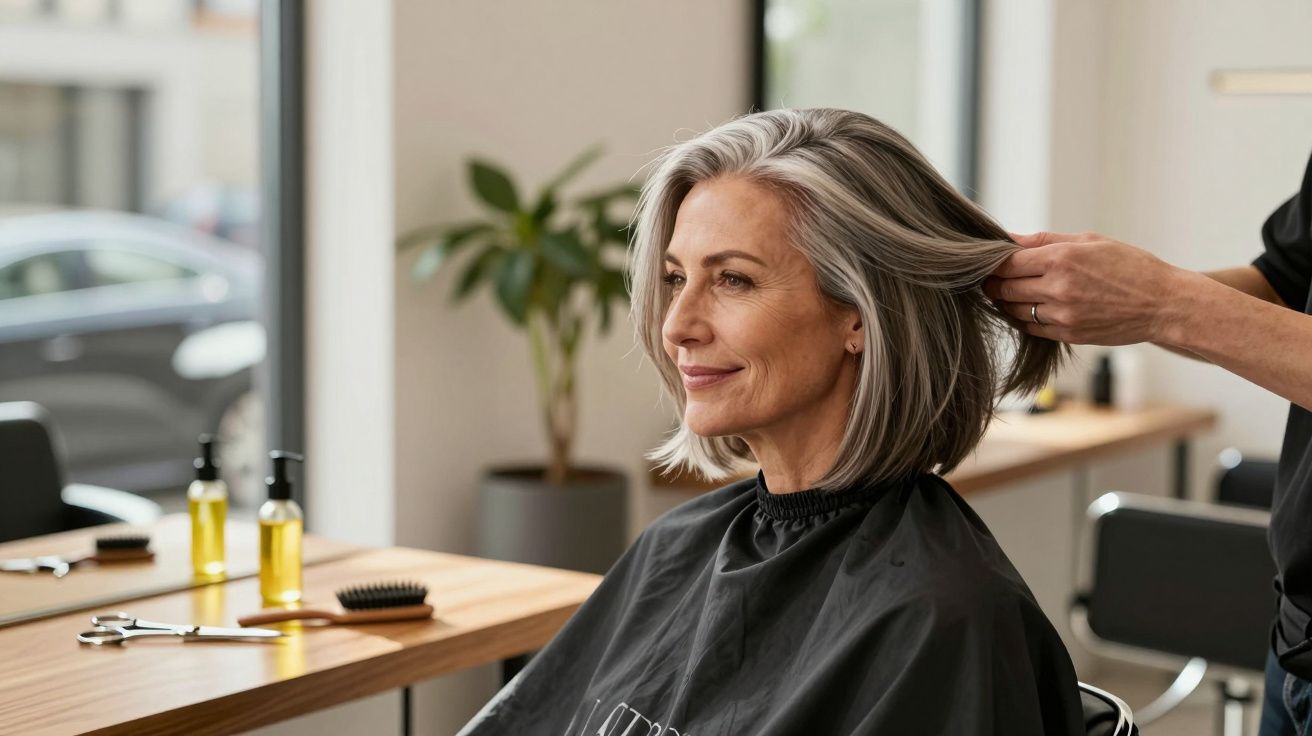
Going grey can look effortlessly stylish and beautifully defined - yet the wrong haircut or a few unhelpful styling habits can suddenly make facial features appear harder and more severe.
Hairdressers across Europe and the United States tend to agree on one point: salt-and-pepper hair can read as contemporary and striking, or it can add years in an instant, depending on a handful of choices. Your hair’s texture, the length you keep, and how firmly you pull it back often determine whether the final effect feels bright and lifted or flat and “grannyish”.
The new status of grey hair
For decades, grey hair was treated as something to disguise. Now it is widely worn as a confident style choice. Performers, broadcasters and influencers in their 50s, 60s and beyond increasingly embrace silver tones, which has encouraged many people to stop colouring and allow their natural hair to come through.
It also helps to remember that grey strands are not simply “undyed” hair. As pigment fades, the hair fibre commonly becomes drier and more porous. That change can make it more reactive to sunlight, pollution and hot tools - leading to frizz, a coarser feel, and brassy, yellowish tones that are hard to ignore.
Salt-and-pepper hair needs a cut and a styling routine built for its changed texture - not the hair you had at 35.
Most ageing missteps start when those shifts are overlooked. Once silver dominates, keeping exactly the same cut and repeating the same styling routine you used when your hair was fully pigmented often stops working.
The biggest haircut error with salt-and-pepper hair
When long, natural curls stop flattering
Stylists frequently flag one combination that can instantly add years: very long, naturally curly grey hair worn without any real shape. Curly hair is naturally more prone to dryness than straight hair because scalp oils do not travel as easily along a spiral. Combine that with the extra dryness often found in white or grey strands and curls can lose definition, turning into a fluffy, “cloud-like” silhouette.
On darker hair, that soft halo of frizz can be less obvious. On white or silver hair, each fuzzy strand reflects the light. Add too much length and the overall shape can pull the eye downward, visually dragging the face and dulling shine along the way.
Long grey curls without structure often look puffy and lacklustre - even when the hair itself is in good condition.
A modest cut can be transformative. Removing the heaviest, most tired lengths allows curls to rebound, forming clearer spirals. Grey can also look brighter afterwards because a smoother surface reflects light more cleanly.
So what length tends to work better?
There is no universal rule, but many stylists recommend keeping curly salt-and-pepper hair somewhere between the jawline and the collarbone. This zone preserves movement while avoiding the stretched, droopy look that can happen when curls are weighed down.
- Jaw-length bob: lifts the face; often suits round or heart-shaped faces particularly well.
- Long bob (lob): sits just above the shoulders; generally flattering on most face shapes.
- Collarbone-length with layers: maintains softness while taking weight out of the ends.
Layers should be gentle and carefully blended. Overly harsh, choppy layering can make grey curls appear uneven or thinner than they are. The goal is to lighten and refine the outline, not to shred it.
Strict hairstyles that can make grey hair look older
The tight, slicked-back trap
Even a strong cut can be undermined by daily styling. Hair professionals repeatedly caution against ultra-strict looks on grey or white hair: tightly pulled buns, ponytails yanked straight back, and perfectly slick, low chignons.
These styles remove lift at the roots and reveal every contour of the face. On mature skin, that can emphasise fine lines, hollows and slackness around the jaw. With silver hair, the sharp contrast between scalp and hairline can also appear more severe.
Any style that presses grey hair flat to the scalp often reads as stern and ageing rather than sleek.
Very tight plaits can create a similar impression when they are pulled straight back and braided rigidly. The issue is not ponytails or braids themselves - it is the absence of softness and movement.
How to keep classic styles but make them look current
You do not need to abandon buns, ponytails or plaits. A few small adjustments can create a noticeably fresher, more lifted result.
| Strict style | Why it can look ageing | Modern alternative |
|---|---|---|
| Slick low bun | Flattens the root area and hardens facial features | A looser low chignon with a few soft face-framing pieces |
| Tight high ponytail | Tugs at the hairline and draws attention to the temples | A ponytail with subtle root lift and a softly teased crown |
| Rigid, straight-back braid | Can read as severe and overly controlled | A side braid with texture and a touch of volume |
A wispy fringe or a few light tendrils left out around the face, combined with a small lift at the crown, can make the overall look feel kinder and more awake.
Other grey-hair cut mistakes that quietly add years
The one-length “curtain” effect
Very long grey hair cut to a single length can look dreamy on a small number of people - but for many it visually weighs the face down. Heavy ends create a solid curtain that can overwhelm the jawline and neck.
Introducing subtle face-framing layers helps open up the features. A soft fringe or side-swept pieces can blur the look of forehead lines and pull focus towards the eyes rather than the hairline.
Not adapting to changes in texture and density
Grey hair often shifts in density and feel. Some people notice their hair becomes coarser and thicker; others experience thinning, particularly at the crown or along the parting. If you stick with a cut designed for your former density, the new reality can be highlighted rather than disguised.
- If hair feels thicker and wiry: blunt shapes can build into a blocky, helmet-like outline.
- If hair is finer or thinning: heavy, long layers can make it appear even sparser.
In either case, a cut tailored to your current thickness and growth patterns is usually more flattering than copying a celebrity haircut from a decade ago.
Colour nuances and shine tricks
Salt-and-pepper hair is rarely one uniform shade. It commonly includes a mix of white, silver, charcoal and traces of your original colour - and the haircut can either complement that pattern or fight against it.
Crisp, geometric cuts tend to suit more even, uniform silver. When tones are mixed, a softer shape with light layering typically blends the colours in a more natural way. Gentle toning products that reduce yellowing can also make the cut look sharper and the grey appear intentional rather than accidental.
When grey hair looks bright and reflective, even a simple cut looks purposeful and fashionable.
One warning that comes up often: heavy, oily serums can quickly weigh down fine grey strands and leave them looking flat. Lightweight creams or foams that add definition without greasiness are frequently a better match.
Practical scenarios: what to ask your stylist
If you are unsure how these ideas translate in the salon, imagine these two consultations.
Scenario 1: Long, frizzy salt-and-pepper curls
You arrive with mid-back curls that have become noticeably drier and fluffier as your grey has come through. Rather than asking for “just a trim”, you request a cut that:
- Falls somewhere between the jawline and the shoulders to remove weight.
- Uses soft internal layers to help curls form properly.
- Keeps a bit more length at the front to frame the face.
The result is a lighter outline, improved curl definition and a fresher shape around your features.
Scenario 2: White hair that’s usually worn in a tight bun
Your hair is straight, fully white and you typically scrape it into a sleek low knot. You ask for a cut and styling guidance that:
- Adds gentle layering for movement rather than creating a harsh, solid line.
- Shows you how to build a loose chignon with volume at the crown.
- Includes a soft fringe or side pieces to soften the hairline.
The bun can then look deliberate and chic - not like a rushed way to hide your hair.
Extra considerations: caring for grey hair between appointments (added)
Because grey hair is often drier and more porous, your cut will look better for longer if you support it with moisture and protection. Many people find a weekly conditioning mask and a heat-protectant spray before blow-drying or using hot tools makes a visible difference to smoothness and shine, which in turn helps grey look brighter.
It is also worth planning your maintenance schedule around shape. A carefully layered bob or lob tends to lose its lift if it grows out too far, so regular trims can be the difference between “modern” and “tired” - even when the colour is beautiful.
Extra considerations: transitioning to salt-and-pepper hair (added)
If you are growing out dye, the cut can help you through the in-between stages. Slightly shorter lengths and soft layers often blend the line between coloured ends and natural grey roots more gracefully, and they can make the overall look feel intentional while the colour catches up.
Discuss with your stylist whether subtle blending techniques (such as lowlights or gentle toning) would help your salt-and-pepper pattern look more even during the transition - without committing you to full coverage again.
Grey hair terms that make salon conversations easier
Three expressions often come up when people discuss salt-and-pepper hair, and understanding them can help you explain what you want more clearly.
- “Mousey” or “flat”: used when grey looks dull, with little contrast or shine.
- A French-salon term meaning “grannyish/ageing”: used to describe a look that feels old-fashioned or that adds years to the face.
- “Undone” or “deliberately tousled”: a finish with movement and texture, rather than perfectly smooth hair.
Asking for a cut that avoids an “ageing” effect and keeps a light, “undone” finish signals that you want a modern, youthful interpretation of your natural grey - not a stiff, set-and-spray style.
Related reads mentioned alongside this topic
- The future of nuclear power in France: a new Generation IV reactor raises €645 million over five years
- Hairstyles after 50: the best cuts to look younger in 2026
- Airbus achieves a first: bringing two aircraft to the same point without collision
- Mid-air takeover: Norwegian military takes control of a bomb dropped by a US fighter jet
- “It’s their season of love”: what it really means if robins are singing in your garden
- A study suggests cats can develop a form of dementia similar to Alzheimer’s disease
- After years of errors, genetic analysis reveals the true story of the Beachy Head Woman
- Stop buying anti-fog sprays: this bathroom staple keeps your mirror clear after every shower
Handled with the right cut and styling choices, salt-and-pepper hair does far more than signal age. It can frame the face, bring out eye colour, and look surprisingly edgy. The difference between sharp and ageing usually comes down to a few practical decisions about length, structure and how tightly you pull your hair back day to day.





Comments
No comments yet. Be the first to comment!
Leave a Comment