
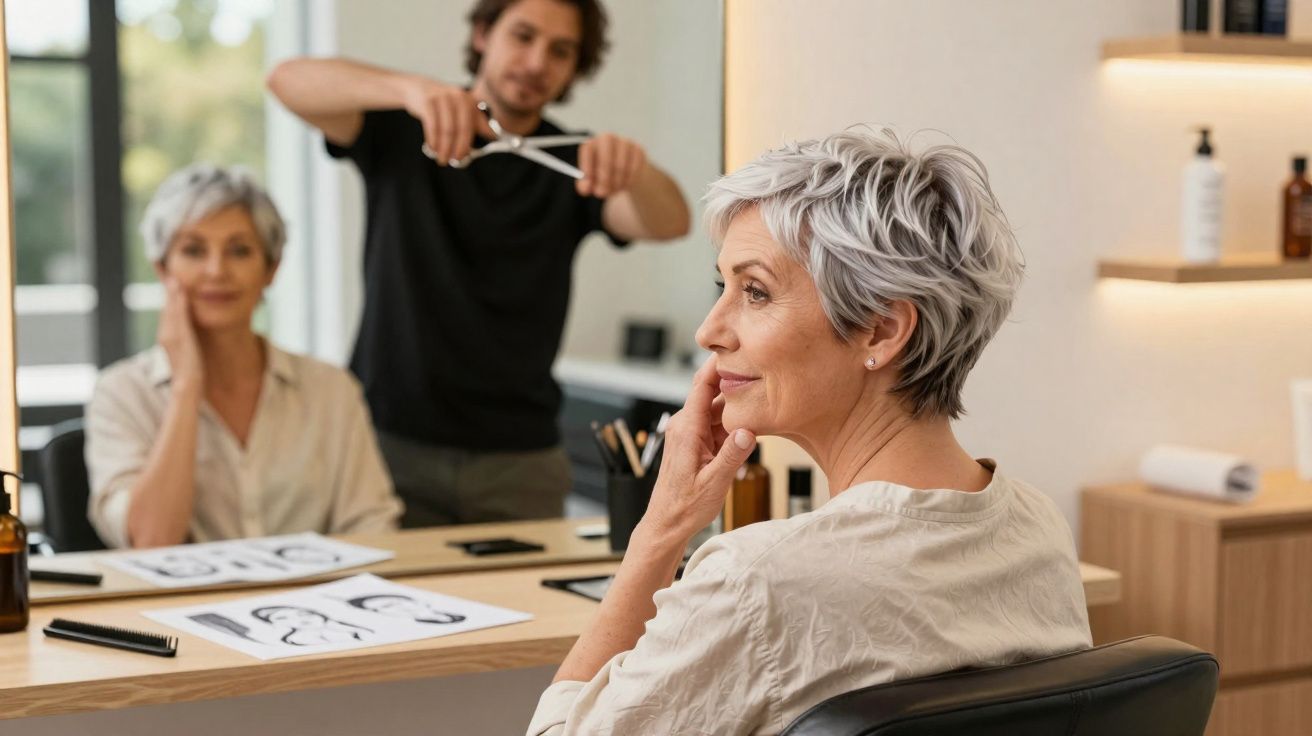
The woman in my chair studied herself in the mirror, drew a steadying breath and murmured, “I’m 56. Am I too old for short hair?”
Her bob lay flat against her shoulders: the colour had dulled, the outline had softened, and the shape she once relied on had long since disappeared. She rolled the tips between her fingers as if length were evidence that “long” meant feminine and “short” meant… danger. Around us the salon buzzed-hairdryers whirring, cups clinking, and the soft soundtrack of other women sharing their own hair histories.
Some ask the question with a grin, others through clenched teeth, and a few with eyes that shine as though they might spill over. But the question is almost never only about hair. It’s about being seen. About dating again. About grandchildren. About work, health, confidence, identity. When someone asks, “Should I cut it?”, what they often mean is, “If I change this, who will I become?”
So I did what I always do: I picked up my comb, took a step back, and pictured her with hair that actually suited the life she’s living now. Then I asked three questions. Her answer to the third made both of us go quiet.
The real question isn’t “short or long” - it’s “who are you now?”
When women over 50 sit in my chair and bring up short hair, I rarely begin with centimetres. I watch how they hold themselves, how their gaze flicks to the mirror and away again, how their hands hover near the ends as if negotiating with the past. In truth, short hair isn’t mainly about scissors; it’s about permission.
At 25, a haircut can be purely decorative. At 55, it becomes intimate and, in its own small way, political-a private statement of “I’m here”. You’ve lived through things. Your face carries a record of laughter, grief, determination and change, and your hair can either harmonise with that story or argue with it. Hair that argues with you doesn’t merely add years; it saps energy you’d rather spend elsewhere.
That’s why my best advice comes before the first snip: decide which version of you deserves to walk out of the salon. Not the mother your children remember. Not the junior you once were at work. You-today-with your laugh lines, your boundaries, your shifted priorities, and mornings that look different to how they used to. Short hair, done well, doesn’t disguise that truth; it frames it.
Short hair after 50: why it can feel like a reset (without pretending time hasn’t passed)
A few months ago a client-Claire-arrived with a long ponytail she’d kept since her thirties. She was 62, newly retired, and produced printed photographs of herself from two decades earlier-creased and folded, like directions back to a younger person. Her ponytail had thinned, her fringe had stopped cooperating, and she was spending about 40 minutes each morning trying to “repair” what ageing was simply rewriting.
We talked it through. I asked her what a good day looks like now. No alarm, she said. Long walks. Looking after grandchildren. Coffee with friends. “But on Zoom I just look… exhausted,” she confessed. Her hair was pulling her features down-literally and emotionally. We chose a textured cut that skimmed the cheekbones, lifted around the face and revealed just enough neck to feel airy rather than exposed.
When we finished, she reached back and touched the shape-surprised by the sensation of less. Then she smiled: slow, genuine, and not measured against any old photographs. Two weeks later she emailed: “I don’t avoid the camera anymore. I feel like I’ve finally caught up with myself.” That’s what a good short cut over 50 should deliver: not a time machine, but alignment.
There’s a practical reason short hair can feel transformative after 50, and it isn’t the tired “wash and go” cliché. With age, three changes are common: hair often becomes less dense, less glossy, and less springy. Long lengths can weigh down what remains, which tends to create flat roots, wispy ends and a face that looks more tired simply because everything is being dragged southwards.
Going shorter removes that weight, allowing the volume you do have to lift rather than collapse. Thoughtful layers can add height at the crown and softness around the jaw-almost like a gentle, natural lift without a single needle. When the nape is shaped properly, the neck can look longer, the shoulders can appear less rounded, and posture often improves in a subtle but real way.
Texture matters too. Grey and silver hair frequently arrives with extra personality: it can be coarser, drier, and more rebellious. Left long, that can feel unruly. Cut short and finished with the right products, it becomes definition and character. Instead of fighting frizz and bends, you start using them-hair shifts from “daily struggle” to “useful partner”. That’s the quiet logic behind my scissors whenever a woman over 50 says, “I’m thinking of going short.”
One more truth, often overlooked: short hair is a commitment to maintenance and freedom. You may visit the salon more frequently for shape-often every 4–8 weeks, depending on the cut-but you’ll usually gain time back every morning, especially if the style is designed for your natural texture rather than against it.
How to choose the right short cut after 50 (women over 50 + short hair), and avoid regret
When someone asks for my “best” advice about short hair, I start here: stop chasing the trend and start analysing your real life. Before I cut, I ask three questions:
- How much time do you actually spend on your hair in the morning?
- Do you wear glasses?
- Which feature do you love most about your face?
If you loathe blow-drying, I won’t send you home with a precision bob that requires a round brush, tension and ten minutes of effort every single day-let’s be honest, hardly anyone truly does that daily. If you wear glasses, I’ll keep the sides softer so the frames and the hair don’t compete visually. If you love your eyes, we can bring attention upward with a light fringe or extra lift near the temples.
The strongest short cut for women over 50 is built around bone structure and routine-not magazine face-shape charts. For one person, a choppy pixie with side-swept layers is ideal. For another, a soft jaw-length bob with a broken, textured edge is more flattering and more wearable. The “right” option is the one you can style in under ten minutes and still recognise yourself in the mirror, rather than feeling like you’ve borrowed someone else’s head.
The common mistakes I see (and how to sidestep them)
Trap one: going too short, too suddenly, in a moment of upheaval. Break-ups, redundancies, milestone birthdays-I’ve seen that fierce look: “Just take it all off.” It can be cathartic, absolutely, but it can also leave your reflection feeling unfamiliar for longer than you expected. There’s nothing wrong with a bold change; the key is making sure it’s your bold change, not a rush of adrenaline.
Trap two: getting stuck on a rigid idea of “age-appropriate”. Some women over 50 are pushed towards “practical”, which strangely translates into stiff helmet hair and sharp, ageing lines. Others swing the other way and request a cut designed for a 19-year-old influencer with thick, untouched hair. Both extremes can add years-just for different reasons.
The most forgiving route is usually the middle: a touch shorter than you think you dare, but soft where it counts. A fringe to diffuse forehead lines, gentle movement around the cheeks, and no severe, flat sides. Short hair should feel like lightness and motion, not like a penance.
One of my favourite clients, Maria, said something I repeat often:
“At 52, I stopped asking whether my hair made me look younger and started asking whether it made me feel alive. Younger keeps moving. Alive is now.”
That thought changed the way I talk about short hair after 50. It isn’t a trick to rewind the clock; it’s a frame that lets your current life take centre stage.
Here are the practical signposts I share in the salon when we’re about to go short:
- If your hair is fine and thinning: choose a soft crop with internal layers rather than a heavy bob that splits at the back.
- If your hair is wavy or curly: ask for the shape to be cut and refined in its natural texture, not only after a blow-dry you won’t recreate at home.
- If you’re anxious about losing length: begin with a collarbone-length cut and move shorter over two or three appointments.
- If you colour your hair: short cuts can make regrowth feel less harsh, but flat, single-tone colour shows sooner-aim for softer blends, lowlights or highlights.
- If you’ve kept the same cut for 15+ years: take it as a sign. Hair has seasons, and you’re allowed a new one.
A helpful addition many women don’t consider: bring two or three photos, but also bring one sentence about your life. “I swim twice a week.” “I never use heat.” “I need it off my face at work.” That single line can be more valuable than any picture, because it prevents a cut that looks brilliant in the salon and becomes unmanageable at home.
Short hair after 50 is less about age and more about honesty
A quiet revolution is taking place in salons. Women over 50 are arriving with screenshots of silver pixies, undone French bobs, and undercuts tucked beneath soft layers. Many are done with performing youth as though 35 is the only acceptable target. The aim is changing: not “How do I cheat time?”, but “How do I look the way I actually feel?”
Short hair, chosen for the right reasons, is radically honest. It reveals the neck, the jaw, the shape of the skull. There’s less to hide behind-and that’s exactly why it can look so powerful. Your eyes become the focus. Your expression reads clearly. Presence replaces camouflage. On a woman who has lived, laughed, grieved and carried on, that honesty doesn’t read as “giving up”; it reads as authority.
On a practical level, clients tell me the same things after going short at 50, 60, even 70: mornings feel easier; travelling is simpler; hair stops being a project and becomes background. They reclaim time, mental space, and a small daily lift when their hands meet a shape that simply works. Emotionally, many stop apologising for the face they’ve earned.
If you’re teetering on the edge of a short cut, ask yourself what you’re truly afraid of losing. The length-or an older version of you that no longer fits? Say the answer out loud to your hairdresser. A good one won’t only cut your hair; they’ll help you meet the person in the mirror, fully-perhaps for the first time in years.
| Key point | Detail | Why it matters to you |
|---|---|---|
| Choose based on real life | Build the cut around styling time, glasses and the features you like most | Prevents the “looks great in the salon, impossible at home” haircut |
| Prioritise lightness and movement | Remove weight, create lift at the crown, soften the perimeter | Gives a gentle “lifted” effect without looking rigid |
| Move in stages if needed | Start with an in-between length before going properly short | Lowers the risk of regret and gives you time to adjust |
FAQ
- How short is “too short” after 50? There isn’t a universal rule. “Too short” is any length that stops you styling it in a way that still feels like you. If you’re unsure, start slightly longer than your favourite reference photo, then refine it at your next appointment.
- Will short hair make me look older? A poorly balanced short cut can, yes. But a shape with lift at the crown, softness around the face and a colour that isn’t harsh usually makes features look brighter rather than older.
- Can I go short if my hair is thinning? Often, short hair is your best ally. Removing length prevents stringy ends, and strategic layering can create the illusion of fuller hair.
- What if I regret cutting it? Hair grows back. Begin with a “soft short” such as a jaw-length bob or a longer pixie so you have room to adjust. Tell your stylist what worries you before the scissors come out.
- Do I have to go grey to wear short hair? Not at all. Short cuts can look brilliant in natural grey, blended highlights or deeper shades. The key is dimension-avoid flat, single-tone colour sitting heavily on a sharp shape.



Comments
No comments yet. Be the first to comment!
Leave a Comment