
The orthopaedic waiting area had that familiar mix of diluted disinfectant and tired magazines. One woman in leggings massaged her knee through the fabric while scrolling her phone; an older man kept readjusting in his seat, grimacing whenever his leg shifted. When the clinician finally waved them through, the recommendation felt predictable before it was even finished: “Have you tried swimming? Maybe some Pilates.” You nod politely, accept the leaflet, book the class you’ll cancel twice, and head home with the same knee, the same ache, and the same nagging sense that something’s been missed.
What if the answer isn’t in a pool or on a studio mat at all?
The quiet activity knee experts whisper about: strength training for knee pain
Speak off the record with a few seasoned physios and you’ll often hear the same confession. The thing that frequently makes the biggest difference to sore knees isn’t Pilates or swimming. It’s straightforward, unglamorous strength training-not bodybuilding, not gym selfies, but progressive, targeted work that gives your hips and legs the support your knee has been begging for.
It doesn’t always look “gentle”, yet it can be the most joint-friendly option once it’s dosed properly.
I met a 43-year-old runner, Sophie, who stopped jogging after being told she had “runner’s knee”. She did what nearly everyone does: aqua-gym, yoga, long walks. They helped her mood, but stairs still felt like a tense bargaining session with every step.
Things only shifted when a young sports physio said-almost as if apologising-“We’re going to start loading you. Squats. Deadlifts. Step-ups.” Sophie laughed, then worried, then gave it a go. Three months later she walked up the Underground stairs thinking about her podcast, not her patella.
Why “low impact, low load” became the default (and why your knee responds to load)
So why does this idea trigger pushback from some therapists and trainers? Because it challenges a long-standing comfort zone. For years, mainstream knee-pain advice has been built around “low impact, low load, be careful”: pools, exercise bikes, stretchy bands. It sounds safe, it feels reassuring, it keeps insurers calm, and it doesn’t frighten patients.
But the knee is essentially a hinge caught between the hip and ankle. It relies on the strength and timing of the muscles above and below it to keep forces controlled. When that support system is underpowered, even ordinary walking becomes a negotiation. Done sensibly, load isn’t your knee’s enemy; load is the message your tissues are designed to understand.
One practical addition most people are never told: improving knee pain isn’t only about the knee. Sleep, overall training stress, and day-to-day habits (like how many stairs you do, how long you sit, and how suddenly you ramp activity) all influence sensitivity. Strength training works best when it’s part of a wider plan, not a heroic burst followed by a week of regret.
How to use strength training when your knee already hurts
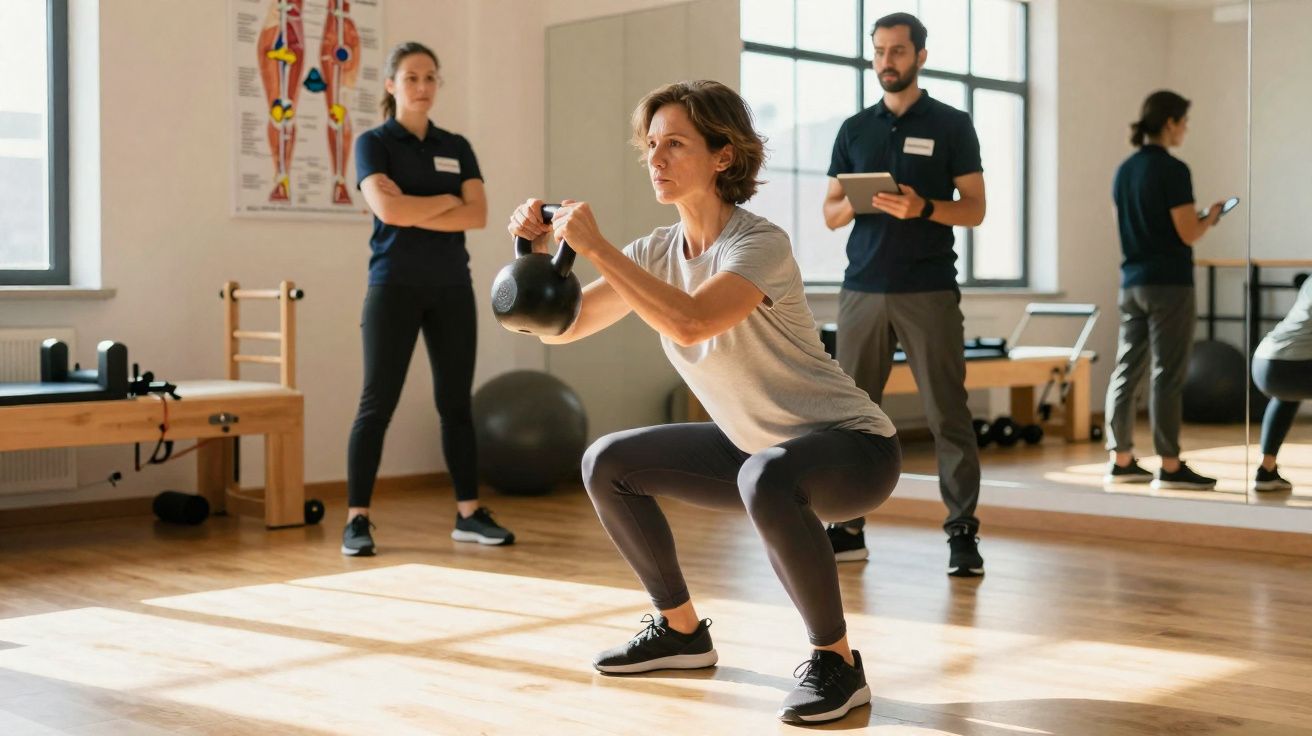
The point is not to fling yourself under a barbell on day one. Step one is choosing movements that challenge the muscles around the knee without sending a lightning bolt through the joint. Keep it simple and controlled:
- slow sit-to-stands from a chair
- mini-squats while holding the kitchen worktop
- step-ups on a low step
- glute bridges on the floor
Start with one or two sets, two or three times a week, at an effort that feels challenging but not savage.
Where most people derail is in one of two directions: they do nothing at all, or they do far too much too soon. We’ve all had that moment-you feel slightly better and decide today is the day you’ll run 5 km “just to test the knee”. That’s often the day the knee “tests” you back.
Your tissues adapt gradually, and your nervous system needs time to stop interpreting every load as a threat. Progress means nudging up weight or repetitions in small steps, hovering just under the flare-up line rather than sprinting past it.
“People are told to ‘protect’ their knees so intensely that they end up detraining the very muscles that would protect them,” one exasperated physiotherapist told me. “Then they’re sent away with a pool programme and a prayer.”
A simple way to keep yourself honest is to use a 24-hour rule: a mild, manageable increase in discomfort during exercise can be acceptable if it settles back to your baseline within a day. If pain spikes sharply, lingers, or changes character (stabbing, catching, locking), that’s not “good soreness”-it’s a sign to adjust the movement, range, or load.
Practical principles (that beat perfectionism)
- Begin with controlled, pain-aware reps rather than hunting for “zero pain at all”.
- Put the focus on hips and thighs: quads, hamstrings, and glutes carry much of the knee’s workload.
- Use support early on-a chair, handrail, or wall-so you feel secure as confidence builds.
- Progress one variable at a time: a touch more load, or a few extra reps, or a slightly deeper bend.
- Stop chasing flawless form clips; consistent, “good enough” reps beat heroic, rare workouts.
Why this makes some professionals uneasy - and why your knee doesn’t care
There’s an awkward truth behind the scenes: gentle options are easier to sell than hard, useful truths. Many people like the idea of floating in a pool, stretching on a mat, or “activating” tiny muscles with pastel resistance bands. Strength training sounds heavier, less fashionable, and less Instagrammable. It also disrupts an ecosystem of cautious, soothing advice that keeps patients careful-and often dependent.
Your knee, however, doesn’t read captions. It responds to load, repetition, and time.
Some clinicians worry they’ll be blamed if a patient’s symptoms flare after starting strength work. Others were trained in an era where rest and protection were the main tools. That legacy still shapes recommendations today, even though recent research repeatedly supports carefully loaded exercise over purely passive approaches.
And no-almost nobody executes this perfectly every day. The win is consistency, not intensity. Two or three sessions a week, delivered with a plan, commonly outperforms months of “float and hope”.
So where does that leave you-someone hobbling down stairs while juggling advice from Google, friends, and rushed appointments? Somewhere between sensible caution and practical bravery. You don’t need to become a “gym person”. You don’t need matching leggings or a trainer barking clichés. You need a quiet corner, something stable to hold, and a willingness to load your legs a little more than last week.
The backlash from some professionals is real because this flips the story: you aren’t a fragile joint to be wrapped in cotton wool forever. You’re a whole body that can get stronger.
| Key point | Detail | Value for the reader |
|---|---|---|
| Strength beats “gentle only” | Targeted strength work for hips and thighs often eases knee pain more effectively than endless low-impact cardio alone | A realistic route back to function, not just short-lived relief |
| Start small, progress slow | Begin with chair stands, mini-squats, low step-ups, then build intensity gradually | Less fear, fewer flare-ups, better adherence |
| You’re not fragile | The knee adapts to sensible loading rather than lifelong protection and rest | Restores confidence in your body and everyday movement |
FAQ
Question 1: Can I do strength training if my knee already hurts a bit?
Answer 1: Yes-provided the discomfort is manageable and doesn’t surge sharply during the session or worsen afterwards. Aim for a tolerable level that settles within 24 hours. Avoid movements that trigger stabbing pain, locking, or a sudden sense the joint is catching.Question 2: What if I don’t have access to a gym?
Answer 2: You can do plenty at home: chair sit-to-stands, wall squats, stair step-ups, glute bridges, and calf raises using body weight. As you improve, add simple “weights” such as a backpack or water bottles.Question 3: How often should I train for knee pain improvement?
Answer 3: Two to three strength sessions per week is usually sufficient. Rest days help joints and muscles adapt, so daily heavy training isn’t required and can even slow progress.Question 4: Is swimming or Pilates useless for knee pain?
Answer 4: No. Swimming and Pilates can improve mobility, circulation, and overall fitness-and many people genuinely enjoy them. The problem is when they replace meaningful strength training instead of supporting it.Question 5: When should I see a doctor or specialist instead of training alone?
Answer 5: Seek medical assessment if your knee locks, repeatedly gives way, swells significantly, wakes you at night, or if the pain follows a serious fall or injury. A proper diagnosis can rule out issues that need more than exercise alone.




Comments
No comments yet. Be the first to comment!
Leave a Comment