
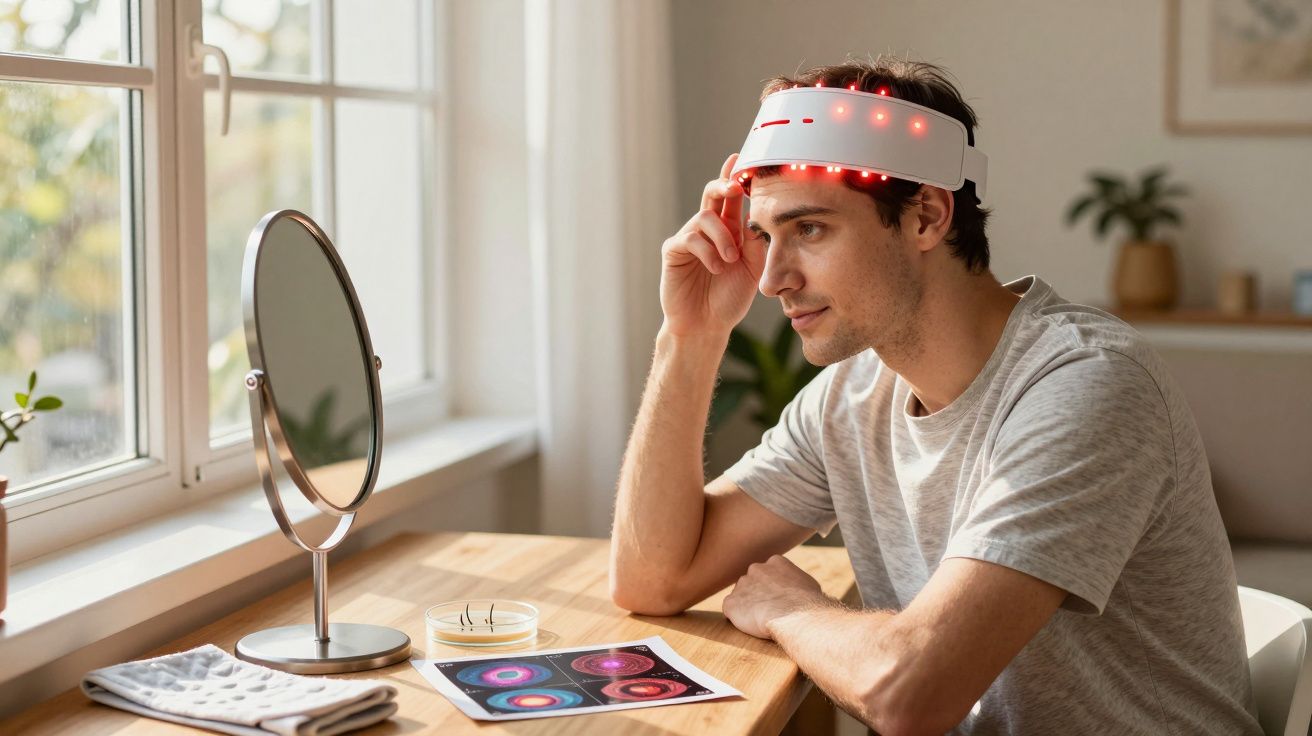
Scientists in South Korea are working on a comfortable light therapy hat designed to support hair loss management and encourage hair growth.
Why a new light therapy hat for hair loss matters
Many existing hair loss helmets rely on red light therapy, yet they are often rigid, bulky, and awkward to wear. The Korean team’s goal is to create something people can use more easily day to day-potentially even outdoors-without the obvious “medical device” look.
A key motivation is the role of ageing in common forms of thinning. Ageing hair cells contribute to several types of hair loss, including hereditary patterned hair loss (androgenetic alopecia), the most widespread form globally.
Near-infrared wavelengths targeting hDPCs (human dermal papilla cells)
The approach centres on near-infrared wavelengths that are carefully tuned to stimulate human dermal papilla cells (hDPCs)-cells at the base of hair follicles that are essential for hair regeneration.
Unlike some forms of phototherapy that require a stiff helmet to hold light sources in place, this platform is intended to sit inside a flexible cap that fits closer to the scalp, making it easier to wear in public with more comfort and style.
Organic Light-Emitting Diodes (OLEDs) for more even scalp illumination
A further difference is how the light is delivered. Many current systems use LEDs or lasers, which can produce comparatively concentrated spots of illumination. Here, Organic Light-Emitting Diodes (OLEDs) are used to generate broader, more evenly distributed light across the scalp.
“Because OLEDs are thin and flexible, they can closely conform to the curved surface of the scalp, delivering uniform light stimulation across the entire area,” explains electrical engineer Kyung Cheol Choi from the Korea Advanced Institute of Science & Technology (KAIST).
Laboratory results and the β-galactosidase ageing biomarker
Although a wearable “hat” has not yet been tested on a human head, the underlying system has shown strong early performance in laboratory work at KAIST, supported financially by City University of Hong Kong.
As hair follicles age and begin to deteriorate, they express β-galactosidase-a biomarker enzyme first described in 1995 and now widely used to gauge how anti-hair-loss interventions affect cellular ageing.
The new Korean OLED platform produced notably favourable results on this marker. The device is customised to emit near-infrared light in the 730–740 nm range, which the researchers describe as optimal for activating dermal papilla cells.
In laboratory experiments, this finely tuned system reduced age-associated changes in human hair cells by nearly 92% compared with untreated cells. The team also reports that, when compared with hair cells treated with red OLED, those treated with the customised OLED light showed 92% fewer markers linked to age-related decline.
If these findings can be reproduced in real clinical trials, the method could become a superior option for treating hair loss.
How this compares with current hair loss treatments
In the United States, hereditary patterned hair loss affects up to 40% of the population, yet only a small number of approved treatments exist-and they can involve significant drawbacks.
- Minoxidil (an over-the-counter topical treatment) can slow hair loss and support some regrowth, but it is not effective for everyone.
- Finasteride (brand name Propecia), taken orally, may also slow hair loss. However, it can cause discouraging side effects including erectile dysfunction, testicular or breast pain, reduced libido, and depression, and it is not approved for use in female patients.
To avoid invasive hair transplants, an increasing number of people have turned to low-level light therapy, which has shown some effectiveness for treating androgenic alopecia in both sexes. The KAIST team aims to improve on those outcomes by optimising wavelength and delivery while also making the device more wearable.
Wearability, safety, and real-world use
A flexible, close-fitting cap could improve adherence: treatments only work if people can realistically use them consistently. A softer form factor may also help ensure more stable contact and more uniform light exposure across the scalp.
That said, translating laboratory results into everyday benefit will depend on careful validation-especially around safe exposure levels, skin sensitivity, and the practicalities of repeated use. As with any device intended for therapeutic application, the route to real-world deployment will require robust evidence and clear safety standards.
Next steps: a washable cap and preclinical studies
The researchers are now aiming to develop a fully washable version of their hair-loss hat that can tolerate daily wear.
“Going forward, we plan to verify safety and efficacy through preclinical studies and progressively evaluate the potential for real therapeutic applications,” says Choi.
The study was published in Nature Communications.


Comments
No comments yet. Be the first to comment!
Leave a Comment