
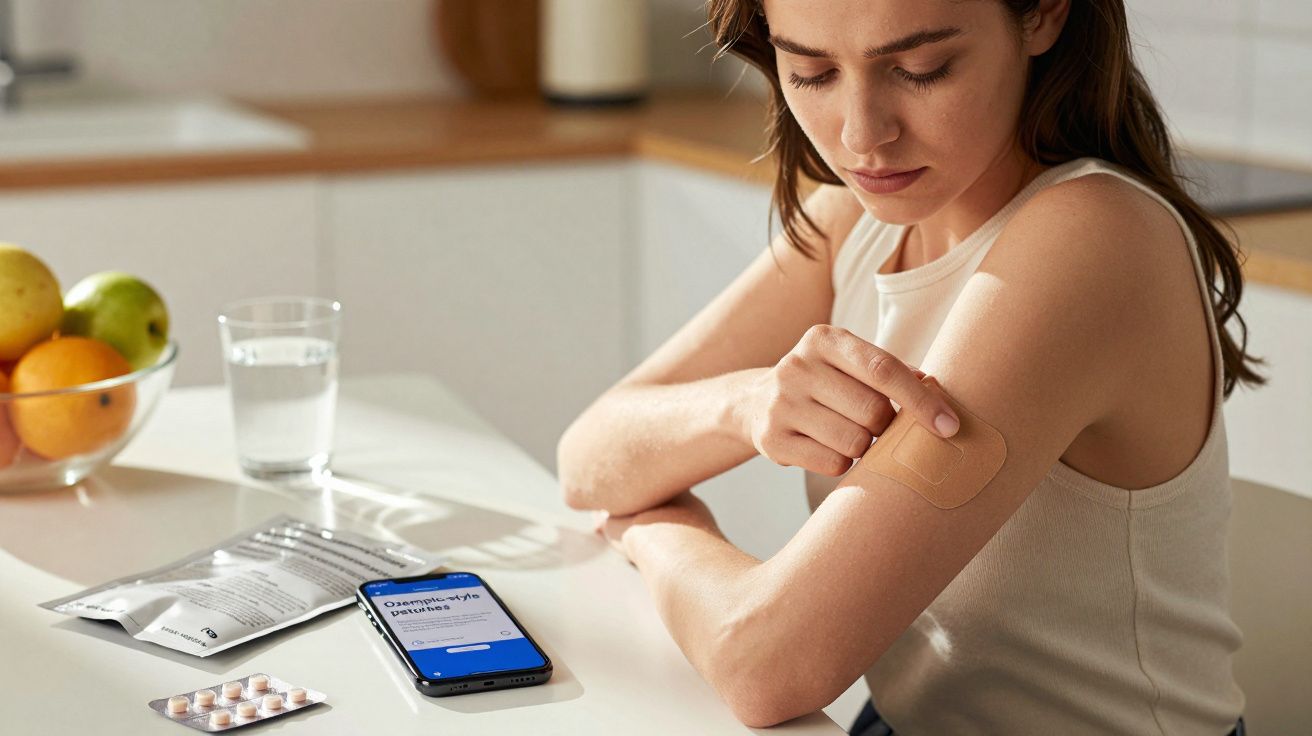
Could a stick-on patch, marketed as an Ozempic-style shortcut, really help you lose unwanted kilograms without the discomfort and hassle of an injection?
Online adverts for these Ozempic-style weight-loss patches are spreading quickly, often promising striking results while offering very little credible evidence to support the claims.
You’ll also see plenty of “personal recommendations”, including from apparent “doctors” on social media. However, independent fact-checkers have identified that some of these endorsements are generated using AI rather than coming from real clinicians.
Before you part with your money, here are the key reasons to be cautious about buying a weight-loss patch.
Ozempic-style weight-loss patches (GLP-1 patches): what’s actually in them, and do they work?
These Ozempic-style patches are frequently described as GLP-1 patches. Despite the name, they do not contain any pharmaceutical ingredient from Ozempic (semaglutide) or related medicines such as Mounjaro (tirzepatide).
Instead, they typically rely on blends of herbal extracts, commonly including berberine, green tea (Camellia sinensis), the tropical fruit (Garcinia cambogia), and bitter orange (Citrus x aurantium L.).
In laboratory settings, there is some evidence that certain components may have biological effects. Examples include compounds within berberine, the polyphenols found in green tea extract, and hydroxycitric acid from G. cambogia, which have been linked with appetite suppression, reduced blood glucose (sugar) levels, and processes involved in fat metabolism that could, in theory, support weight loss.
But results in the lab do not reliably predict what will happen in real people. More recent human evidence suggests these herbs have minimal impact on weight reduction.
Consider berberine: overall, research indicates that users do not lose much weight. One scientific review reported that taking up to 3 grams per day for 12 months produced only a modest change in body weight and waist circumference.
Another review pooling data from multiple studies found that taking up to 2.4 g of green tea extract daily for 13 weeks, and more than 4 g of *G. cambogia* daily for 17 weeks, did not reduce people’s weight.
For bitter orange extract, taking up to 54 mg of synephrine (a compound isolated from bitter orange extract) each day for eight weeks similarly failed to produce weight loss.
It’s also crucial to highlight that all of the research above relates to oral products (for example, tablets and capsules), not herbal extracts delivered via patches.
Do the ingredients in weight-loss patches pass through the skin?
Whether any ingredient from a weight-loss patch can enter the body depends heavily on how that extract has been prepared.
Human skin is highly lipophilic, meaning it more readily takes up oily or fat-soluble substances while acting as a strong barrier to water-loving (hydrophilic) compounds.
That’s why many medicines cannot be given through the skin. Ozempic, for example, is delivered by injection because its drug molecule is both too large and too hydrophilic to cross the skin effectively.
If a patch’s herbal extracts are produced using water-based methods, the active components are unlikely to penetrate the skin at all-meaning the patch may simply sit there doing nothing until it is removed.
A further practical limitation is capacity: patches can only carry tiny amounts of extract. In the studies mentioned earlier, grams of material were required even to test for potential effects. In contrast, Ozempic-style patches commonly contain less than 0.1 g of extract.
So even in the best-case scenario-where some ingredients do pass through the skin-there is usually too little in the patch to make any meaningful difference.
You can’t assume Ozempic-style patches are safe
In Australia, the Therapeutic Goods Administration (TGA) is responsible for regulating medical products, including herbal extracts.
To be legally sold in Australia, a herbal product generally needs to be included on the Australian Register of Therapeutic Goods. There are no Ozempic-style patches listed on that register.
As a result, the quality and safety of any patch you purchase may not have been assessed, and it cannot be assured.
An Australian study has reported cases in which unregistered herbal products were contaminated with undeclared plant materials, heavy metals, and even prescription medicines such as warfarin. Such contaminants are especially concerning because they may be absorbed through the skin and then circulate throughout the body.
A note on regulation and misleading marketing in the UK
In the UK, weight-loss products and medical claims may fall under scrutiny from bodies such as the MHRA and the ASA, but online marketplaces and social platforms can still be flooded with listings that are difficult to police in real time. That means consumers can easily encounter products that appear legitimate yet provide no robust evidence, transparent sourcing, or reliable manufacturing standards.
If you see adverts leaning heavily on dramatic “before and after” images, vague scientific language (such as “GLP-1 boosting”), or viral testimonials from suspicious accounts, treat them as red flags-especially when the seller cannot provide clear, independent evidence of efficacy and safety.
In a nutshell
Although Ozempic-style weight-loss patches may sound like an attractive idea, the available evidence indicates they don’t work, and their safety is not assured.
Rather than spending money on a patch, speak with your GP or pharmacist about weight-loss approaches that are supported by evidence. They can discuss safe, effective options and help tailor a plan to your health needs and goals.
Nial Wheate, Professor, School of Natural Sciences, Macquarie University and Wai-Jo Jocelin Chan, Pharmacist and Lecturer, UNSW Sydney; University of Sydney
This article is republished from The Conversation under a Creative Commons licence. Read the original article.





Comments
No comments yet. Be the first to comment!
Leave a Comment