
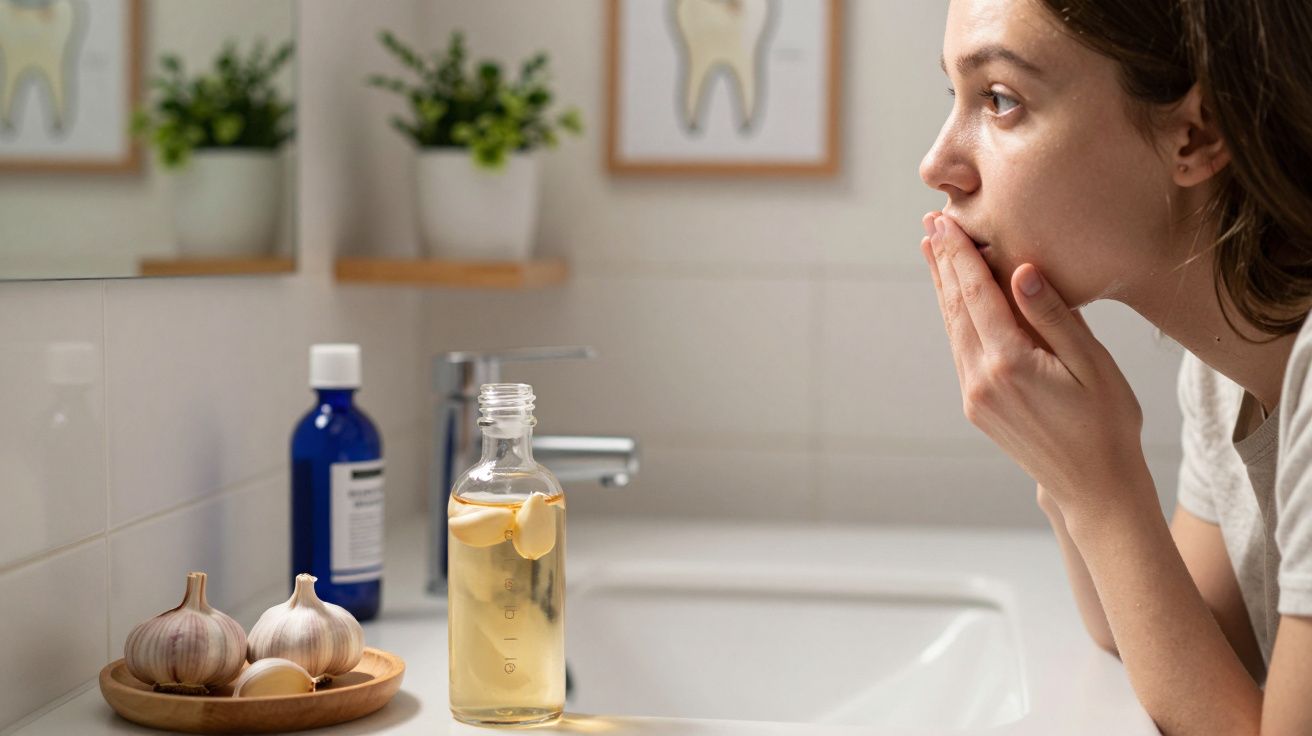
Garlic may do more than feature in folklore about keeping vampires at bay: evidence suggests it can also act against harmful mouth microbes. A recent review indicates that a mouthwash made with garlic extract may perform similarly to chlorhexidine-the long-standing benchmark ingredient in many mouthwash products-while potentially bringing fewer unwanted effects.
What the review found about garlic extract vs chlorhexidine
Researchers from the University of Sharjah in the United Arab Emirates analysed findings from five earlier human studies that compared the bacteria-reducing effects of garlic-based rinses with chlorhexidine rinses.
Taken together, the results showed that garlic extract mouthwash reduced harmful oral bacteria to a level broadly comparable with chlorhexidine-based mouthwash. The clearest effect was seen against Mutans Streptococci (MS), the group of bacteria most closely linked with tooth decay.
The authors note that chlorhexidine is widely viewed as the “gold standard” for mouthwash use, but they also emphasise longstanding concerns about side effects and antimicrobial resistance. In their view, garlic extract could be a credible substitute-particularly when used at higher strengths.
Concentration matters for Mutans Streptococci (MS) reduction
The review highlighted that effectiveness depended on dose. Across the included studies:
- A 0.2% chlorhexidine solution reduced MS in saliva more effectively than a 2.5% garlic solution.
- When the garlic rinse was increased to 3%, the garlic mouthwash produced the stronger reduction.
In other words, the comparison is not simply “garlic vs chlorhexidine”; the concentration used appears to be a key driver of how well each rinse performs.
Side effects: garlic mouthwash is not problem-free
The evidence was not uniformly positive. The studies reported several side effects associated with garlic mouthwash, including:
- a very strong taste
- bad breath
- a more intense sensation of spiciness
- a burning feeling in the mouth
These issues are generally considered less serious than the well-known downsides of chlorhexidine-such as teeth staining-but they still matter in practice. If the taste or burning sensation discourages regular use, the real-world benefit could be limited even if the antimicrobial effect is strong.
Why chlorhexidine raises antimicrobial resistance concerns
The review also revisits worries raised in earlier research that repeated exposure to chlorhexidine can encourage bacteria to adapt. The authors point to evidence suggesting that long-term or low-level exposure may promote antimicrobial resistance, including cross-resistance to antibiotics. These limitations, they argue, strengthen the case for identifying safer alternatives that are similarly effective.
Allicin: the compound behind garlic’s antimicrobial activity
Garlic has a long history as a natural remedy for a wide range of complaints. Knowledge of its health-related uses stretches back thousands of years, with civilisations such as Rome, Egypt, and China each independently recognising garlic’s potential to help fight illness and support wellbeing.
Much of garlic’s antimicrobial benefit is attributed to allicin, a compound produced when garlic is chopped or crushed. Allicin can interfere with bacterial growth and help reduce cellular stress-while also being responsible for garlic’s distinctive smell (including the lingering odour on the breath of those who eat it).
What would need to happen before garlic mouthwash becomes mainstream?
In time, garlic-derived formulations could provide a bacteria-fighting mouthwash option aimed at lowering tooth decay risk and supporting broader oral health. However, the authors stress that the current evidence base is limited: only five studies were included, and each involved relatively few participants.
They conclude that more clinical research is required, with larger sample sizes and longer follow-up, both to confirm effectiveness and to improve real-world clinical usefulness.
One additional consideration for future trials is acceptability and adherence: even a highly effective rinse may fail in practice if users cannot tolerate the taste, odour, or oral burning sensation. Formulation work-such as improving flavour, controlling odour, and reducing irritation-could therefore be as important as antimicrobial performance.
It is also sensible for future studies to examine safety across different groups, including people with sensitive oral tissues or those prone to irritation. As with any mouthwash intended for regular use, guidance on frequency and duration would be needed so that benefits can be achieved without creating new problems.
The research was published in the Journal of Herbal Medicine.






Comments
No comments yet. Be the first to comment!
Leave a Comment