
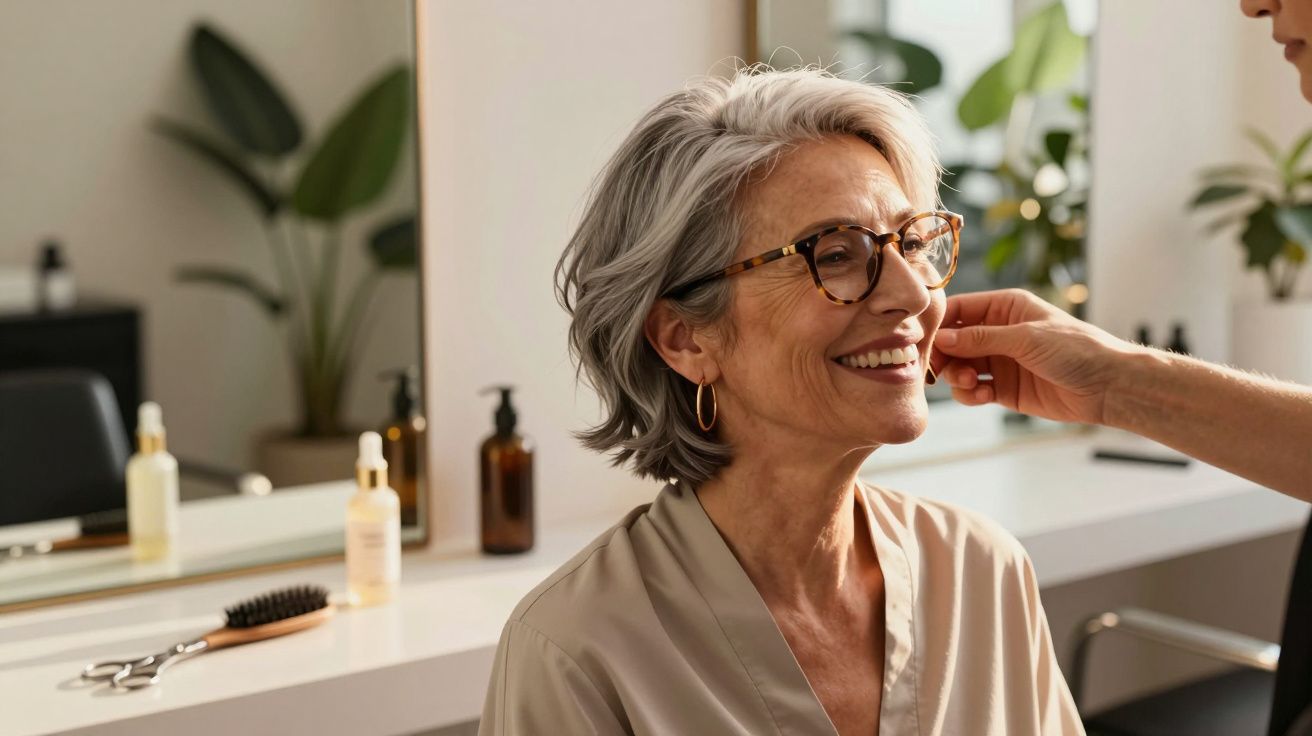
A quietly emerging short-hair trend is reshaping the way women over 50 are wearing grey hair-and it does so without the commitment (or shock) of a dramatic colour overhaul.
In salons across the UK, the US and Europe, stylists are seeing more clients arrive with screenshots of soft, piecey crops designed to make grey hair look brighter while subtly emphasising the cheekbones. At the heart of this movement is a cut with a highly technical name and an unexpectedly flattering finish: the micro contour crop.
What is the micro contour crop?
The micro contour crop is a cropped, short haircut built on clean precision, feathered edges and fine, face-focused texture. It sits slightly longer and lighter than a traditional pixie, yet it remains unmistakably a crop.
The purpose isn’t to disguise grey hair-it’s to frame it so it appears intentional, luminous and contemporary.
Using gentle layers and carefully planned “disconnection”, hairdressers tailor the outline to skim the jaw, lift the cheekbones and visually open the eye area. On salt-and-pepper hair, the texture breaks up flat, solid tones, so natural silver reads more like high-end highlights than “grown out” colour.
Why the micro contour crop works brilliantly on grey hair after 50
Grey hair often behaves unlike pigmented hair: it can be drier, more porous and occasionally wirier. A blunt bob can make that texture balloon outwards, while an ultra-short pixie may spotlight every cowlick and swirl.
The micro contour crop neatly avoids both extremes.
- Length with lightness: Long enough to settle and lie nicely, but short enough to feel crisp and purposeful.
- Soft edges: Feathered ends prevent grey hair looking blocky or “helmet” shaped.
- Face contouring: Layer placement mirrors where a make-up artist might add highlighter and blush.
- Built-in movement: Texturising creates lift through the crown and a gentle drift around the temples.
Together, these details produce a subtle “lifted” impression. With slightly cropped sides and controlled volume on top, the gaze naturally moves upwards-creating a fresher, more awake look without anything invasive.
How the micro contour crop rejuvenates the face
French beauty editors often label this style a rejuvenating cut, and the reasons are practical rather than mystical.
Softer shaping around cheekbones and jaw
Short, tapered pieces near the cheeks glide over areas where lines often deepen with age. Instead of sticking to the skin, the hair sits just away from the face, casting a soft shadow that makes the area appear smoother.
When the jaw is gently revealed-without being completely exposed-it tends to look cleaner and more defined. That measured balance is what keeps a crop modern, rather than severe or dated.
Crown lift instead of a heavy fringe
Rather than relying on a weighty fringe to “cover” the forehead, the micro contour crop keeps the front lighter. The volume is positioned slightly further back, which can lengthen the profile and reduce the look of heaviness around the brows and eye area.
Think of it as contouring with hair: height through the centre, softness at the edges, and no dense sections pulling the face down.
How it differs from other trending short cuts
The micro contour crop is arriving alongside other short-hair trends for 2025, many of which are also being adapted to suit grey hair.
| Cut | Main vibe | Best for |
|---|---|---|
| Micro contour crop | Softly sculpted, modern, face-framing | Grey or salt-and-pepper hair, anyone wanting subtle lift |
| Trixie cut | Very short, 90s-inspired, sharp and edgy | Those who prefer bold, defined shapes and minimal styling |
| Short shag | Tousled, layered, relaxed movement | Fine hair that needs volume and an effortless feel |
| Wispy crop | Feather-light, feminine, airy | Anyone wanting softness and easy everyday styling |
Compared with a pixie, the micro contour crop usually retains a little extra length around the ears and nape-something many women over 50 find more flattering. It also steers clear of the heavier layering associated with a classic shag, favouring tidy, tailored shaping instead.
Who suits the micro contour crop best?
Although it’s highly adaptable, certain features tend to pair especially well with this cut.
- Face shapes: Oval, heart and softly square faces often wear it effortlessly. If your face is rounder, extra crown height can help avoid a “too spherical” silhouette.
- Hair texture: Straight or slightly wavy hair is an easy match. Coarser or very curly hair can still suit the shape, but it’s best done by a stylist confident with dry cutting and advanced texturising.
- Lifestyle: If you want something quick and low-fuss, it’s ideal-this crop copes with bedhead better than a precision bob.
If your hair is extremely fine and tends to sit flat, a stylist may blend the micro contour approach with elements of a short shag, adding internal layers to build lift without leaving the scalp exposed.
Extra consideration: glasses, earrings and neckline (new)
Because the micro contour crop clears the face and often exposes more of the ear and jaw area, it pairs particularly well with glasses and statement earrings. If you wear glasses daily, ask your stylist to leave enough softness at the temples so the frames don’t create a harsh break in the silhouette. Likewise, discuss how much nape exposure you’re comfortable with-especially if you prefer scarves, roll-necks or collared coats in winter.
How to ask your stylist for a micro contour crop
You won’t always see “micro contour crop” written on a salon price list, so the consultation-and the description of the finish you want-matters more than the label.
Bring reference photos and describe the result you’re after: lifted, softened and modern, not simply “short”.
Key points to cover:
- Ask for a short cut with soft, textured edges, not a blunt bowl shape or a severe pixie.
- Request face-framing pieces that contour the cheekbones and jaw, rather than one dense fringe.
- Ask for subtle layering on top to create movement, avoiding obvious steps or chunky tiers.
- Be clear that you want to keep your grey or salt-and-pepper colour.
A skilled stylist will tailor the cut to your hairline, cowlicks and density. For example, a strong crown growth pattern may be left slightly longer so it sits more neatly.
Styling grey hair in a micro contour crop
Most versions of the micro contour crop are designed to look good without much effort, but a few habits make grey hair look noticeably healthier and brighter.
- Texture cream or paste: Warm a pea-sized amount between your palms, then pinch into the ends at the temples and crown to emphasise the contour.
- Light mousse or root spray: Applied to damp hair, it adds gentle lift so the shape doesn’t collapse.
- Purple or silver shampoo: Used weekly, it neutralises yellowing that can make grey look dull.
- Glossing drops: A single drop smoothed over the surface can boost shine without making hair heavy.
Many women can simply air-dry this cut, then refine a few sections with their fingers or a quick blast of the hairdryer. That low-maintenance reality is a major reason it’s catching on with women in their 50s and 60s who want a deliberate style without daily effort.
Keeping the cut looking expensive between appointments (new)
To maintain that “fresh from the salon” finish, treat heat as a tool rather than a routine: use a heat protectant whenever you blow-dry, and keep irons on a moderate setting. Grey hair can be more porous, so it can lose moisture quickly; a lightweight leave-in conditioner used sparingly can help the feathered edges stay soft instead of fluffy.
Why short grey hair looks especially modern in 2025
A broader cultural change is fuelling the popularity of crops like the micro contour crop. Well-known figures in fashion, television and politics are increasingly wearing their hair naturally grey-then matching it with sharply considered cuts. The overall effect reads confident rather than apologetic.
Instead of asking how to conceal grey, more women are asking how to make it look its best. Short hair shows off the full mix of silver, white and darker strands, often with the same depth you’d expect from salon highlighting. When the shape is structured around the face, that texture stays on the “intentionally styled” side of the line, rather than drifting into “unkempt”.
Grey hair care terms worth knowing
A few salon and product terms can make consultations far clearer.
- Porosity: How readily hair absorbs and releases moisture. Many grey strands are high-porosity, meaning they take in product quickly but can dry out just as fast.
- Cuticle: The hair’s outer layer. With age, it may become rougher, so smoothing products are often more useful than heavy oils.
- Texturising: Methods such as point cutting or slide cutting that remove weight for softness, rather than creating obvious, chunky layers.
With this vocabulary, you can ask for more targeted support. If grey hair feels rough, for instance, you might request a glossing treatment to seal the cuticle rather than using a strong permanent colour that adds further stress.
A realistic scenario: going grey with a micro contour crop
Picture a woman in her mid-50s who has been colouring her hair dark brown every six weeks and decides she’s done with the routine. She could endure a long year of growing out a stark root line-or she could move to a micro contour crop and let the grey come through more quickly in a shape that looks deliberate.
With less length, the old dye drops away sooner. Textured edges soften any remaining demarcation line, while purple shampoo keeps the emerging silver clear and bright. She may tweak her make-up slightly-perhaps a stronger brow or a fresher blush-to complement the sharper haircut. Rather than feeling as though she’s “letting herself go”, it comes across as a confident style refresh.
There are compromises. A crop like this usually needs reshaping every six to eight weeks to keep its structure. And if you like tying hair back on low-effort days, that option largely disappears. Still, many find the trade worth it: less weight, a clearer sense of identity, and an easier daily routine.
If you’re torn between keeping length and making a change, ask your stylist to simulate the outline-pinning hair up or using a virtual try-on tool can help. Once you see how a sculpted contour interacts with your own silver streaks, the question often changes from “am I too old for short hair?” to “why didn’t I do this sooner?”





Comments
No comments yet. Be the first to comment!
Leave a Comment